
Product
Sugarcane
Names
Saccharum officinarum; Hybrids
Insight Articles
#PS709
Main Product
Sugar Crop Grasses
Segment
Animal and Vegetal Products
Main-Family
Agricultural Feedstocks
Sub-Family
Grasses
Physical State

Solid

Description

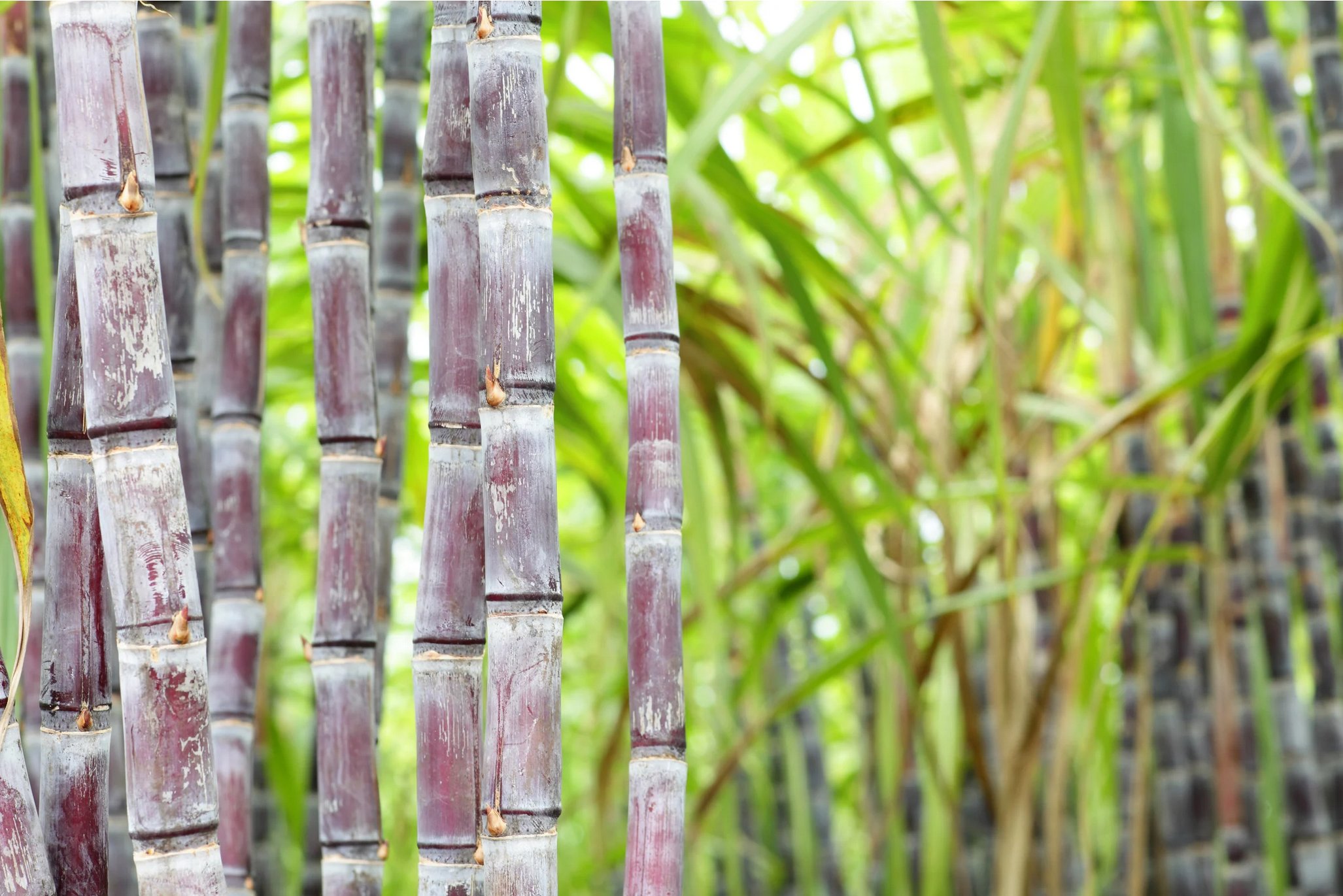
Sugarcane (Saccharum officinarum and Hybrids) is a tall perennial tropical grass from the Poaceae family, cultivated primarily for the high concentration of fermentable sugars accumulated in its thick fibrous stems. As the world's largest crop by production tonnage (approximately 1.9 billion tons annually), sugarcane serves as the primary feedstock for both sugar and bioethanol production globally, with major cultivation across tropical and subtropical regions.​

Botanical Classification and Morphology

Scientific Classification:

  • Family: Poaceae (Gramineae) - Grass family
  • Genus: Saccharum
  • Principal species: Saccharum officinarum L. (noble cane)
  • Commercial cultivars: Primarily interspecific hybrids of S. officinarum × S. spontaneum × S. robustum

Plant Characteristics:

  • Height: 3-6 meters (10-20 feet) at maturity​
  • Stem structure: Solid cylindrical stalks (canes) 2-5 cm diameter, composed of nodes and internodes; mature stalks contain 10-20% total sugars (primarily sucrose) in juice​
  • Leaves: Long narrow blades (0.9-1.5 m length, 4-7 cm width) with parallel venation and sheathing base; arranged alternately along stem​
  • Root system: Fibrous adventitious roots extending 1-2 meters depth and 2-3 meters laterally​
  • Inflorescence: Terminal plume-like panicle (arrow) 0.5-1.0 m length, though most commercial varieties flower rarely under cultivation​

Propagation and Growth Cycle

Vegetative Propagation:
Sugarcane is propagated asexually from stem cuttings called "setts" (2-3 node sections) rather than from seed, ensuring genetic uniformity and rapid establishment. Each sett develops 5-15 shoots (tillers) forming a dense stool or clump.​

Growth Timeline:

  • Plant cane (virgin crop): 12-18 months from planting to first harvest​
  • Ratoon crops (regrowth): 10-14 months for subsequent harvests from same root system​
  • Economic life: 3-7 ratoon crops before replanting required (varies by variety and management)​
  • Annual production cycle: One harvest per year in subtropical regions; staggered planting enables year-round harvest in tropical regions​

Environmental Requirements

Climate:

  • Temperature: Optimal growth at 20-30°C; minimum 15°C for germination; frost-sensitive​
  • Growing season: Minimum 200-220 frost-free days; 300+ days ideal for tropical varieties​
  • Photoperiod: Long days (>12.5 hours) promote vegetative growth; short days trigger flowering and sugar accumulation​

Water:

  • Rainfall requirement: 1,500-2,500 mm well-distributed annual rainfall or equivalent irrigation​
  • Water consumption: Extremely high water demand (approximately 1,500-2,000 liters water per kg sugar produced)​
  • Critical periods: High water requirement during tillering and grand growth phase; water stress during ripening enhances sugar accumulation​

Soil:

  • Texture: Deep (>1 meter), well-drained loamy soils preferred; adaptable to clay loams and sandy loams​
  • pH: Optimal 6.0-7.5; tolerates 5.0-8.5 range​
  • Fertility: High nutrient demand, particularly nitrogen (80-150 kg N/ha), phosphorus, and potassium​

Agronomic Performance

Yield Parameters:

  • Cane yield: 50-120 tons fresh cane per hectare per year (highly variable by variety, management, and region)​
  • Sugar content: 10-16% sucrose (pol) in mature cane; total sugars 12-20%​
  • Ethanol potential: 85-90 liters ethanol per ton sugarcane; 6,000-8,000 liters per hectare per year​
  • Land productivity: Among highest of all crop species on energy-per-hectare basis (120-170 GJ/ha/year including bagasse)​

Byproduct Generation:

  • Bagasse: 250-300 kg fibrous residue per ton cane (at 47-52% moisture); provides complete energy self-sufficiency through cogeneration​
  • Trash/tops: 140-200 kg per ton cane (field residue); increasingly collected for additional bioenergy​
  • Filter cake (press mud): 30-40 kg per ton cane; returned to fields as organic fertilizer​

Geographic Distribution and Production

Major Producing Regions:

  • Tropical: Brazil (world's largest producer, 715+ million tons annually), India (370+ million tons), Thailand, Pakistan, Indonesia, China​
  • Subtropical: Southern USA (Florida, Louisiana, Texas), Australia, South Africa, southern China​
  • Total global production: 1.9 billion tons annually across 26 million hectares​

Climatic Zones:

  • Latitude range: 36.7°N to 31°S (absolute limits); economically viable 30°N to 30°S​
  • Altitude: Sea level to 1,600 meters in tropical highlands​

Industrial Applications

Primary Uses:

  • Sugar production: 80% of global sugar supply originates from sugarcane (vs. 20% from sugar beet)​
  • Bioethanol production: 26+ billion liters annually in Brazil alone; enables direct fermentation without enzymatic saccharification​
  • Electricity cogeneration: Bagasse combustion provides surplus electricity for grid export (80-120 kWh per ton cane)​
  • Bioplastics: Sugarcane ethanol converted to bio-based polyethylene

Processing Pathway:
Sugarcane stems are crushed or diffused to extract juice containing directly fermentable sugars, eliminating the enzymatic saccharification step required for starch crops, resulting in simpler process configuration and lower capital/operating costs.​

Advantages as Industrial Feedstock

  • High sugar concentration: 10-20% fermentable sugars directly available in juice​
  • Energy self-sufficiency: Bagasse provides 100% of process energy via cogeneration​
  • Rapid fermentation: 8-12 hours vs. 48-72 hours for starch-based ethanol​
  • Superior GHG profile: 70-90% lifecycle greenhouse gas reduction vs. gasoline​
  • High land productivity: 2-3× ethanol yield per hectare vs. corn ethanol in temperate climates​
  • Mature technology: Decades of established cultivation practices and processing infrastructure​

Limitations and Challenges

  • Extreme water intensity: Major environmental concern in water-scarce regions​
  • Geographic constraints: Requires frost-free tropical/subtropical climate​
  • Labor-intensive: Manual harvesting still predominates in many regions, though mechanization increasing​
  • Seasonal production: Non-continuous harvest in subtropical regions creates processing bottlenecks​
  • Land use competition: Tension between food (sugar) vs. fuel (ethanol) production​
  • High input requirements: Significant fertilizer, pesticide, and irrigation demands​

Sugarcane represents humanity's most efficient large-scale renewable carbohydrate production system, combining exceptional photosynthetic efficiency (approximately 2% solar energy conversion vs. 0.5-1% for most crops) with integrated food-fuel-energy production capabilities that make it the cornerstone of tropical bioeconomy development.​

References

  1. (Last edited: Aug 25, 2025). Saccharum officinarum. Wikipedia
  2. (Last edited: Dec 7, 2025). SugarcaneWikipedia
  3. Campbell C.S. (Last edited: Sep 26, 2025). PoaceaeBritannica
  4. Jun 17, 2020: Botanical Name: Saccharum officinarumByjus Biology Resources
  5. Brand, K., Donnelly, E., Kaplan, J., & Wang, M. (Jan 16, 2014). Sugar Cane Ethanol Plant Design ReportCornell University, School of Chemical and Biomolecular Engineering
  6. Vohra, S. (Dec 14, 2022). India aims to go big on sugarcane-based ethanol, but water intensity of the crop throws up concerns. Mongabay India
  7. Reddy, B.V.S., & Ramesh, S. (2003). Sweet Sorghum: Characteristics and Potential. International Sorghum and Millets Newsletter, 44, 26-28. ICRISAT, Patancheru, India
  8. 2025 Case Study Report: Ethanol Production from Sugarcane and Cassava in ThailandGlobal Center for Green Fuels (GCGF)
  9. Zaworski, F. (Jan 14, 2025). India Leads Asian Ethanol Production BoomCZ App Analyst Insights
  10. Muller G. et al. (Jul 29, 2023). Improved Sugarcane-Based Fermentation Processes by an Isolated Yeast Strain from Colombian Bagasse. J. Fungi (Basel), 9(8), 803
  11. Kumar, D., & Singh, V. (2019). Bioethanol production from corn. In Corn (3rd ed., pp. 615-631). AACC International Press
  12. Liu, X., Khanna, M., Wang, M., & Wu, M. (Aug 1, 2023). Life Cycle Greenhouse Gas Emissions of Brazilian Sugar Cane Ethanol. Environmental Science & Technology, 57(30), 11119-11129
  13. Leal, M.R.L.V., Scarpare, F., & Walter, A. (2013). Sugarcane straw availability, quality, recovery and energy use: A literature reviewBiomass and Bioenergy, 53, 11-19
  14. Harden S. (Nov 3, 2025). Sugarcane and Sorghum Syrup ProductionEncyclopedia of Alabama. Auburn: Auburn University

Insight Articles
Your insights will be shown here

Sugarcane
Identifiers

No Identifiers defined

Chemical Data

Specific Gravity
1.00
Crude Data

API Gravity
10
Country
Product Settings

Default
Status
A
Content provided by
Transaction Name Date
Modified by UserPic   Kokel, Nicolas 12/11/2025 12:07 PM
Added by UserPic   Kokel, Nicolas 12/11/2025 10:18 AM