
Product
Iron(II) Oxide — FeO
Names
Ferrous oxide
Insight Articles
#PS762
Main Product
Iron Oxides
Segment
Chemicals
Main-Family
Inorganics
Sub-Family
Inorganic Oxides
Physical State

Solid

Description

Iron(II) oxide (FeO), also known as ferrous oxide, is an inorganic compound in which iron exists exclusively in its +2 oxidation state. Its mineral form is wüstite. It is a black, fine-grained powder that is thermodynamically unstable under ambient conditions and does not occur in significant natural deposits at the Earth's surface — making it primarily a chemical phase of industrial and metallurgical significance rather than a commercial mineral.

Natural Occurrence

FeO is rare at the Earth's surface due to its thermodynamic instability, but it constitutes approximately 9% of the Earth's mantle by composition, where high pressures stabilise the Fe²⁺ phase. It occurs as the mineral wüstite in highly reduced geological environments such as meteorites, volcanic fumaroles, and some deeply sourced xenoliths, but never in economically minable concentrations.

Synthesis

Stoichiometric FeO is difficult to produce in pure form. Principal synthesis routes include:

  • Thermal decomposition of iron(II) oxalate under inert atmosphere: FeC₂O₄ → FeO + CO₂ + CO
  • High-pressure synthesis — heating Fe₀.₉₅O with metallic iron at 770°C and 36 kbar to yield stoichiometric FeO
  • Controlled reduction of Fe₂O₃ or Fe₃O₄ with hydrogen at carefully controlled temperatures

Crystal Structure

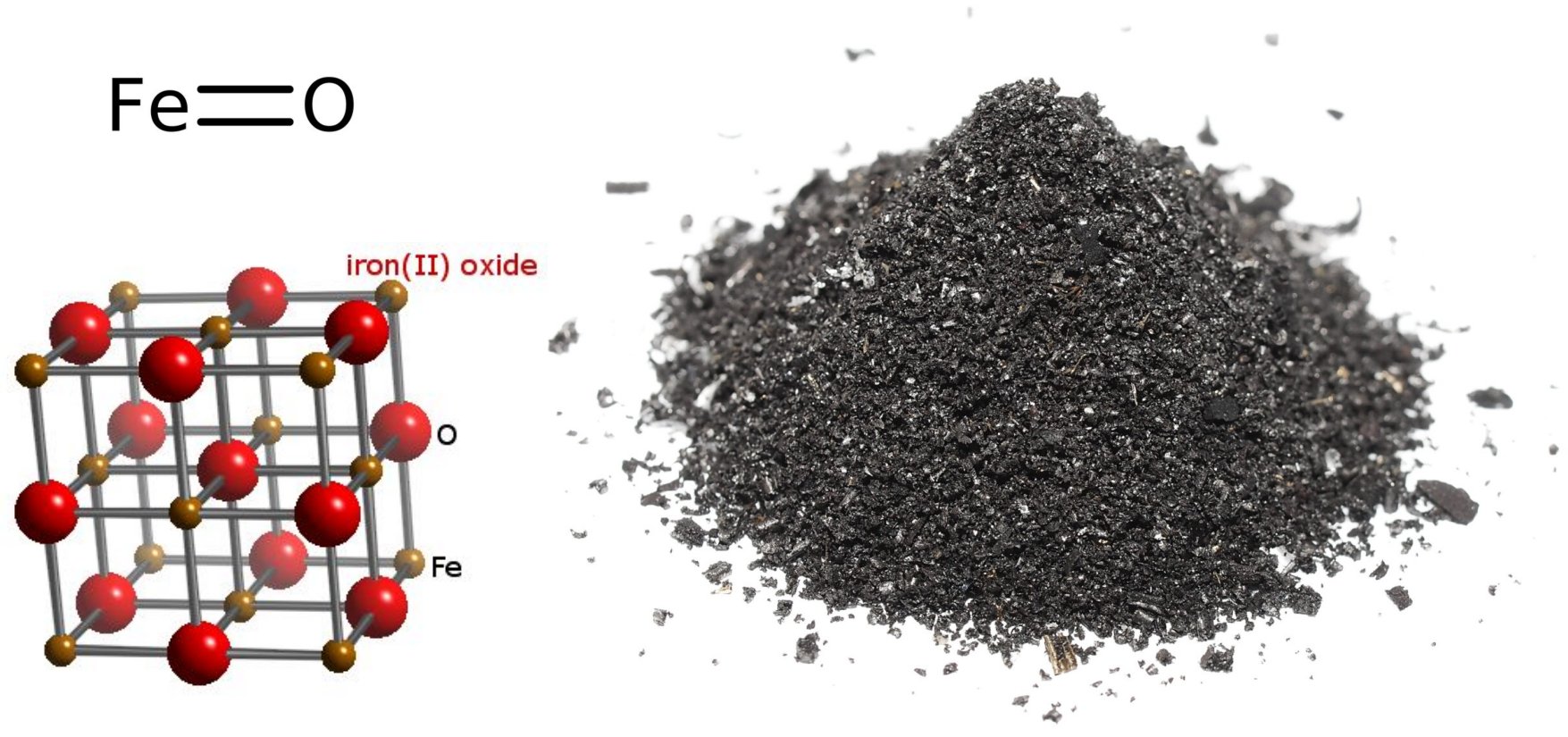
FeO crystallises in the cubic rock salt structure, in which each Fe²⁺ ion is octahedrally coordinated by six O²⁻ ions, and each oxygen is likewise octahedrally coordinated by six iron ions. A defining feature is its non-stoichiometry — pure FeO rarely exists; the compound is inherently iron-deficient, with actual compositions ranging from Fe₀.₈₄O to Fe₀.₉₅O. This iron deficiency arises because Fe²⁺ ions are readily oxidised to Fe³⁺, with some Fe²⁺ vacancies created to maintain charge balance, with Fe³⁺ ions occupying tetrahedral interstitial sites in the oxygen lattice.

Thermodynamic Instability

FeO is thermodynamically unstable below 575°C. Below this temperature it spontaneously disproportionates into metallic iron and magnetite:

4 FeO → Fe + Fe₃O₄


This is a disproportionation reaction — some Fe²⁺ ions are reduced to Fe⁰ (metallic iron) while others are oxidised to Fe³⁺ within the magnetite structure. Above 575°C it is a stable phase, which is why it exists as a transient but essential intermediate in high-temperature metallurgical processes.

Role in the Blast Furnace Process

FeO is the penultimate intermediate in the stepwise reduction of iron ore to metallic iron in blast furnaces, and its efficient reduction is critical to furnace productivity. The full reduction sequence proceeds as follows:

Zone 1 — Upper furnace (300–600°C):

3 Fe₂O₃ + CO → 2 Fe₃O₄ + CO₂


Zone 2 — Middle furnace (600–900°C):

Fe₃O₄ + CO → 3 FeO + CO₂


Zone 3 — Lower furnace / cohesive zone (900–1,200°C):

FeO + CO → Fe + CO₂


The final reduction step — FeO → Fe — is the most thermodynamically demanding of the three stages and defines the critical operating conditions of the blast furnace. It requires the highest temperatures, the highest CO/CO₂ ratios, and the longest residence time of any reduction step. The cohesive zone (where the ore burden softens and partially melts) is the region where most FeO reduction occurs, and its position and shape within the furnace are key operational parameters.

In direct reduction (DRI) processes (Midrex, HYL/Energiron), the same FeO → Fe step occurs at lower temperatures (~800–950°C) using reformed natural gas (H₂ + CO) or, increasingly, pure hydrogen:

FeO + H₂ → Fe + H₂O


Mill scale — the layered iron oxide scale that forms on the surface of hot-rolled steel — contains significant amounts of FeO alongside Fe₃O₄ and Fe₂O₃, and is recycled back into the steelmaking process as an iron source.

Other Applications

Beyond metallurgy, FeO has limited but noteworthy applications:

  • Pigments — registered as C.I. Pigment Black (CI 77489); used in specialty black coatings
  • Electronics research — FeO/Fe₃O₄ core-shell nanoparticles are studied for exchange bias effects in magnetic devices
  • Geophysics — its electrical conductivity in the mantle is studied as a factor in Earth's rotational dynamics


References

  1. Wikipedia. Iron(II oxide (Page version Feb 23, 2026)
  2.  Fiveable Inc. (Aug 2025). Iron oxide (FeO)
  3. National Center for Biotechnology Information (NCBI), PubChem. Ferrous oxide (Page version Feb 21, 2026)
  4. Merck — Sigma Aldrich. Iron(II) oxide (Accessed Feb 20, 2026)

Insight Articles
Your insights will be shown here

FeO molecular formula (top left), crystal Structure (bottom left, source: WebElements). Mill scale, a flaky layer of iron oxides—predominantly FeO with various amounts of Fe3O4 and Fe2O3—that forms on hot-rolled steel (right, source: Anglo Pacific)
Identifiers

logo CAS Number
1345-25-1
logo EC Number
215-721-8
logo ECHA InfoCard
100.014.292
logo IUPAC Name
Iron(II) oxide
logo PubChem ID
449809
Chemical Data

Chemical Formula

FeO

Molecular Weight (g/mol)
71.844
Melting Point (°C)
1377
Sulfur Content (wt%)
0
Specific Gravity
5.75
Crude Data

API Gravity
-106.87
Country
Product Settings

Default
Status
A
Content provided by
Transaction Name Date
Modified by UserPic   Kokel, Nicolas 2/28/2026 8:27 PM
Added by UserPic   Kokel, Nicolas 2/28/2026 6:34 PM