
Product
Iron(II,III) Oxide — Fe₃O₄
Names
FeO·Fe2O3; Magnetite; Diiron(III) Iron(II) Oxide; Ferrosoferric Oxide; Iron oxide
Insight Articles
#PS759
Main Product
Iron Oxides
Segment
Chemicals
Main-Family
Inorganics
Sub-Family
Inorganic Oxides
Physical State

Solid

Description

Iron(II,III) oxide, commonly known by its mineral name magnetite, is a mixed-valence iron oxide containing iron in both the +2 and +3 oxidation states. Its molecular formula is Fe3O4, and its constituent formula (or double oxide notation) is FeO·Fe2O3. It is the most strongly magnetic naturally occurring mineral on Earth and the second most industrially important iron oxide after diiron trioxide (hematite).

Crystal Structure

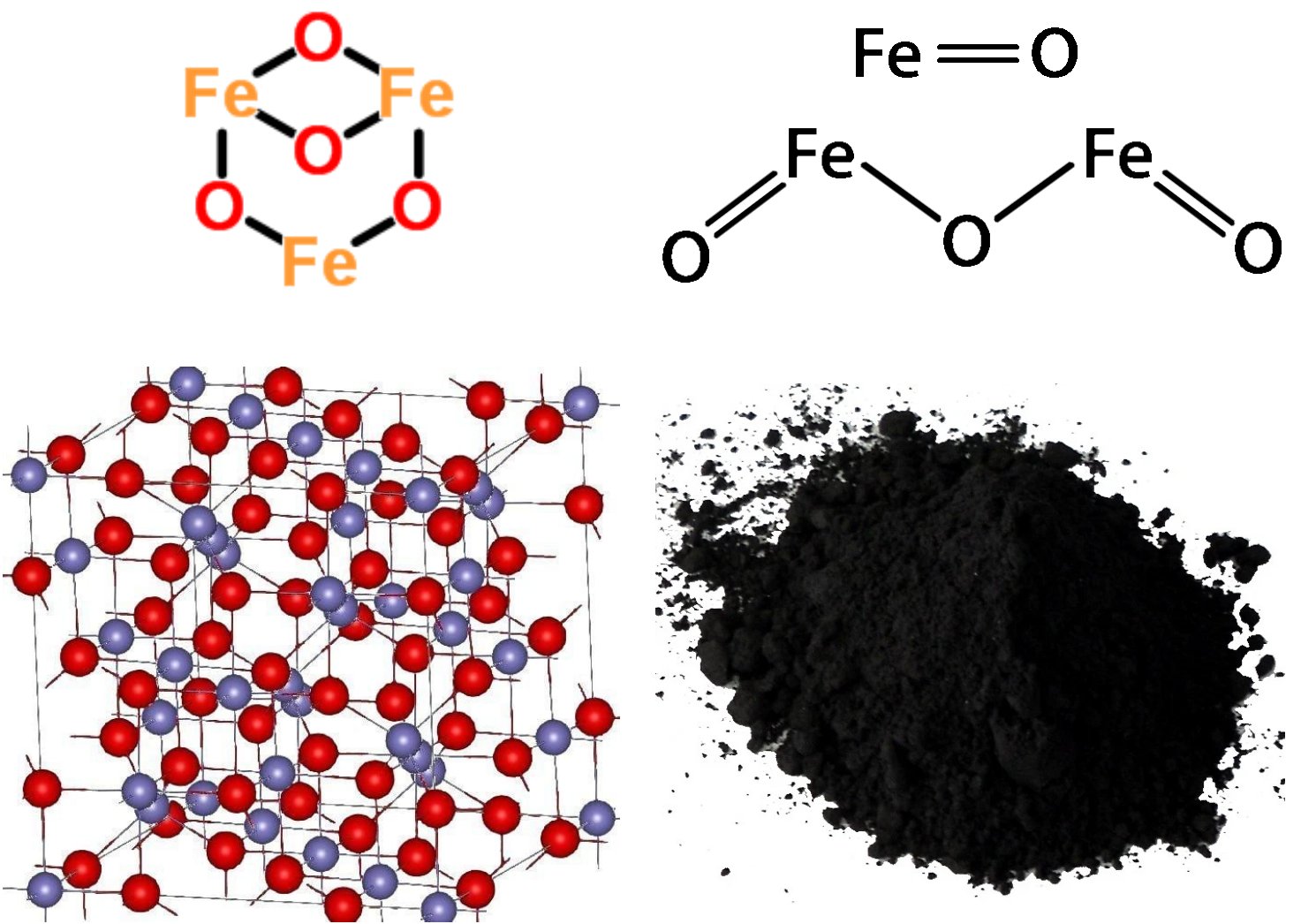
Fe₃O₄ crystallises in a cubic inverse spinel structure, consisting of a cubic close-packed array of O²⁻ anions with iron cations distributed across tetrahedral and octahedral interstitial sites. All Fe²⁺ ions occupy half of the octahedral sites, while Fe³⁺ ions are split evenly between the remaining octahedral sites and all tetrahedral sites. The unit cell contains eight formula units. A notable phase transition — the Verwey transition — occurs at ~120 K (−153 °C), at which point there is a discontinuity in electrical conductivity, crystal ordering, and magnetic properties.

Physical & Chemical Properties

Fe₃O₄ is a black, opaque solid with a metallic lustre and is insoluble in water. Its most distinctive property is its strong ferrimagnetism — the antiparallel alignment of Fe²⁺ and Fe³⁺ magnetic moments yields a net magnetic moment, making it the most magnetic of all naturally occurring minerals. It is also notably electrically conductive for an oxide, due to thermally activated electron hopping between Fe²⁺ and Fe³⁺ ions on adjacent octahedral sites. Upon oxidation it converts to γ-Fe₂O₃ (maghemite), and under vigorous calcination to α-Fe₂O₃ (hematite).

Natural Occurrence

Fe₃O₄ occurs naturally as the mineral magnetite, found in igneous, metamorphic, and sedimentary rocks worldwide. Major commercial deposits are located in Australia, Brazil, Sweden (Kiruna), China, and South Africa. Beneficiated magnetite concentrates can achieve Fe grades above 68%, making them particularly attractive for hydrogen-based direct reduction ironmaking.

Synthesis

Synthetic Fe₃O₄ is produced by several routes:

  • Thermal decomposition of iron(III) hydroxide under controlled reducing conditions
  • Co-precipitation of Fe²⁺ and Fe³⁺ salts in alkaline solution — the dominant industrial route for nanoparticle production
  • Reduction of α-Fe₂O₃ with hydrogen or carbon monoxide at ~400°C
  • Oxidation of metallic iron or FeO under controlled oxygen partial pressure
  • Hydrothermal synthesis for high-purity crystalline forms

Industrial Applications

Fe₃O₄'s combination of magnetic behaviour, high density, and mixed-valence chemistry underpins a uniquely broad application portfolio:

  • Iron & steel production — major iron ore mineral; reduced via Fe₃O₄ → FeO → Fe in blast furnaces and DRI reactors
  • Dense media separation — used as a suspension medium in coal washing and mineral beneficiation due to its high density and easy magnetic recovery
  • Water treatment — magnetic separation of heavy metals and contaminants from wastewater
  • Catalysis — catalyst and support in the Haber–Bosch ammonia synthesis and Fischer–Tropsch reactions
  • Magnetic recording — historically used in magnetic tapes and storage media
  • Pigments — black iron oxide pigment (PBk11) for paints, coatings, and construction materials
  • Biomedical — superparamagnetic Fe₃O₄ nanoparticles used as MRI contrast agents, in hyperthermia cancer treatment, and targeted drug delivery


References

  1. Blaney, L. Magnetite (Fe3O4): Properties, Synthesis, and Applications (2007). Volume 15 - 2007. Paper 5
  2. Wikipedia. Iron(II,III) oxide (Page version Dec 11, 2025)
  3. ScienceDirect. Magnetite (fe3o4) (Accessed Feb 27, 2026)
  4. Byjus (Feb 18, 2019). What is Iron (II, III) oxide?
  5. Testbook Edu Solutions. Fe3O4 Iron (III) Oxide: Name, Structure, Oxidation Number, Molar Mass, Production, Properties, Uses (Accessed Feb 27, 2026)
  6. Reports and Data (Dec 11, 2025). Magnetite Iron Ore Market
  7. JXSC (Jun 12, 2024). Mastering Hematite vs Magnetite: Expert Guide

Insight Articles
Your insights will be shown here

Iron(II,III) Oxide: molecular structure (top), crystal lattice structure (bottom left), magnetite powder (bottom right) | Various sources
Identifiers

logo CAS Number
1317-61-9
logo EC Number
215-277-5
logo ECHA InfoCard
100.013.889
logo IUPAC Name
Diiron(III) iron(II) oxide
logo PubChem ID
16211978
Chemical Data

Chemical Formula

Fe3O4

Molecular Weight (g/mol)
231.53
Boiling Point (°C)
2623
Melting Point (°C)
1597
Sulfur Content (wt%)
0
Specific Gravity
5.18
Crude Data

API Gravity
-104.18
Country
Product Settings

Default
Status
A
Content provided by
Transaction Name Date
Modified by UserPic   Kokel, Nicolas 2/27/2026 8:15 PM
Added by UserPic   Kokel, Nicolas 2/27/2026 5:34 PM