Product
Iron Oxides
Segment
Chemicals
Main-Family
Inorganics
Sub-Family
Inorganic Oxides
Link
Insight Articles
#PS758

Description

Iron oxides are a class of inorganic chemical compounds composed of iron (Fe) and oxygen (O) atoms, often also including related oxyhydroxide forms that incorporate hydrogen. There are approximately 16 known iron oxides and oxyhydroxides, making them a structurally diverse group of compounds.​ Iron oxides are among the most abundant and widespread inorganic compounds on Earth, playing important roles in geology, biology, and industry. They occur naturally as minerals, form as corrosion products (most famously rust), and are found in biological systems such as hemoglobin.

Chemical Structure

Iron oxides feature iron in either its ferrous (Fe²⁺) or ferric (Fe³⁺) oxidation states, or a combination of both. Structurally, they consist of close-packed arrays of oxygen anions (O²⁻) — typically in hexagonal or cubic close-packed arrangements — with iron cations occupying octahedral or tetrahedral interstitial sites. Many iron oxides are non-stoichiometric, meaning their elemental ratios do not conform to simple whole-number proportions.

Principal Forms

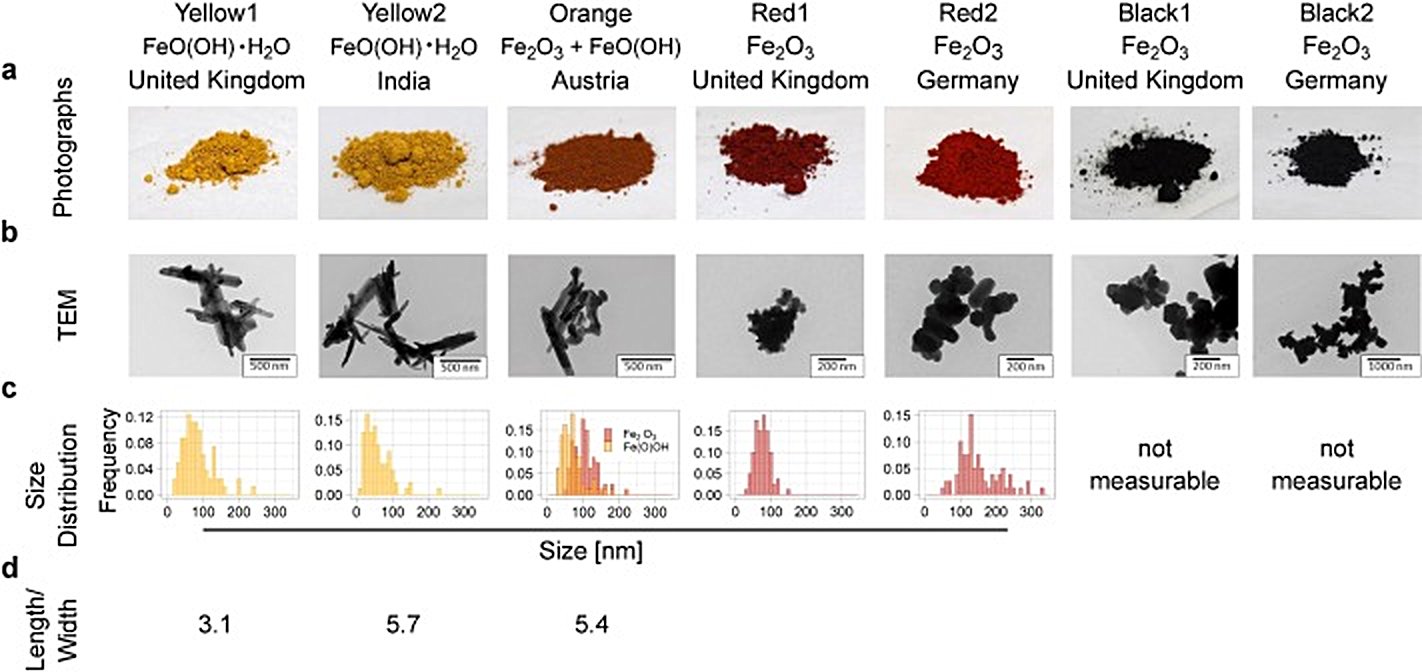
Iron oxides are chemical compounds, defined by their formula, crystal phase, and oxidation state. Beyond pure oxides, a related family of iron oxyhydroxides (FeOOH) incorporates hydroxide groups and is closely associated with weathering and corrosion processes.

Primary Name Formula Mineral Synonym Color Natural Occurrence
Iron(III) oxide
(α-phase)
α-Fe₂O₃ Hematite Reddish-brown Yes — primary iron ore
Iron(II,III) oxide Fe₃O₄ Magnetite Black Yes — primary iron ore
Iron(III) oxyhydroxide
(α-phase)
α-FeOOH Goethite Yellow-
brown
Yes —widespread; minor ore
Iron(III) oxide
(γ-phase)
γ-Fe₂O₃ Maghemite Reddish-brown Rarely, as
alteration product
Iron(II) oxide FeO Wüstite Black Extremely rare
at surface
Iron(III) oxyhydroxide
(γ-phase)
γ-FeOOH Lepidocrocite Orange Yes — common corrosion mineral


Key Applications

Iron oxides' stability, low cost, and range of properties make them commercially significant across many sectors. The table below lists the principal applications by compound, ranked by breadth of industrial relevance:

Rank Compound Key Applications
1 α-Fe₂O₃ Pigments (paints, coatings, colored concrete); iron ore / steelmaking; heterogeneous catalysis; gas sensors; food colorant E172
2 Fe₃O₄ Steelmaking; magnetic storage and sensors; water treatment; heterogeneous catalysis; biomedical applications
3 α-FeOOH Dominant yellow pigment (PY42) for construction and coatings; precursor to hematite and maghemite
4 γ-Fe₂O₃ Magnetic recording media; ferrofluids; biomedical applications (MRI contrast agents, hyperthermia)
5 FeO Metallurgical intermediate in iron ore reduction; precursor in iron and steel production
6 γ-FeOOH Corrosion product; minor orange pigment; precursor in oxyhydroxide chemistry


Beyond these compound-specific roles, iron oxides as a class are widely used in thermite reactions — where Fe₂O₃ reacts exothermically with aluminium to produce molten iron for welding and incendiary applications — and as a group contribute broadly to pigment production, generating earthy yellow, orange, red, brown, and black tones across paints, coatings, plastics, and ceramics.

References

  1. Ali A, Zafar H, Zia M, ul Haq I, Phull AR, Ali JS, Hussain A. Synthesis, characterization, applications, and challenges of iron oxide nanoparticlesNanotechnol Sci Appl. 2016;9:49-67. DOI: 10.2147/NSA.S99986
  2. Wikipedia. Iron oxide (Page version: Nov 13, 2025)
  3. ScienceDirect. Iron Oxide (Accessed Feb 27, 2026)
  4. Vedantu. Iron Oxide – Definition, Types, Formula, and Uses (Accessed Feb 27, 2026)
  5. Zadeh J., Discovery Alert (Apr 3, 2025). Hematite vs Magnetite: Understanding Types of Iron Ore in 2025
  6. Fortune Business Insights (Feb 9, 2026). Report FBI108698 — Iron Ore Market Size, Share & Industry Analysis, By Type (Hematite, Magnetite, and Others), By Application (Steel Production and Others), and Regional Forecast, 2026-2034
  7. Reports and Data (Dec 11, 2025). Magnetite Iron Ore Market
  8. JXSC (Jun 12, 2024). Mastering Hematite vs Magnetite: Expert Guide
  9. O'Hanlon G., Natural Pigments (Apr 15, 2018). Names for Iron Oxide Earth Pigments
  10. Ali, A., Zafar, H., Zia, M., ul Haq, I., Phull, A. R., Ali, J. S., & Hussain, A. (Aug 19, 2016). Synthesis, characterization, applications, and challenges of iron oxide nanoparticlesNanotechnology, Science and Applications, 9, 49–67. DOI: 10.2147/NSA.S99986
  11. David, 911Metallurgist (Jan 4, 2021). Iron Oxide Pigments
  12. ChemAnalyst (Jan 2026). Iron Oxide Market Analysis.
  13. Mordor Intelligence (Mar 12, 2020). Iron Oxide Pigments Market Size & Share Analysis - Growth Trends and Forecast (2026 - 2031)

Insight Articles
Your insights will be shown here

Properties of iron oxides in E172 food additive https://www.sciencedirect.com/science/article/abs/pii/S0308814620308621
Settings

Status
A
Unit of Measure
Metric Ton
Physical State

Solid

Content provided by
Transaction Name Date
Modified by UserPic  Kokel, Nicolas 2/28/2026 9:07 AM
Added 6/25/2024 7:30 AM