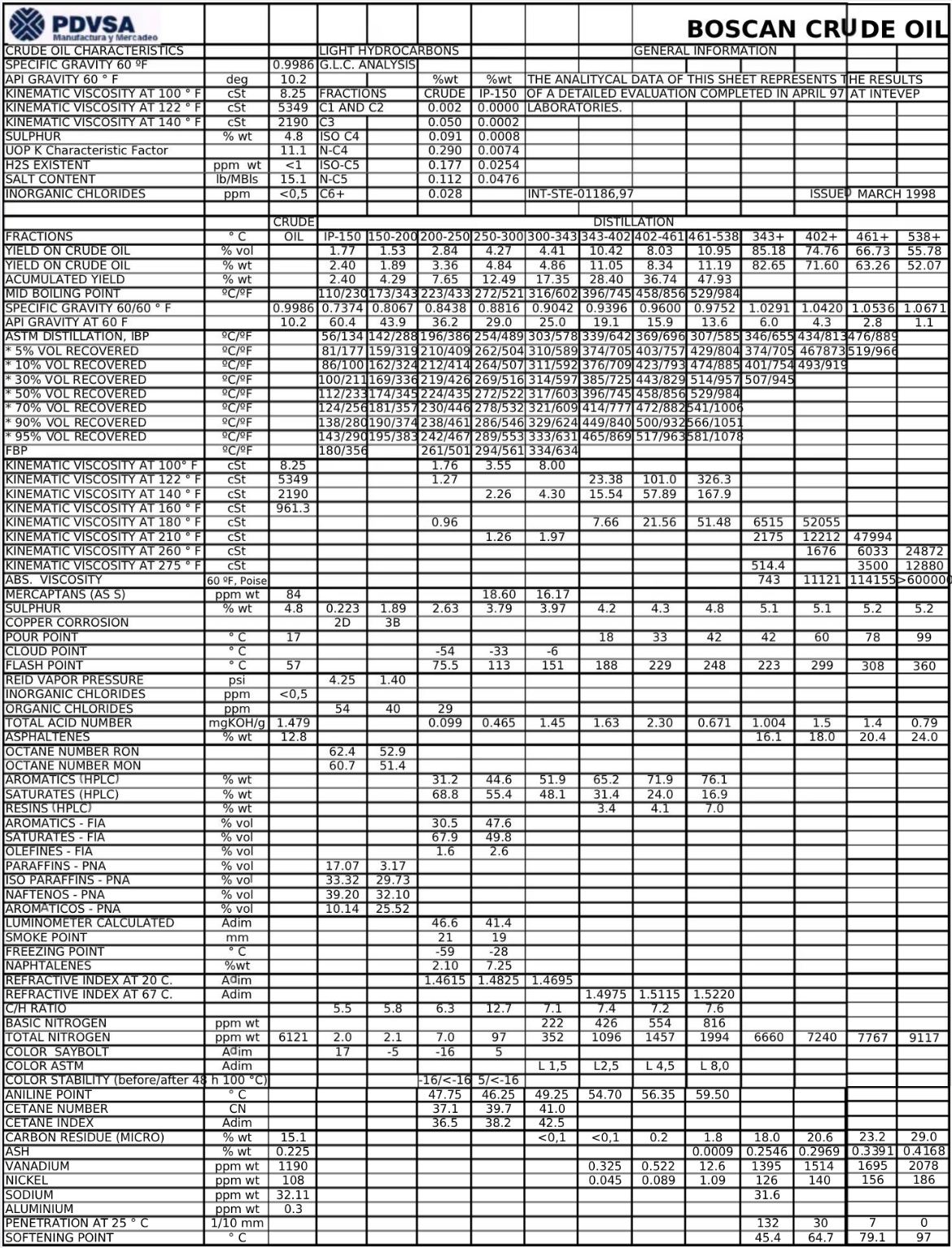

Boscan is one of the most extreme crude oils commercially produced in the world — an onshore Venezuelan extra-heavy crude defined by extraordinarily high viscosity, massive vanadium content, and ultra-low API gravity that places it at the very bottom of the crude oil quality spectrum.
Origin & Field Overview
The Boscán field is located approximately 40–45 km southwest of Maracaibo, in Zulia State, western Venezuela. It was discovered in 1945–1946 by Richmond Exploration Co. (later Chevron) and first produced in 1947. The field covers roughly 660–900 km² and produces from the Eocene Misoa Formation, a sequence of tidal channel and bar sandstones with porosity of 10–26% and permeability of 100–5,000 md. Proved reserves stand at approximately 1.4–1.6 billion barrels against an estimated OOIP of 25–35 billion barrels, yielding a modest recovery factor of only 5–7%.
The field is operated by Petroboscán S.A., a joint venture between PDVSA (60%), Chevron (39.2%), and Inepetrol (0.8%). Current production is approximately 100,000–107,000 b/d, with the operating agreement extended through 2041.
Key Physical Properties
| Parameter |
Typical Value |
| API Gravity |
10.1° |
| Sulfur Content |
5.4% wt |
| Kinematic Viscosity @ 100°F |
11,233 cSt |
| Vanadium |
11,222 ppm |
| Neutralization Number (TAN) |
0.91 mg KOH/g |
| Pour Point |
+7°C |
The Vanadium Anomaly
Boscan's vanadium content of ~11,222 ppm is not a typo — it is one of the highest vanadium concentrations ever recorded in a commercially produced crude oil, more than 40× higher than Merey (~262 ppm) and 36× higher than Maya (~308 ppm). This makes Boscan a unique feedstock: it is entirely unsuitable for FCC or hydrocracking without extremely aggressive demetallization pre-treatment, as it would immediately destroy any conventional catalyst inventory. Paradoxically, this extreme vanadium richness also makes Boscan crude a historical feedstock for vanadium pentoxide (V₂O₅) recovery operations.
Chemical Classification
Detailed molecular characterization using the Watson Characterization Factor (K_UOP) places Boscan in the naphthenic crude category (K_UOP between 10.5–11.5), with a hydrocarbon composition dominated by naphthenic rings (~40.65%) and paraffins (~27.35%). This naphthenic character, combined with its high asphaltene fraction, drives the extraordinary viscosity and complicates thermal processing.
Refinery Requirements & Processing Challenges
With a reservoir viscosity of 130–500 cP at depth and a surface viscosity of over 11,000 cSt at 100°F, Boscan cannot flow through pipelines at ambient temperature without heating or diluent blending. Field infrastructure includes:
-
Dehydration plants to reduce BS&W to ≤1% before delivery to Bajo Grande terminal
-
Steam-assisted production (beam pump, electric submersible pump, and rod pump methods) across ~580 active wells
-
SCADA remote monitoring system (CIBO — Centro de Información Boscán) for real-time field management
At the refinery, Boscan demands a configuration purpose-built for ultra-heavy naphthenic crude:
Export & Logistics
Boscan crude is transported by heated pipeline to the Bajo Grande terminal near Maracaibo, where it is loaded for export. Its extremely high pour point (+7°C) requires heated tankage and heated vessel coils throughout the logistics chain. Primary export destinations have historically been US Gulf Coast asphalt-grade refineries and Chinese heavy crude processors.