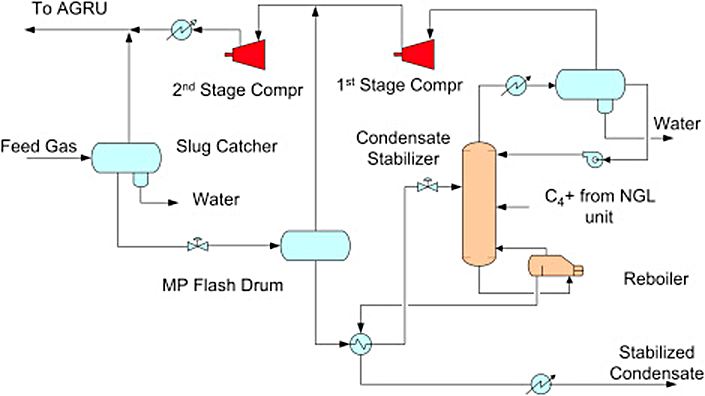
Condensate stabilisation is a separation process that removes dissolved light-end hydrocarbons (methane, ethane, propane, and butane) from raw liquid condensate recovered at the inlet of a gas processing plant or at wellhead separators. The objective is to produce a stable condensate — a liquid hydrocarbon stream with a sufficiently low Reid Vapour Pressure (RVP) and true vapour pressure (TVP) to allow safe atmospheric storage, transportation by pipeline or tanker, and blending with crude oil or export as natural gasoline.
Raw condensate arriving from wells or inlet separators contains significant quantities of dissolved light gases. Without stabilisation, these would vaporise during storage and transport, creating safety hazards, product losses, and vapour pressure non-compliance with pipeline or tanker specifications. The stabilised condensate product typically meets an RVP specification of 8–12 psi (0.55–0.83 bara) for pipeline export or 10–14 psi for tanker loading, depending on contractual and regulatory requirements.
The light-end gases liberated during stabilisation — collectively termed the stabiliser overhead gas or flash gas — are recovered and routed to the plant fuel gas system, recompressed into the sales gas stream, or used as refrigerant makeup in associated NGL recovery units.
Process Variants
There are two principal process configurations, selected based on throughput, desired product specification, and project economics:
1. Multi-Stage Flash Stabilisation
The simplest and lowest-cost configuration. Raw condensate is passed through a series of two to four flash vessels operating at progressively decreasing pressures — from inlet separator pressure down to near-atmospheric. At each stage, dissolved light ends flash off as vapour, which is collected and recompressed. No external heat input is required beyond the pressure let-down across control valves.
-
Advantages: Low capex, simple operation, no fired equipment required
-
Limitations: Less precise product RVP control; higher light-end content in stabilised product compared to distillation-based stabilisation; not suitable where tight product specifications are required
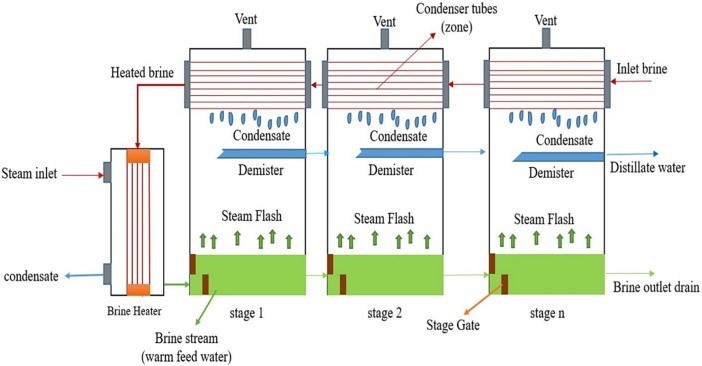
Figure 1 — Simplified diagram of a typical multistage flash vaporization unit [5]
2. Stabilisation by Atmospheric Distillation (Stabiliser Column)
A more sophisticated configuration using a distillation column — the condensate stabiliser — operating at near-atmospheric or low pressure (1.5–3 bara). The raw condensate feed is pre-heated in a feed/bottoms heat exchanger and enters the column at mid-point. Light ends are stripped from the liquid by rising vapours generated in a reboiler at the column base; the stabilised condensate is withdrawn as the bottoms product. The overhead vapour (flash gas / LPG-rich stream) is condensed, with the liquid portion returned as reflux and the vapour recovered as fuel or sales gas.
-
Advantages: Precise RVP control; can produce an LPG-quality overhead product; handles a wider range of feed compositions
-
Limitations: Higher capex; requires fired reboiler or heat integration; more complex operation
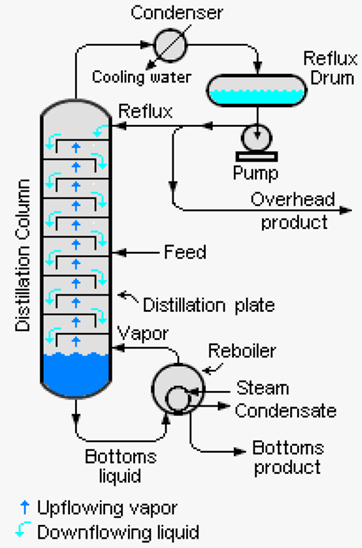
Figure 2 — Simplified diagram of a typical condensate distillation column [5]
3. Combine Approach
A combined approach is common in large plants: multi-stage flash vessels reduce the light-end load before the stabiliser column, reducing column diameter and reboiler duty.
Key Design Parameters
| Parameter |
Typical Value |
| Feed condensate temperature |
20–80°C |
| Stabiliser operating pressure |
1.5–3.5 bara |
| Reboiler temperature |
150–220°C |
| Stabilised condensate RVP |
8–14 psi (0.55–0.97 bara) |
| Stabilised condensate TVP at 37.8°C |
<0.75 bara (typical export spec) |
| Recovery of C5? in product |
>95% |
Integration with Other Units
Condensate stabilisation interfaces closely with several other process units:
- Upstream: Inlet slug catcher and 3-phase separator supply raw condensate feed
- Upstream: Produced water separated in inlet vessels is routed to produced water treatment
- Downstream: Stabilised condensate routed to atmospheric storage tanks or export pipeline
- Downstream: Stabiliser overhead gas routed to fuel gas system, sales gas recompression, or NGL fractionation
- Heat integration: Stabiliser reboiler duty is frequently provided by waste heat from gas compression aftercoolers or other plant streams
Licensors & Technology Providers
Unlike some gas processing technologies, basic condensate stabilisation is not heavily proprietary — the process principles are well-established and most EPC contractors and engineering companies design these units independently. However, several process licensors and technology providers offer optimised or integrated condensate stabilisation designs:
| Licensor / Provider |
Technology / Offering |
| Ortloff Engineers (now Targa Resources / licensor) |
Integrated NGL recovery + condensate stabilisation configurations; SCORE™ and GSP™ processes include stabilisation as an integral step |
| Honeywell UOP |
Full gas processing train designs including stabilisation columns; UOP PolySep™ membrane systems for associated gas |
| Sulzer Chemtech |
Column internals (structured packing, trays) optimisation for stabiliser columns; process design services |
| Koch-Glitsch |
Tray and packing technology for stabiliser columns; process design |
| Linde Engineering |
Integrated cryogenic condensate stabilisation within NGL recovery plant designs |
| Exterran |
Modular and skid-mounted condensate stabilisation units for remote or smaller-scale applications |
| CECO Environmental / Pro-Quip |
Packaged modular stabilisation systems |
| Wood / Worley / Technip Energies |
EPC-level proprietary optimised designs for large grassroots plants |
For large baseload plants, the stabilisation unit is typically designed by the FEED/EPC contractor without a separate process licence fee, often using simulation tools to optimise the configuration for the specific feed condensate composition.
References
- GPSA Engineering Data Book, 14th edition (2017). Gas Processors Suppliers Association, Tulsa, OK. Section 3: Characterisation of Crude Petroleum and Natural Gas; Section 16: Hydrocarbon Recovery
- Campbell J.M. (2004). Gas Conditioning and Processing, Vol. 2: The Equipment Modules, 8th edition. Campbell Petroleum Series, Norman, OK. Chapter 13: Glycol Dehydration
- Manning F.S. & Thompson, R.E. (Jan 1, 1991). Oilfield Processing of Petroleum, Vol. 1: Natural Gas. PennWell Publishing, Tulsa, OK
- Stewart, M. (Aug 29, 2014). Surface Production Operations, Vol. 2: Design of Gas-Handling Systems and Facilities, 3rd edition. Gulf Professional Publishing, Houston, TX
- Firdauzi (Oct 7, 2024). Balancing Vapor Pressure: How Condensate Stabilization Works. Linkedin article