
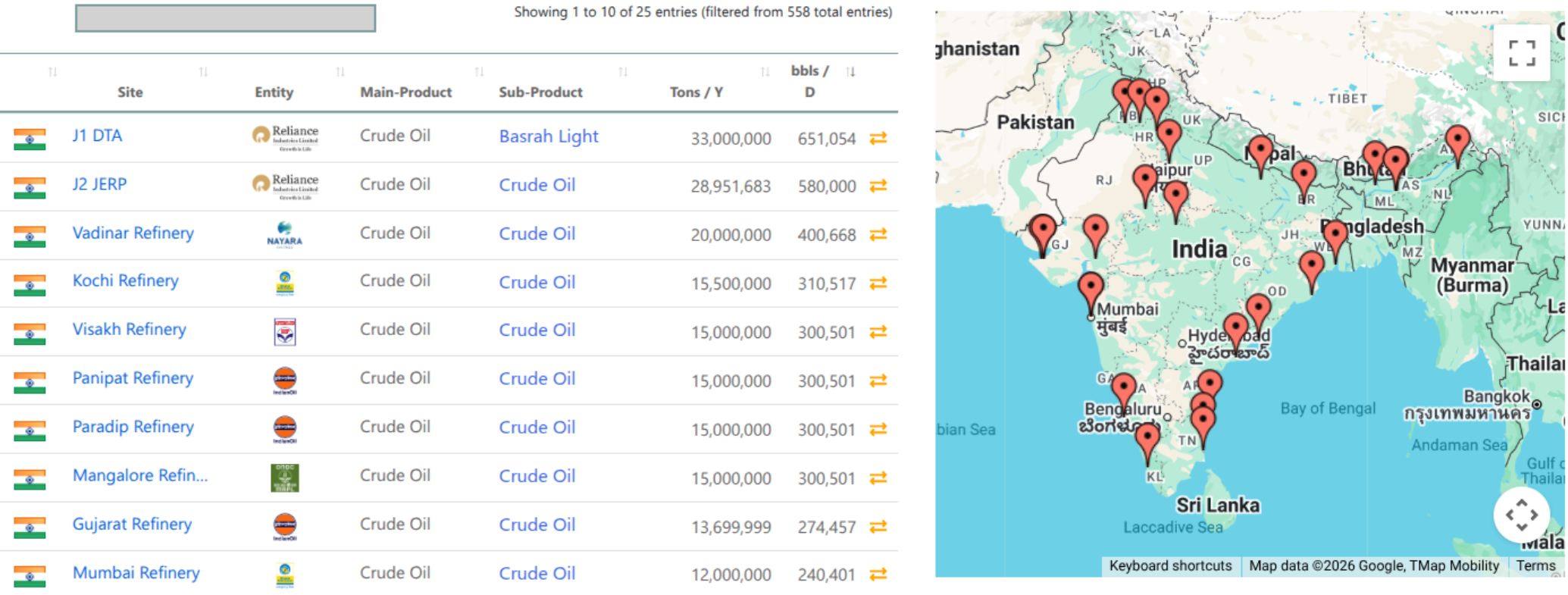
Ten largest Indian refineries (left) and map of all Indian refineries (right) from the Refinery Module
|
|
|
During the live session of the Molecules to Market program certain observations were made with respect to the optimal capacity of the DREAM Refinery complex. Some members from the audience members opined whether a smaller capacity would suffice the purpose. Well as discussed and mentioned, in the response to the comments, it was considered prudent that this observation warrants a detailed response and therefore this post.
The subject of optimal capacity of complexes was discussed extensively in the earlier Podcasts on ppPLUS where one of the central points was what should be an ideal capacity of an integrated complex. The historical development of the Refineries in India was tracked and the transition to large capacity refining complexes such as Reliance and Nayara was discussed. It was also debated that the capacity increment of refineries in Public Sector Undertakings (PSUs) moved gradually from 6 MMTPA to 9 MMTPA and then gradually to 12 and 15 MMTPA. Barring one refinery, which was set up for a capacity of 15 MMTPA, most of the other refineries and integrated complexes were of 9 MMTPA single train which gradually through expansions, debottlenecking and revamp projects was augmented to higher capacities. Well, all this is a function of timing, the investment and the strategy that a refiner perceives is in the best interest of their company. The effective demand projection assessment is another critical factor.
All this is fine though debatable. The merits of the plant being set up for a certain capacity, and then gradually augmented to a higher capacity is one way to look at the options. Experience does reveal however, that this can often be time consuming, cost ineffective and perhaps does constrain efficient stream disposition. The optimal configuration capacity therefore, is always an important issue, which warrants deliberation. For variety of reasons, including Capital Investment, it may be worthwhile to examine the option of the initial design being for ultimate capacity, and then the scale down to rationalize the investment, if required. This may involve some pre investment, but it is worth it, as it saves precious implementation time and quicker turnaround for the plant to achieve its ultimate capacity in phases. We prefer to call this deferred investment. As may be understood, this is a critical subject and involves a very informed decision making process to kick in, to help arriving at optimal solutions.
Pre-requisites
- It is important to recognize that the Hydrocarbon Industry is highly capital and technology intensive. The scale is very important to realize the optimal unit cost and appropriate stream dissemination. It is important to address this issue in Initial conceptualization and therefore, it is vital to debate single train vs two train issues, shutdown scenarios, to sort out a clear direction early.
- For instance, how to size the mother blocks is crucial. For example, for mixed crudes what is the maximum single train capacity that can be addressed efficiently? Is the single train subject to frequent upsets? It is equipped with critical rotating machinery, which cannot be spared and therefore, could prompt upsets? What are the type of internals that can be used in high capacity un-spared equipment, which can run without fouling uninterruptedly between planned turnarounds?
- References, Proven Track Records of operation is equally important. Mother plants such as a Crude and Vacuum Distillation unit, a Steam Cracker, or a CCR required for maximization of Aromatics, are all very vital issues to be addressed in early stages.
- A linked issue with this is what is required from the Project, he Objective function to be more precise. A fuel refinery vs an Integrated complex meant to maximize petrochemicals, along with fuels is the key question. Often the answer to this is not available off hand, a study may be warranted, which could encompass the local demand, forecast of the demand a few years down the line, and have the projections closely interface with economic growth. Most of these are subtle questions for which directions could be available, but straight and more accurate answers would warrant a more concrete study be performed.
- In case petrochemicals is the intent, the capacity of the Olefin plant and Aromatic complex both should of world scale size. That being so the general direction is that refinery capacities of 9-12 MMTPA do not support a world scale petrochemical complex. Remember that in India LPG is not available as a Cracker feedstock, which makes it difficult to achieve world scale size of cracker to be achieved, without scale up of the refinery capacity itself. Light naphtha, Heavy naphtha, Light Kersosene, Petro FCC (PFCC) off-gas, DCU off-gas and C4 recycles would possible be the cracker feedstock. A minimum capacity of 1.7 MMTPA furnaces and 2 MMTPA total ethylene recovery is a good objective function to address.
- Similarly, it would be prudent to recover aromatics from the Py-gas of the Dual feed Cracker, and combine the same with the Aromatic effluent of the CCR to address a world scale capacity of 1.5 MMTPA of PX. Here the options could emerge. In case CCR is designed only for Reformate blending to gasoline pool, its capacity could reduce with simultaneous reduction of PX. It could possibly range between 500-700 KTPA depending upon how the Cracker Feed Diet is defined. This is a choice, which has to be made early.
- Another very important issue is the Optimized size of a High Pressure Hydroprocessing plant vs its ultimate capacity. These plants are not easy to revamp and often the capital investment of the revamp could be more than the cost of a virgin plant. The schedule for implementation and the shutdown duration linked with the revamp itself would be a dampener.
- All the above, have a direct impact on the establishment of the optimal capacity of the plant.
- General directions however provide critical pointers:
- For Integrated Complexes where higher petrochemical production is intended, a crude mix of AL: AH 50: 50 provides higher levels of lighters, which can enhance the petrochemical intermediate produce.
- A key decision has to be whether the project has to address maximization of fuels, maximization of Aromatics, maximization of Olefins or moderation of fuels but maximization of both Aromatics and Olefins.
- Is the Project Capital constrained and would be developed in phases, if yes, the constraints and the phases of development, will have to be defined. Pre-investment in such a case is inevitable.
- Often most of the above issues can be addressed as part of screening study which forms an integral part of the feasibility study
Capacity identified for the Dream project
Defining the capacity of the Dream project was done directionally, keeping a few aspects in mind.
Considerations
- The Key objective is to produce at least 2-2.2 MMTPA of Ethylene, 1.5 MMTPA of PX and Propylene between 3-3.5 MMTPA. The Ethylene and Propylene numbers considered are the combined produce from Petro FCC and Cracker complex.
- 50:50 AL:AH crude is to be considered for the complex.
- Coker capacity pegged to a two-chamber design, of maximum 2.4 MMTPA.
- Disel Hydrotreating (DHDT) to be designed as a mild hydrocracker to maximize the feedstock diet of cracker to meet World scale capacity.
- Commercial LPG to be recovered as product.
- K-COT could be considered to handle C4 mix from Cracker and PFCC after meeting an Alkylate production equivalent to 1 MMTPA of Alkylation capacity.
- All CLO from PFCC, Fuel Oil from Steam Cracker, Pitch from slurry Hydrocracker, organic waste from WWTP to be routed to Coker (DCU). The total balance VR after meeting the capped Coker capacity to 2.4 MMTPA to be routed to Slurry hydrocracker.
- The complex to be gas integrated for production of Refinery Hydrogen through SMR.
- Pet Coke mixed with Coal to meet the captive steam and power requirements.
Optimal capacity
- For the above capacities less than 15 MMTPA are ruled out as both Cracker and Aromatic capacity cannot be met.
- 15 MMTPA vs 20 MMTPA are favored options.
- 15-MMTPA capacity
- The Slurry Hydrocracker will have to be deleted 100% of the Vacuum Residue (VR) routed to the SDA unit. The SDA recovery to be adjusted so that the heavy pitch and blending bottoms fed to the Delayed Coker to support 2.4 MMTPA capacity. The recovered De-Asphalted Oil (DAO) feeds directly into the VGO Hydrotreater to augment Petro FCC capacity.
- ATF production capped to 1 MMTPA and LPG not being routed to Cracker.
- In case total PX is targeted for 1.5 MMTPA PX, the Cracker capacity is constrained with LN, HN, Light kerosene and offgases from PFCCU and DCU, Propane from PFCC as Feedstock. K- COT supports, but total ethylene remains in the block of 1.2-1.4 mmtpa max.
- In case CCR is designed for gasoline reformate and its capacity is reduced, additional Heavy naphtha can be routed to Cracker to achieve 1.5-1.7 MMTPA capacity with DHDT operating as Mild Hydrocracker. PX will be to the tune of 600-700 KTPA. Total propylene may be to the tune of 1.4-1.7 MMTPA.
- The Objectives of the Complex therefore are not fully addressed. Capex is low overall, Petrochemical make may be 38-42% of crude throughput.
- 20-MMTPA capacity
- Combination of Slurry Hydrocracker and DCU will comprise the bottoms upgraders. Directionally for a capped capacity of DCU at 2.4 MMTPA the Petro FCC capacity will increase due to increased VGO from SHCU. (HCGO + VGO from SHCU vs DAO+HCGO in 15 MMTPA case)
- For a capped capacity of 1.5 MMTPA of PX from the complex the cracker capacity would be 1.7-2.0 MMTPA and a total ethylene production could be about 2.1-2.2 MMTPA. Propylene Production may be upwards of 3 MMTPA considering all other conditions similar to 15 MMTPA.
- Both the objective functions are met, and total Petrochemical produce would be upwards of 45%.
- DHDT severity may marginally reduce to meet the Cracker feedstock requirement. In proportion Diesel make would be higher.
The above inferences are directional deductions and a complete modelling will help in fine-tuning the results. In either case the Capex of the Projects being substantial, a strategy for Capex deferment for building the complex in phases can be considered.
All queries are welcome! Click the 'Add Comment / Reply' button here below 👇 👇 👇
#refinery#petrochemicals #feeddiet #hydrocarbons #refinerycapacity #initialdesign