The Unsaturated Gas Plant (USGP) separates the contents of the overhead of the FCCU and DCKU
- Technology Type
- Unsaturated Gas Plant (Cracked Gas Plant)

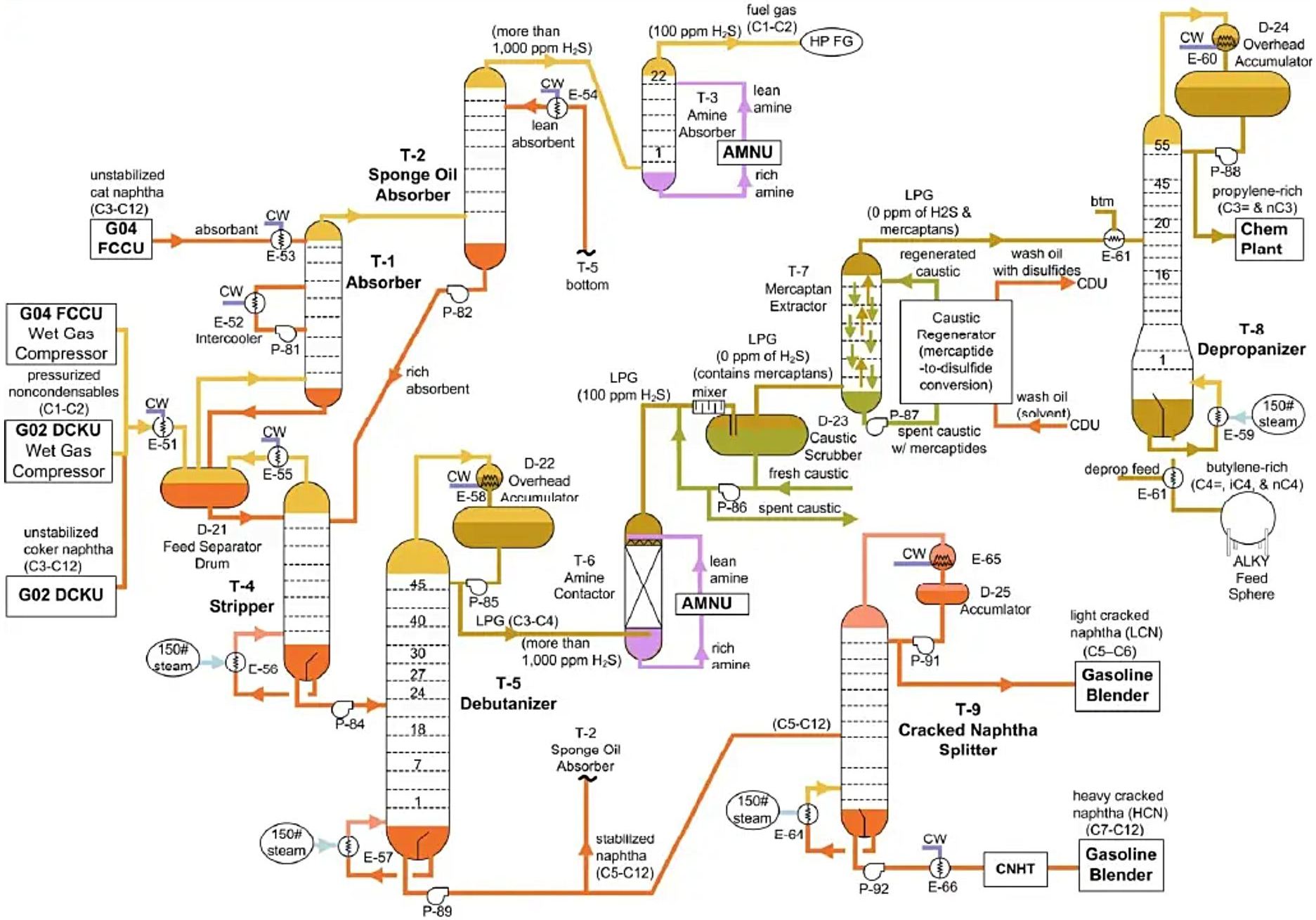
Unsaturated Gas Plant PFD | Source: Warren Averill, Visual Performance Solutions, Inc.- Refinery Operations Handbook (ROHB) for Operators
The Unsaturated Gas Plant (USGP) — also called the FCC Gas Recovery Unit, or Cracked Gas Plant — separates the contents of the gas and liquid streams coming from the overhead of the Fluid Catalytic Cracking Unit (FCC) and the Delayed Coking Unit (DCKU) into pressurized noncondensables (C1–C2 with trace C3s from the wet gas compressors) and unstabilized naphtha (C3–C12) from the main-column overhead systems. The plant is termed “unsaturated” because the cracked streams it processes are rich in olefins — molecules containing carbon–carbon double bonds (butylene rather than butane) — produced by the hydrogen-poor thermal cracking of the coker and catalytic cracking of the FCC riser.
Its purpose is threefold:
- Recover olefin-bearing LPG — propylene, a key feedstock for plastics production in chemical plants, and butylenes, valuable reactants for alkylate production in the Alkylation Unit — from wet gas that would otherwise be downgraded to fuel gas
- Stabilize and split cracked naphtha — light cracked naphtha is a valuable high-octane, low-RVP gasoline blending component; heavy cracked naphtha is desulfurized downstream in the Cracked Naphtha Hydrotreater
- Reject dry gas — The reject dry gas (C1/C2, hydrogen, H2S) is sent to the amine system, fuel gas header, or — in petrochemical-integrated configurations — to downstream hydrogen and ethylene recovery facilities
Compared with the sister Saturated Gas Plant, three differences define the USGP’s design: the volume of LPG and noncondensables entering the plant is many times greater, so the front-end separation and sulfur-removal processes are much more robust; the propylene product is a premium chemical-plant feed; and the butylene product supplies the alkylation unit with high-octane gasoline blending component. Segregating the two gas plants allows each to be optimized independently — olefin-recovery economics on the cracked side, simple robust LPG/naphtha recovery on the saturated side — a configuration documented in the Chevron Salt Lake City plant-wide energy assessment, where constructing a dedicated saturated gas plant avoided reprocessing saturated gas in the alkylation plant and saved an estimated 20,000 MMBtu/yr of fuel. Both plants share the same core architecture of wet-gas compression, absorption, stripping and debutanization, differing in feed slate, compression duty and product disposition.
Continue reading here.
#unsaturatedgasplant #usgp #crackedgasplant #cgp #fccgas #cokergas #olefinsrecovery #lpg #crackednaphtha