delayed coking is the most widely applied bottom-of-the-barrel carbon-rejection process
- Technology Type
- Delayed Coking

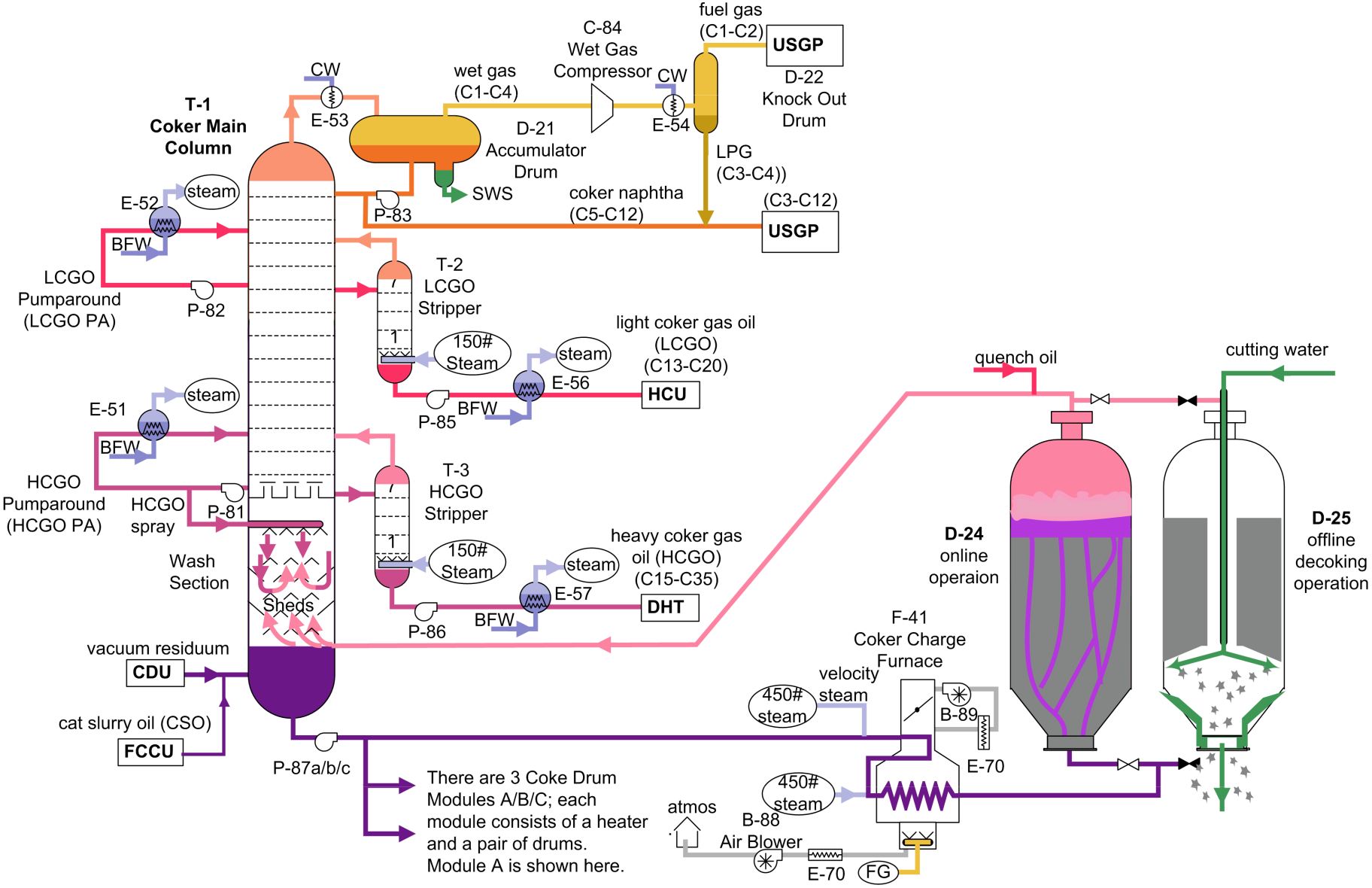
Delayed Coker Unit Functional Process Flow | Source: Ref. 9 indescription
Delayed coking is a semi-batch cyclic thermal cracking process that upgrades residual oils — vacuum residue from the vacuum distillation unit, atmospheric residue, solvent deasphalting pitch, FCC decant (slurry) oil, and unconverted bottoms from ebullated-bed hydrocracking — into lighter products (fuel gas, LPG, coker naphtha, light and heavy coker gas oils) plus a solid carbon product, petroleum coke It is the workhorse of the Petroleum Coking technology type: more than 90% of world petroleum coke is produced in delayed cokers, and delayed coking is the most widely applied bottom-of-the-barrel carbon-rejection process, with an installed base of roughly one quarter of the world's ~700 refineries. Licensed generic designs are offered today by Wood (SYDEC), Chevron Lummus Global (a Chevron/Lummus Technology joint venture), and Bechtel (ThruPlus, acquired from ConocoPhillips in 2011), alongside extensive in-house design capability at Chinese state refiners (e.g. Sinopec's engineering arms).
The name "delayed" reflects the defining design principle: the residuum feed is superheated in a fired furnace to about 485–505 °C under short residence time (aided by velocity steam), so that coking in the furnace tubes is "delayed" until the effluent reaches large downstream coke drums, where lengthy residence time at high temperature completes the cracking and polycondensation reactions. The heart of the unit is the furnace; the product-defining feature is the pair (or pairs) of coke drums that are switched on and off line on a cyclic schedule.
Continue reading here.
#delayedcoking #delayedcoker #dcu #dcku #residualoils #carbonrejection #thermalcracking #petcoke #petroleumcoke #greencoke