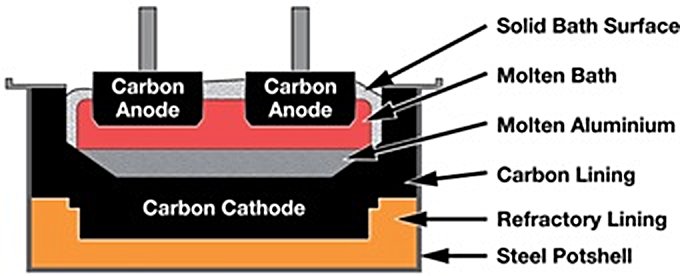
Carbon anodes are shaped, high-density carbon components manufactured from calcined petroleum coke and coal tar pitch binder, used as the positive electrode (anode) in electrochemical and electrolytic industrial processes where high electrical conductivity, thermal stability, and controlled electrochemical reactivity are simultaneously required. They are among the most strategically important consumable materials in the global metals industry.
Manufacturing
Carbon anodes are produced by mixing calcined petroleum coke (CPC) — the aggregate — with coal tar pitch as a binder, forming the green anode by vibration moulding or extrusion, and baking at approximately 1,100°C in ring furnaces to carbonise the pitch binder and develop the required mechanical strength, electrical conductivity, and density. The baking process drives off volatiles and creates a rigid, low-porosity carbon matrix. Key quality parameters include apparent density, electrical resistivity, compressive strength, thermal expansion coefficient, and sulphur and metal impurity levels.
Anode Technologies
Two principal anode designs are used industrially:
-
Prebaked Carbon Anode (PBA) — pre-manufactured rectangular blocks installed in electrolytic cells via steel rod assemblies; replaced periodically as consumed; dominant technology in modern aluminium smelters due to lower voltage drop (~300 mV vs. ~500 mV), lower PAH emissions, automation compatibility, and scalability to high-current cells (up to 500 kA); individual blocks weigh up to 1,000 kg
-
Söderberg Anode — a continuous self-baking anode in which paste (CPC + pitch) is added to the top of the anode structure and baked in-situ using waste cell heat; lower capital cost but higher PAH emissions and energy consumption; being progressively phased out globally due to environmental regulations
Industrial Applications
Carbon anodes serve as electrochemical consumables across several major industries:
-
Primary aluminium smelting (Hall-Héroult process) — the dominant application; anodes are electrochemically oxidised to CO/CO₂ as oxygen ions from alumina are discharged; consumption is approximately 400–450 kg per tonne of aluminium produced, making the carbon anode the single largest consumable cost in aluminium production
-
Chlor-alkali industry — carbon anodes used in electrolytic cells for the production of chlorine, sodium hydroxide, and hydrogen from brine
-
Zinc electrowinning — carbon anodes used in electrolytic zinc refining
-
Copper electrorefining — in some process configurations
-
Lithium extraction — carbon anodes facilitate electrochemical separation in lithium processing
Spent Anodes & Recycling
After consumption, the remaining anode stub — known as anode butt — retains approximately 15–25% of the original anode mass attached to the steel rod assembly. Anode butts are stripped, crushed, and recycled back into the anode manufacturing process as a carbon aggregate component, significantly reducing raw material costs and waste. Anode butt scrap not suitable for recycling into new anodes is redirected as a carbon additive in steelmaking, foundries, and ferroalloy production.
Market Context
The global carbon anode market for aluminium electrolysis was valued at approximately USD 1.2 billion in 2024, projected to reach USD 1.5 billion by 2032, driven by expanding primary aluminium capacity in the Middle East, India, and Southeast Asia.
References
- ScienceDirect. Carbon Anode (Accessed: Mar 4, 2026)
- Huaro (Shanghai) Industrial Company (Oct 11, 2025). Carbon Anode Block: A Comprehensive Overview from Basic Principles to Cutting-Edge Applications
- Chen B., Chaouki H., Picard D., Lauzon-Gauthier J., Alamdari H., Fafard M. (Feb 15, 2021). Physical Property Evolution of the Anode Mixture during the Baking Process. Materials (Basel). 14(4):923. DOI: 10.3390/ma14040923. PMID: 33672082; PMCID: PMC7919669.
- Anode Jacking Frame Blog (Apr 28, 2017). There are two primary technologies using the Hall–Héroult process
- SMF Metall (Nov 4, 2025). Carbon Anode Scrap
- Amara, B., Kocaefe, D., & Kocaefe, Y. (Jun 2025). A review of the studies on the utilization of petroleum pitch and its blends with coal tar pitch for carbon anode production in aluminum industry. Next Research, 2(2), 100250. DOI: 10.1016/j.nexres.2025.100250
- Verified Market Research (Jun 2025). Report 525790: Carbon Anode for Aluminum Electrolysis Market