
Product
Raffinate-2
Abbreviation
C4R2 | RAF-2
Names
RAF2
Insight Articles
#PS265
Main Product
C4 Stream
Segment
Refined Products
Main-Family
Refinery Gases
Sub-Family
Fuel gases & Lighter hydroc.
Physical State

Gas

Description

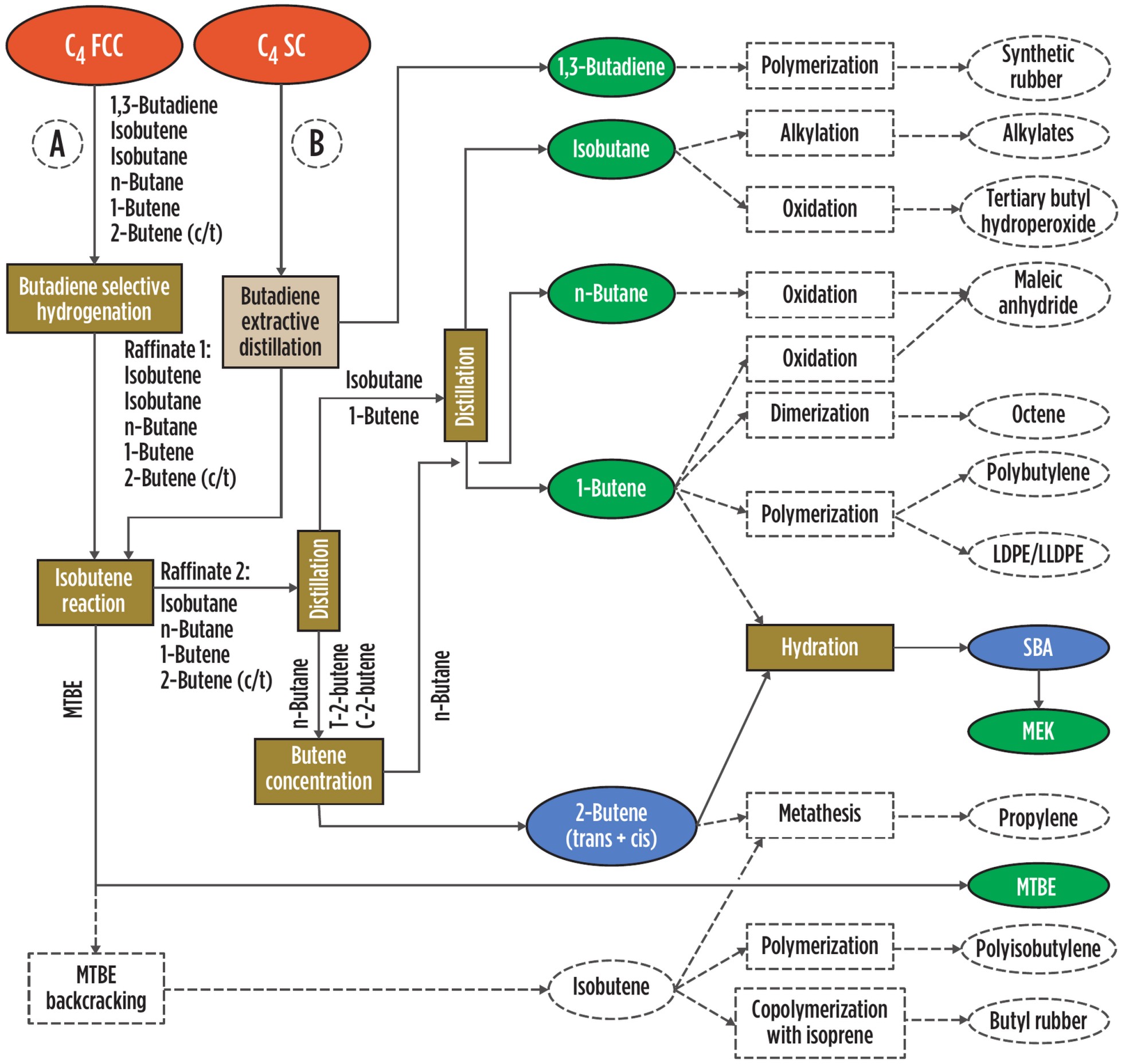
Raffinate-2 is the residual C₄ stream obtained after extraction or selective hydrogenation of 1,3-butadiene from steam-cracker or FCC-derived crude C₄ (yielding raffinate-1) followed by removal of isobutylene via MTBE/ETBE etherification, hydration into TBA, or an equivalent conversion route. RAF-2 typically emerges as the unreacted C₄ side-stream from a tert-Butyl Alcohol (TBA) unit or an MTBE/ETBE unit processing raffinate-1.  It is a mixed olefin/paraffin liquefied gas consists mainly of cis- and trans-2-butene (50–60 wt%), 1-butene (10–15 wt%), n-butane (~20 wt%), and minor isobutane. When raffinate-1 is fed to a tert-Butyl Alcohol unit, RAF-2 is produced as the unreacted C₄ side-stream.


Typical Composition (wt%)

Component Typical Range Notes
2-butene
(cis + trans)
50–60% trans usually predominates over cis
1-butene 10–15% most valuable single component
n-butane ~20% (15–25%) main inert
isobutane 1–5% minor
isobutylene < 0.5–1% spec-limited residue
1,3-butadiene < 0.1% (ppm if hydrogenated) removed in upstream extraction
Traces — possible MTBE/MeOH (from etherification units) or TBA (from hydration units)

Composition varies with C₄ origin (steam cracker vs. FCC), cracking severity, and the extraction/conversion technology applied.


Physical Properties

  • Appearance: colorless liquefied petroleum gas, faint hydrocarbon odor
  • Mean molecular weight: ~56–57 g/mol
  • Boiling range (1 atm): approx. −12 °C to +4 °C
  • Liquid density: ~0.57–0.60 g/cm³ (saturated)
  • Flammable limits in air: ~1.6–10 vol%
  • Storage/transport: pressurized spheres/bullets or refrigerated, LPG-type handling; commonly shipped under UN 1010 (butylene) or per the mixture SDS

Applications & End Uses

  1. Metathesis feed (largest modern outlet): 2-butene + ethylene → 2 propylene (Olefin Conversion Technology / triolefin-type units); requires hydrogenated RAF-2 with butadiene reduced to ppm levels
  2. 1-Butene recovery: polymer-grade 1-butene for LLDPE/HDPE co-monomer, polybutene-1, and oxo-derived plasticizer alcohols (valeraldehyde → 2-propylheptanol/DPHP)
  3. Alkylation feed: high-value C₄ olefin source for H₂SO₄/HF alkylate; 2-butene is a preferred feed
  4. MEK precursor: n-butenes via sec-butanol hydration/dehydrogenation to methyl ethyl ketone
  5. Skeletal isomerization: n-butenes → isobutylene for MTBE/ETBE or downstream C₄ derivatives
  6. Recycle/energy uses: steam-cracker feed recycle, hydrogenation to butane, LPG or fuel-gas blending

Quality Considerations

Typical sales/intermediate specs: butadiene < 0.1 wt% (ppm for metathesis feed), isobutylene < 0.5–1 wt%, acetylenes at ppm, low sulfur, and minimal oxygenate carryover (methanol/MTBE/TBA) from the upstream conversion unit.


Market Notes

Availability is structurally tied to butadiene extraction capacity plus MTBE/TBA operations. RAF-2 is traded mainly in Asia-Pacific and NW Europe, with prices assessed by agencies such as ICIS and Argus, typically referenced against naphtha, butadiene, and LPG values. Growth in on-purpose propylene via metathesis has strengthened demand for hydrogenated raffinate-2.


Insight Articles
Your insights will be shown here

Selected routes of C4 hydrocarbons processing | Source: T. Streich et al., Hydrocarbon Processing (July 2016).
Identifiers

No Identifiers defined

Chemical Data

Molecular Weight (g/mol)
56.5
Specific Gravity
0.59
Crude Data

API Gravity
110.38034188034189
Country
Product Settings

Default
Status
A
Content provided by
Transaction Name Date
Modified by UserPic   Kokel, Nicolas 10/7/2026 2:05 PM
Added by UserPic   Kokel, Nicolas 12/2/2021 12:41 PM