Definition & Production Route
Hydroprocessed (or hydrodewaxed) base oils are high-purity paraffinic base oils produced entirely through catalytic hydrogen-based refining processes, in contrast to the solvent extraction and solvent dewaxing routes used for conventional mineral base oils.
They are obtained by severe hydrotreating and/or hydrocracking of vacuum gas oils (VGOs) or deasphalted oils (DAOs) — and increasingly from hydrocracker unconverted oil (UCO) — followed by catalytic hydroisomerization dewaxing and final hydrofinishing.
This all-hydroprocessing route systematically removes sulphur, nitrogen, metals, and virtually all aromatic compounds, while simultaneously converting straight-chain waxy n-paraffins into branched isoparaffins via isomerization, rather than removing them as slack wax as in conventional solvent dewaxing.
Hydrocarbon Composition
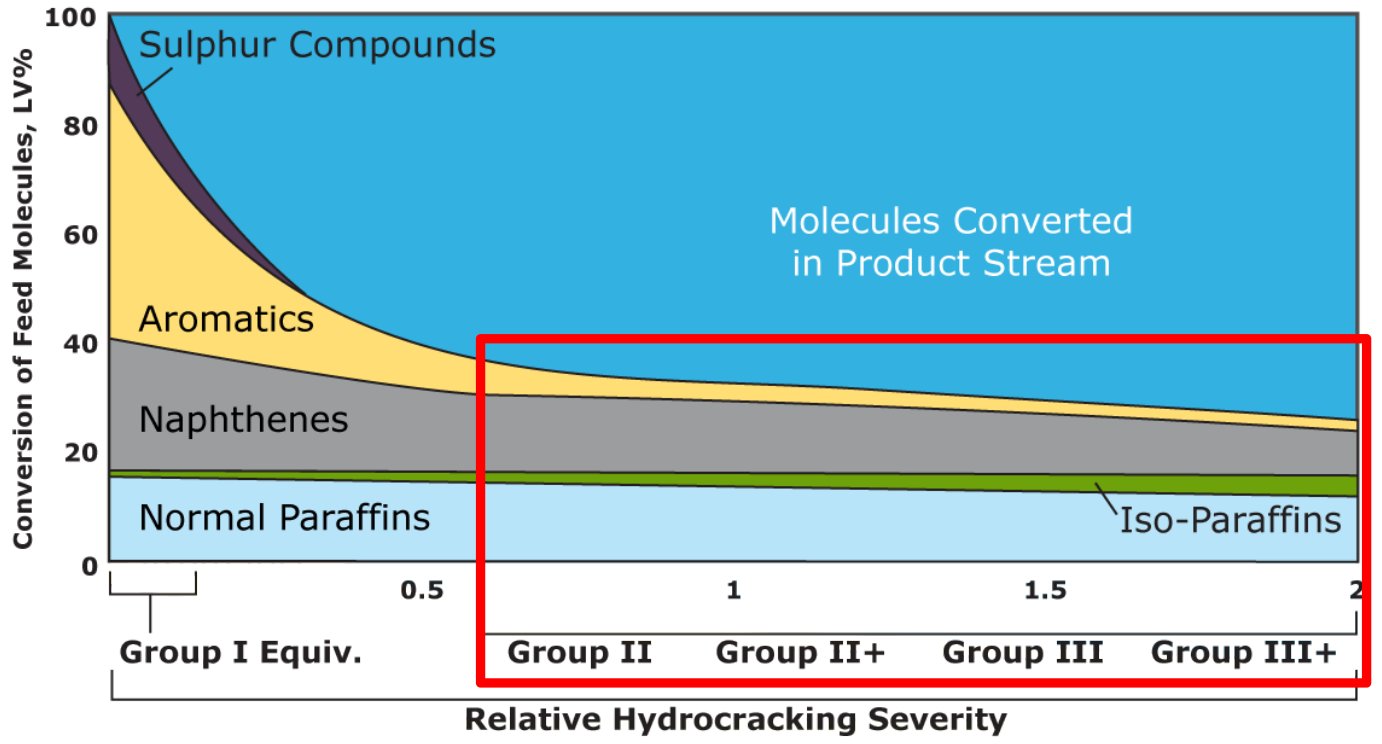
The composition of the final base oil is directly governed by the severity of hydrocracking applied to the feedstock — higher severity yields a greater proportion of isoparaffins and a lower proportion of residual naphthenes and aromatics (see Figure 1).
Figure 1 - Conversion of feed molecules vs. relative hydrocracking severity [10]
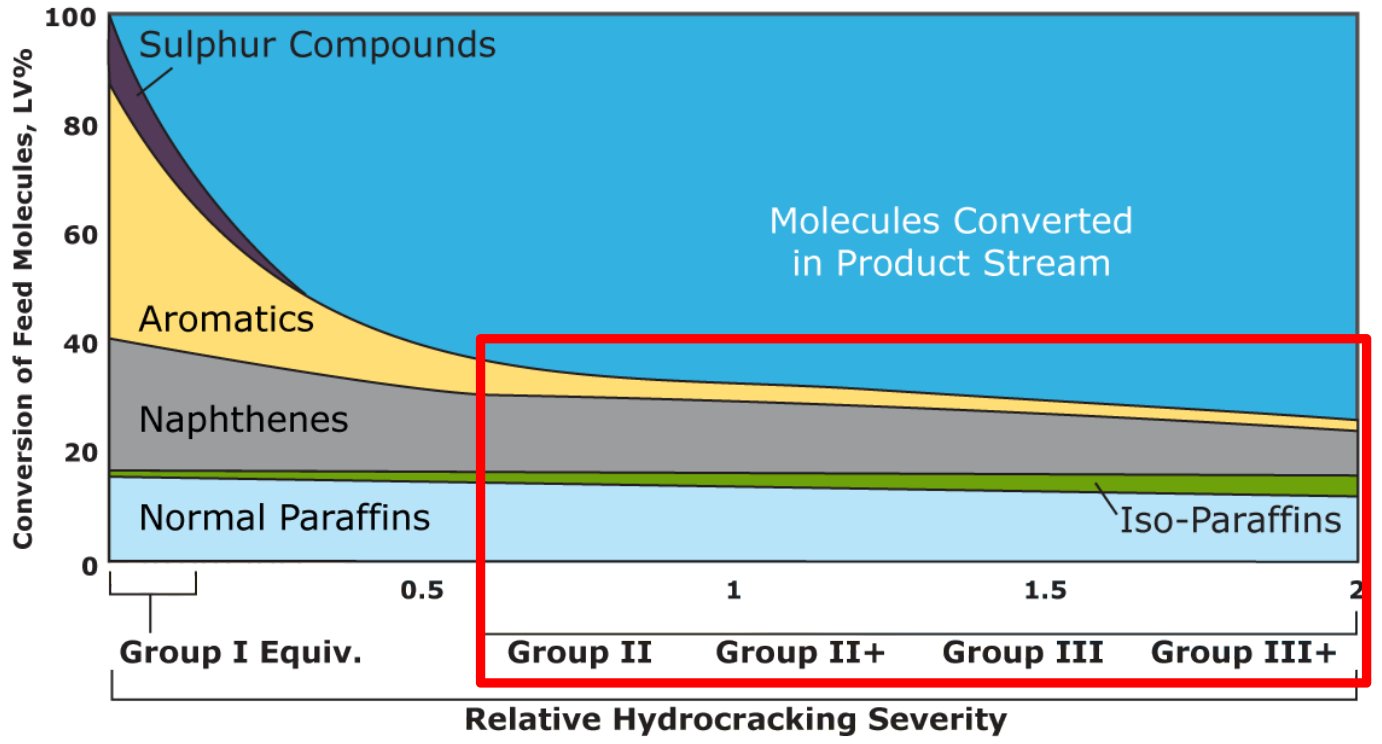
Residual normal paraffins are converted to iso-paraffins during catalytic dewaxing.
Residual aromatics are converted to iso-naphthenes during hydrofinishing.
Residual n-paraffins not converted during hydrocracking are selectively isomerized to isoparaffins during the catalytic dewaxing step, delivering superior low-temperature fluidity without sacrificing yield.
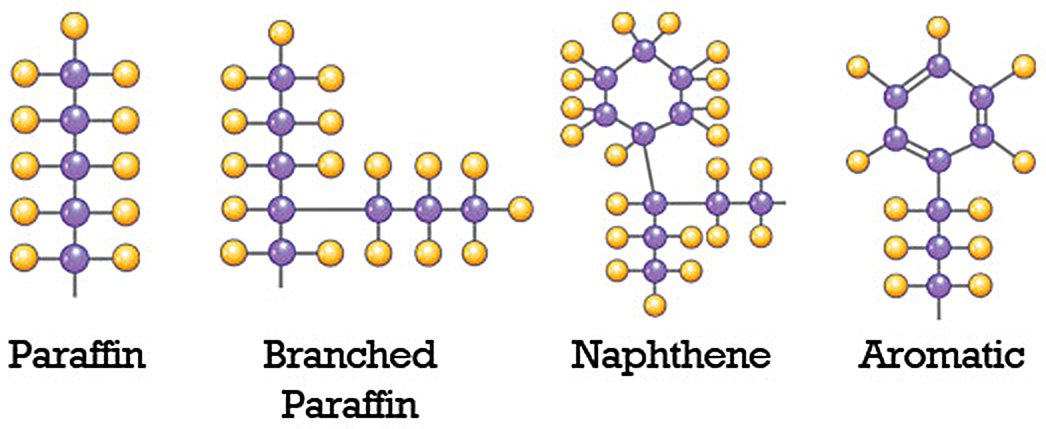
Any remaining traces of aromatic compounds — primarily polynuclear aromatics — are converted to isoparaphinic naphthenes during the final hydrofinishing step, resulting in a saturates content typically exceeding 99% by weight.
Figure 2 - Chemical components of base oils
Key Properties
The resulting hydroprocessed base oils are typically water-white in appearance, with sulphur content at or near zero and saturates above 99%, placing them firmly in the API Group II, Group II+, Group III, or Group III+ classifications. Their most distinguishing performance characteristics are:
- Viscosity Index (VI): Typically ≥115, reaching 130–140+ in Group III and Group III+ grades, owing to the high isoparaffin content
- Pour Point: Excellent low-temperature fluidity from isomerization dewaxing, typically −15°C to −30°C or lower
- Volatility: Low Noack volatility, supporting long-drain and energy-efficient lubricant formulations
- Oxidation & Thermal Stability: Very good to excellent, due to near-complete removal of sulphur, nitrogen, and aromatic compounds that catalyse oxidative degradation
- Density: Approximately 0.84–0.88 g/cm³ at 15°C, varying with viscosity grade and degree of hydroprocessing
API Group Classification
Hydroprocessed base oils occupy API Groups II through III+ because the all-hydroprocessing route consistently delivers the threshold properties required: >90% saturates, <0.03% sulphur, and VI ≥80 (Group II) through VI ≥120 (Group III/III+).
Group II and II+ grades typically result from moderate to high hydrotreating severity, while Group III and III+ grades require deep hydrocracking combined with high-severity isomerization dewaxing.
This distinguishes them from Group I Solvent Neutral (SN) base oils, which retain higher aromatic and sulphur content from the solvent refining route.
Solvency Considerations
One important trade-off of the high saturation level in hydroprocessed base oils is reduced solvency compared to Group I SN base oils. Lower aromatic content reduces the capacity to dissolve polar additives and can affect elastomer seal compatibility. Formulators of finished lubricants may therefore need to account for this by incorporating co-solvent stocks, appropriate additive carriers, or seal-swell agents when transitioning formulations from Group I to Group II/III base stocks.
Comparative Properties
Table 1 - Comparative characteristics and properties of hydrodewaxed base oils, SN base oils and bright stock
| Feature |
Solvent Neutral (SN) Base Oils |
Hydroprocessed (Hydrodewaxed) Base Oils |
Bright Stock |
Process
Route |
Solvent extraction + solvent dewaxing |
Hydrotreating/ hydrocracking + catalytic isomerization dewaxing
+ hydrofinishing |
Deasphalting + solvent refining + hydrofinishing |
| Feedstock |
Vacuum distillates |
Vacuum distillates,
DAO, or UCO |
Deasphalted vacuum residue |
API
Group |
Primarily
Group I |
Group II, II+, III, III+ |
Group I |
Viscosity
t 100°C |
~4–14 cSt |
~4–14+ cSt |
~26–35 cSt |
| Saturates |
<90% |
>99% |
Moderate |
| Sulphur |
Higher (≥0.03%) |
Near-zero (<0.03%) |
Low (hydrofinished) |
Viscosity
Index |
~90–105 |
~110–140+ |
Moderate |
Colour/
Appearance |
Pale to
amber |
Water-white,
very clear |
Bright, pale
heavy oil |
Oxidation/
Thermal Stability |
Good |
Very good
to excellent |
Good |
| Low-Temperature Properties |
Limited |
Excellent
(isomerization
dewaxing) |
Poor |
| Solvency |
High |
Lower; may
require additives |
High |
Typical
Uses |
Cost-effective automotive and industrial lubricants |
Premium engine/
industrial oils,
low-SAPS, long-drain, high-performance blends |
Viscosity builder in gear, marine, and heavy industrial oils |
References
- Mascherpa (December 22, 2022). Hydrogenation process of base oils
- Petro‐Canada Lubricants Inc.. Base Oil Hydrotreating Process
- Wright J. (June 27, 2012). The Fundamentals of Mineral Base Oil Refining. Machine Lubrication
- Eser S. FSC 432: Petroleum Processing — Processing and Conversion of Vacuum Distillation Residue. PennState - College of Earth and Mineral Sciences
- Outhwaite A. & Rosenbaum, J. (2011). Base oils – An evolving landscape. Lubrisense White Paper, 11-11. Axel Christiernsson AB
- Sing Group (October 30, 2024). Group III & III+ (Base Oils)
- DUTM B.V.. Base Oils
- Lubrex. API Base Oil Groups I, II & III: Classification, Key Properties & Comparison Table
- Mahmodi B., Black Water Petrochemical FZE (Dec 30, 2024). The Science Behind Base Oils: Chemistry and Classification