
Product
Hematite
Insight Articles
#PS761
Main Product
Iron Ores
Segment
Extractive Industry Products
Main-Family
Ores
Sub-Family
Metallic Ores
Physical State

Solid

Description

Hematite is the world's most important iron ore mineral and the primary source of iron for global steel production. Named from the Greek haima (blood), a reference to its characteristic red streak, it is the natural mineral form of iron(III) oxide (α-Fe₂O₃) and occurs across a wide range of geological environments.

Ore Identity

Property Value
Mineral Name Hematite
Chemical Formula Fe₂O₃
Theoretical Fe Content 69.94%
Typical Ore Fe Grade (DSO) 58–65%
Color Steel-grey to black (crystalline); red to reddish-brown (earthy)
Streak Reddish-brown (diagnostic)
Hardness (Mohs) 5.5–6.5
Density ~5.26–5.30 g/cm³
Luster Metallic to earthy
Magnetism Non-magnetic (pure hematite)
Crystal System Rhombohedral (trigonal)
Cleavage None
Fracture Subconchoidal to uneven


Geological Occurrence

Hematite forms across all major geological environments — igneous, metamorphic, sedimentary, and hydrothermal. Its principal ore-forming settings are:

  • Banded Iron Formations (BIFs) — Precambrian sedimentary sequences of alternating hematite and silica (chert/jasper) bands; the world's largest iron ore resource, and the source of the great deposits of the Pilbara (Australia), Carajás (Brazil), and Kryvyi Rih (Ukraine)
  • Enriched / supergene deposits — BIFs upgraded by weathering and leaching of silica, producing high-grade massive hematite bodies suitable for direct-shipping without beneficiation
  • Hydrothermal deposits — hematite precipitated from iron-rich hydrothermal fluids in veins and breccias
  • Metamorphic hematite — formed by oxidation of magnetite or recrystallisation of sedimentary iron minerals under elevated pressure and temperature
  • Sedimentary oolitic deposits — oolitic or pisolitic hematite formed by chemical precipitation in shallow marine basins

Physical Forms & Varieties

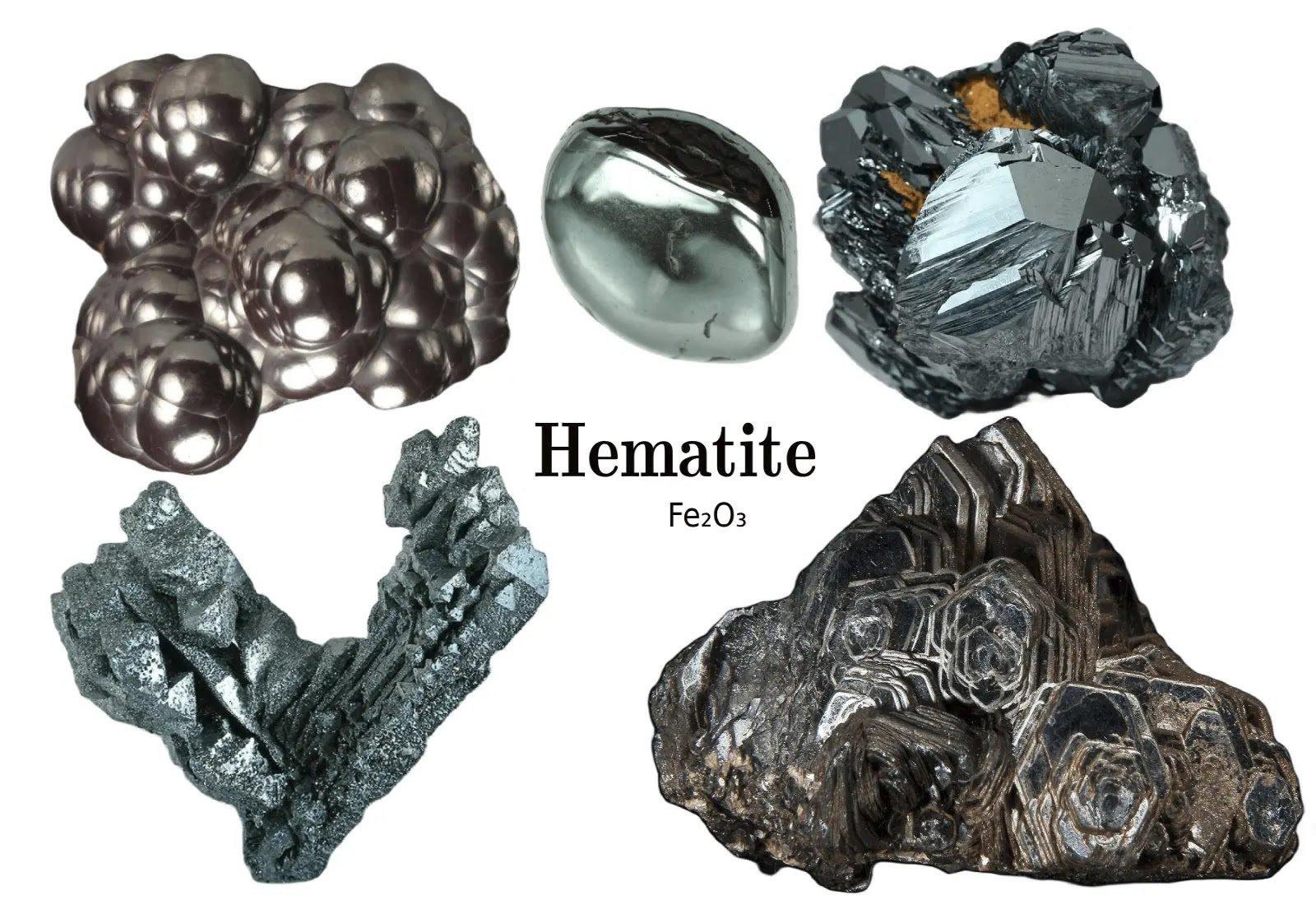
Hematite displays an unusually wide range of habits:

  • Specular hematite — platy, mirror-like metallic crystals with high reflectance
  • Kidney ore — reniform (kidney-shaped) botryoidal masses with a smooth surface
  • Iron roses — rosette-like sub-parallel crystal groupings on basal faces
  • Earthy/ochreous hematite — soft, powdery, red to brown massive material
  • Oolitic hematite — small spheroidal grains formed by concentric precipitation
  • Massive hematite — dense, fine-grained, commercially the most important form

Key Global Deposits

Deposit Country Annual Output Notes
Pilbara region Australia ~900 Mt/yr World's largest;
multiple DSO operations
Carajás Brazil ~200 Mt/yr Highest-grade deposits
globally (~67% Fe)
Sishen South Africa ~30 Mt/yr Northern Cape
BIF-hosted deposit
Kryvyi Rih Ukraine ~60 Mt/yr Major European
iron ore basin
Mesabi Range USA ~35 Mt/yr Historic taconite
/hematite district

Mining & Beneficiation

High-grade hematite deposits (≥58% Fe) are mined as direct-shipping ore (DSO) — crushed and screened without chemical processing before export. Lower-grade ores require beneficiation via crushing, screening, and gravity or magnetic separation to upgrade Fe content. Hematite's non-magnetic character limits the use of magnetic separation, making gravity separation (jigs, spirals, dense media) the dominant beneficiation route.​

Steel Industry Role

Hematite ore is reduced to metallic iron in blast furnaces via the stepwise reaction sequence:

Fe₂O₃ → Fe₃O₄ → FeO → Fe

Its higher Fe grade and lower impurity levels compared to magnetite make it the preferred ore for conventional integrated steelmaking. It is also processed into sinter (agglomerated fines) and pellets for optimised blast furnace burden management.​

Applications Beyond Steelmaking

While steelmaking dominates hematite consumption, the ore also serves as the primary raw material for:​

  • Synthetic red iron oxide pigment (PR101) for paints, coatings, and concrete
  • Dense media suspensions for coal washing and mineral separation (ground hematite powder)
  • Radiation shielding aggregate in heavy concrete
  • Polishing compounds (jeweller's rouge)


References

  1. Geologyin (Jan 25, 2024). Hematite: Properties, Uses, Meaning
  2. King H.M., Geology.com. Hematite (Accessed Feb 28, 2026)
  3. Wikipedia. Hematite (Page version Feb 19, 2026)
  4. Mat M., GEOLOGYSCIENCE (Nov 14, 2025). Hematite
  5. Barthelmy D., Mineralogy Database. Hematite Mineral Data (Accessed Feb 28, 2026)
  6. Mindat.org. Hematite (Accessed Feb 28, 2026)
  7. JXSC (Jun 12, 2024). Mastering Hematite vs Magnetite: Expert Guide

Insight Articles
Your insights will be shown here

Various samples of hematite https://www.geologyin.com/2024/01/hematite-properties-uses-meaning.html
Identifiers

logo CAS Number
1317-60-8
logo EC Number
215-275-4
logo ECHA InfoCard
100.013.888
logo IUPAC Name
Diiron(3+) trioxidandiide
logo PubChem ID
14833
Chemical Data

Chemical Formula

Fe2O3

Molecular Weight (g/mol)
159.69
Specific Gravity
5.28
Crude Data

API Gravity
-104.7
Country
Product Settings

Default
Status
A
Content provided by
Transaction Name Date
Modified by UserPic   Kokel, Nicolas 2/28/2026 10:17 AM
Added by UserPic   Kokel, Nicolas 2/28/2026 9:06 AM