
Product
Sodium Hexafluoroaluminate (Cryolite)
Names
Cryolite; Trisodium Hexafluoroaluminate
Insight Articles
#PS784
cryolite aluminiummaking aluminiummanufacturing electrometallurgy hallheroultprocess sodiumhexafluoroaluminate
Main Product
Aluminum Fluoride
Segment
Chemicals
Main-Family
Inorganics
Sub-Family
Inorganic Fluorine Compounds
Physical State

Solid

Description

Cryolite (Na₃AlF₆) is a sodium aluminium fluoride mineral and one of the most industrially critical inorganic fluorine compounds, serving primarily as the molten electrolyte bath in the Hall-Héroult process for primary aluminium production. Natural cryolite was historically sourced exclusively from a single deposit at Ivittuut (Ivigtut), Greenland — the world's only commercially significant natural occurrence — which was mined to exhaustion by 1987. All industrial cryolite today is synthetic, produced from hydrofluoric acid, sodium carbonate, and aluminium hydroxide.

Chemical Identity

Property Value
Chemical formula Na₃AlF₆
Chemical Name  Sodium Hexafluoroaluminate
Appearance White crystalline powder or granules
Density 2.95–3.01 g/cm³
Solubility in water Slightly soluble


Production of Synthetic Cryolite

Synthetic cryolite is produced through a controlled wet chemical process in which hydrofluoric acid (HF) reacts with aluminium hydroxide (Al(OH)₃) to first form fluoroaluminic acid (H₃AlF₆), which is then neutralised with soda ash (sodium carbonate, Na₂CO₃) or caustic soda (NaOH) to precipitate sodium aluminium fluoride (Na₃AlF₆). The precipitate is filtered, washed, dried, and milled to the required particle size for industrial use. The overall reaction can be summarised as:

Al(OH)3 + 6 HF + 3 NaOH → Na3AlF6 + 6 H2


Natural vs. Synthetic Cryolite

  Natural Cryolite Synthetic Cryolite
Source Ivittuut, Greenland
(exhausted 1987)
Reaction of
HF + Al(OH)₃ + Na₂CO₃
Commercial status No longer available Exclusively used today
Purity Variable Controlled; >98% Na₃AlF₆
Forms Mineral ore Powder, granules


Role in the Hall-Héroult Process

Cryolite's dominant industrial function is as the molten electrolyte bath in aluminium electrolysis, where it performs three critical roles:

  • Melting point depression — dissolves alumina (Al₂O₃), reducing its effective melting point from ~2,050°C to ~950–970°C, making electrolysis economically and technically feasible
  • Electrical conductivity — provides the ionic conductivity required for current to decompose dissolved alumina into aluminium metal and oxygen
  • Density separation — the electrolyte bath density (~2.1 g/cm³) is lower than liquid aluminium (~2.3 g/cm³), allowing molten aluminium to settle at the cell bottom for continuous tapping

Cryolite is not consumed stoichiometrically but is continuously lost through volatilisation, absorption into the carbon cathode lining, and mechanical losses, requiring ongoing make-up additions of synthetic cryolite and aluminium fluoride (AlF₃) to maintain bath chemistry.​

Other Industrial Applications

Beyond aluminium smelting, cryolite serves several secondary industrial uses:

  • Glass & ceramics — used as a flux to lower melting temperatures and as an opacifier producing opal/milky glass for lampshades, cosmetic containers, and optical glass
  • Abrasives — added as a filler and lubricant/coolant in resin-bonded grinding wheels and sandpaper to improve cutting efficiency and tool life
  • Welding fluxes — potassium cryolite (K₃AlF₆) used in aluminium brazing and welding flux formulations
  • Agriculture — used as an insecticide and pesticide, particularly for fruit and vegetable crops
  • Pyrotechnics — imparts a yellow flame colour in fireworks compositions​

Strategic Importance

Cryolite is classified as a critical raw material in the context of aluminium production supply chains. The complete exhaustion of the world's only natural deposit and total dependence on synthetic production ties cryolite supply directly to the hydrofluoric acid and fluorite (fluorspar) supply chains — themselves considered critical minerals. Every tonne of primary aluminium produced requires approximately 20–30 kg of make-up cryolite, making global consumption closely correlated with primary aluminium output of approximately 70 million tonnes per year.


References

  1. Wikipedia. Cryolite (Page version: Feb 22, 2026)
  2. Britannica. cryolite (Page version: Jan 9, 2019)
  3. Yu Fu Heng Jian (Jan 12, 2026). Industrial Applications of Cryolite
  4. Ataman Chemicals. Synthetic Cryolite (Accessed Mar 5, 2026)
  5. Vedantu. Cryolite (Accessed Mar 5, 2026)
  6. The Crystal Council. Science & Origin of Cryolite (Accessed Mar 5, 2026)​

Insight Articles
Your insights will be shown here

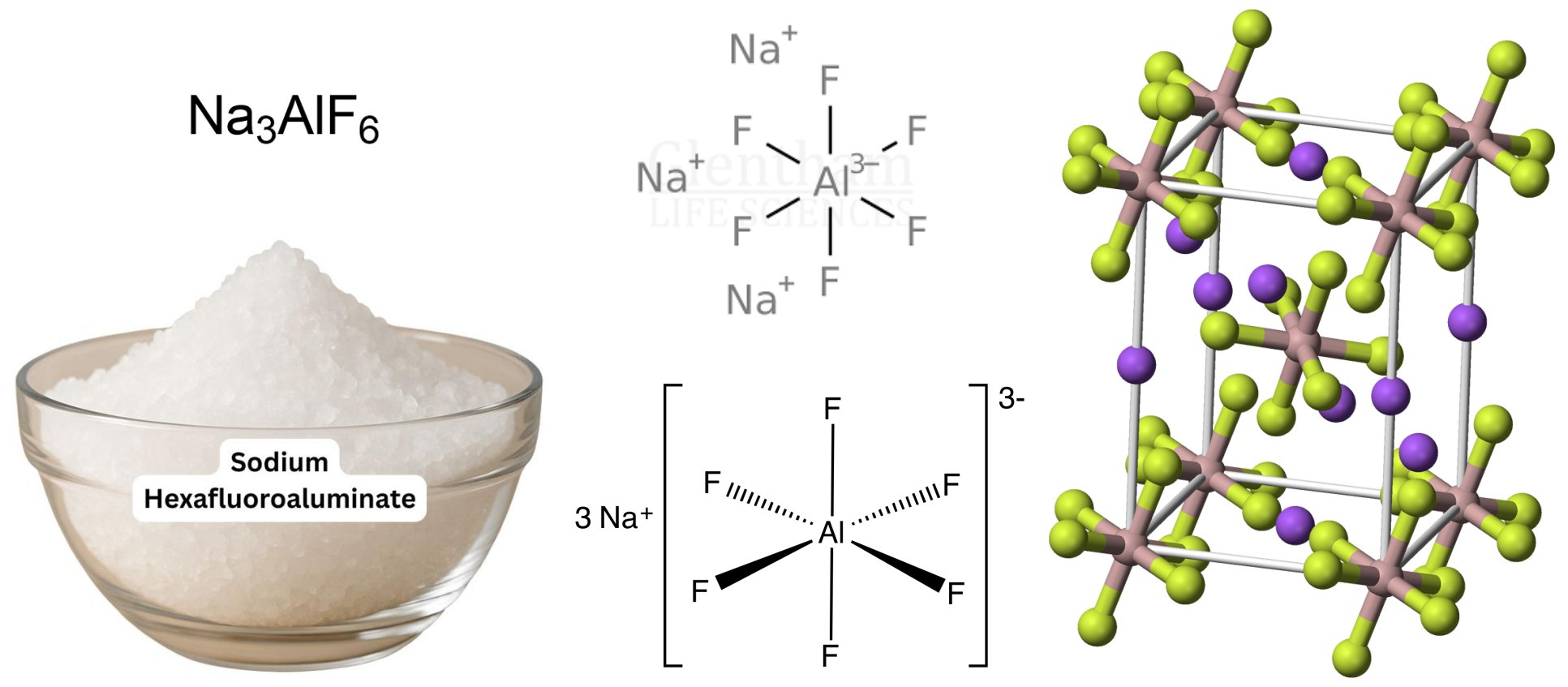
Sodium Hexafluoroaluminate molecular formula, granular form, molecular representations, crystal structure (unit cell) diagram | Various sources
Identifiers

logo CAS Number
13775-53-6
logo EC Number
237-410-6
logo ECHA InfoCard
100.033.995
logo IUPAC Name
Sodium hexafluoroaluminate
logo PubChem ID
159692
Chemical Data

Chemical Formula

Na3AlF6

Molecular Weight (g/mol)
209.94
Melting Point (°C)
950
Sulfur Content (wt%)
0
Specific Gravity
2.90
Crude Data

API Gravity
-82.71
Country
Product Settings

Default
Status
A
Content provided by
Transaction Name Date
Modified by UserPic   Kokel, Nicolas 3/5/2026 4:30 PM
Added by UserPic   Kokel, Nicolas 3/5/2026 3:54 PM