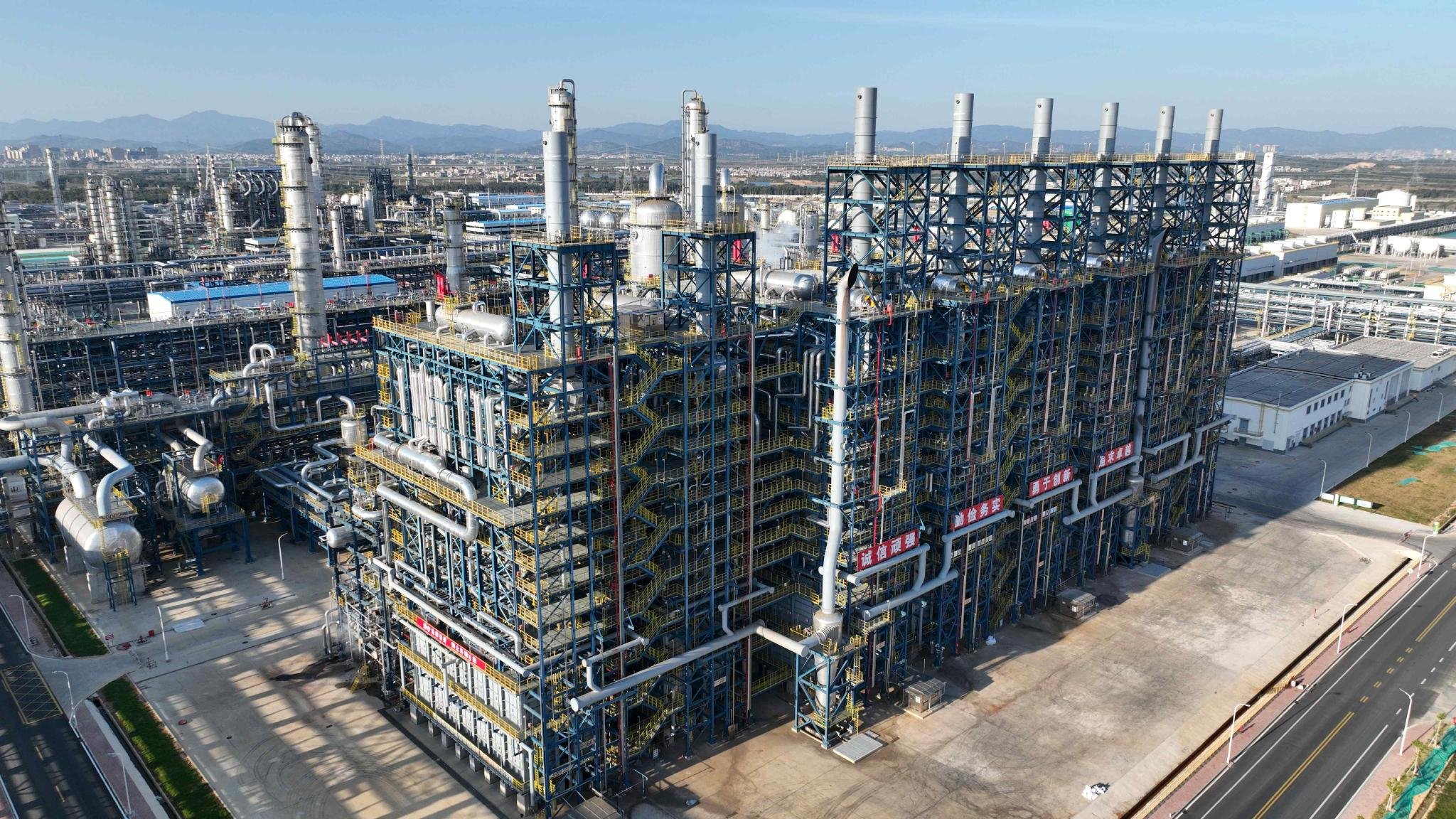
The HQC Ethylene Steam Cracking Technology is a complete indigenous ethylene production system developed by China Huanqiu Engineering Co., Ltd. (HQC/寰球), a subsidiary of CNPC/PetroChina. Development began in 2007 with the "Large Ethylene Phase I" project and continued through "Large Ethylene Phase II" (2017-2023), making China the fourth country globally to master complete large-scale ethylene production technology.
Cracking Furnace Technology
The cracking furnace is the "heart" of the ethylene plant. HQC developed proprietary furnace designs with the following characteristics:
- Radiant section geometry – Typical dimensions of approximately 20m length, over 10m height, and about 3m width
- Tube arrangement – Radiant coils suspended in the center of the firebox, with two-pass configuration: inlet tubes enter from the crossover section at the top, descend to near the furnace bottom where they pass through an S-bend splitting to both sides, then through a U-bend before returning upward as outlet tubes
- Burner configuration – Bottom burners and/or side-wall burners on both sides of the firebox; for bottom-fired designs, fuel gas inlets are arranged in two stages with primary burners at the inner edge of the air inlet and secondary burners on the outer side
- Multi-pass radiant coil configurations – Optimized tube arrangements for different feedstocks, including 2-1-1-1 bottom bend structures for ethane cracking
- Enhanced heat transfer tubes – Proprietary technology in the radiant section reduces the tendency of coking on the inner surface of the furnace tubes, extending decoking cycles by 30-50% and reducing tube wall temperatures by 10-15°C
- High steam production process – Adapted for liquid feedstock operations, the cracking furnace employs a high steam production configuration
- Secondary quench cooling – After cracking gas is cooled by the traditional primary transfer line exchanger (TLE), it is further cooled by boiler feed water for additional temperature reduction
- High thermal efficiency – Furnaces achieve 94-96% thermal efficiency, listed in China's National Industrial Energy-Saving Technology Recommended Directory
- Feedstock flexibility – Capable of processing ethane, LPG, naphtha, coal-based naphtha, hydrogenated tail oil, and light crude oil
- Extended run lengths – Ethane cracking furnaces achieve operating cycles up to 150 days
- High selectivity – Ethylene comprehensive yield reaches 83% for ethane feedstock
- Largest domestic liquid cracking furnace – HQC has designed and built the single liquid cracking furnace with the largest production capacity in China
Process Flow
The feedstock cracking process follows this sequence:
- Convection section preheat – Feedstock enters the convection section for initial preheating
- Dilution steam mixing – Preheated feedstock mixes with dilution steam
- Final preheat and vaporization – Mixed feed is reheated to complete vaporization and raised to cracking temperature
- Radiant section cracking – Feed enters radiant coils where pyrolysis occurs, producing ethylene, propylene, butadiene and other products
- Rapid quench – Cracked gas immediately enters the transfer line exchanger (waste heat boiler) upon leaving the radiant section to minimize secondary reactions and preserve ethylene yield
- Heat recovery – Hot flue gas from combustion passes through the convection section to preheat feedstock and generate superheated steam from boiler feed water
Furnace Design and Simulation Technology
HQC has developed a sophisticated coupled modeling methodology for furnace design verification and optimization:
- Firebox modeling – Computational Fluid Dynamics (CFD) with detailed 3D geometry of burners and tubes, using standard k-ε turbulence model, probability density function (PDF) model for non-premixed combustion, and discrete ordinates (DO) radiation model with weighted-sum-of-gray-gases (WSGGM) for absorption coefficients
- Tube-side modeling – One-dimensional plug flow reactor model with free radical reaction kinetics; feedstock composition characterized using neural network methods based on PONA values and distillation properties
- Coupled iteration – Firebox and tube models are iteratively solved using tube wall temperature and heat flux as boundary conditions until convergence (temperature maximum difference <1°C)
This modeling capability enables prediction of:
- Cracked gas velocity, temperature, pressure, and product yields along tube length
- Tube outer wall temperature and heat flux distribution
- Firebox flue gas temperature, concentration distribution, and flame shape/height
Reaction Kinetics
The tube-side cracking reactions are modeled using detailed free radical reaction mechanisms:
- Chain initiation – Carbon-carbon and carbon-hydrogen bond cleavage
- Hydrogen abstraction – Intramolecular and intermolecular H-transfer reactions
- Radical addition/β-scission – Addition reactions and reverse β-scission
Free radicals are classified into three categories for network simplification:
- β radicals – Small radicals (H- , CH₃- ) participating only in bimolecular reactions
- μ radicals – Larger radicals (>C5) where bimolecular reactions are negligible
- βμ radicals – Intermediate radicals (e.g., C₂H₅- ) exhibiting β behavior at low temperature and μ behavior at high temperature
Kinetic parameters are calculated using group contribution methods.
Compression Section
The technology incorporates China's highest-power domestically manufactured cracking gas compressor, marking a breakthrough in localization of critical rotating equipment for large-scale ethylene plants.
Separation Technology
HQC developed three main separation process configurations:
| Process |
Description |
Application |
| Front-end Deethanization |
C2 and lighter components
separated first after compression |
Ethane
crackers |
| Front-end Depropanization |
C3 and lighter separated before cold box |
Mixed feed crackers |
| Sequential Flow |
Traditional order of separation |
Naphtha crackers |
For ethane cracking, HQC's front-end deethanization with front-end hydrogenation process reduces equipment count by more than 20%. The technology includes a two-stage tail gas expansion refrigeration system that is claimed to reduce ethylene losses by 60% compared to international benchmarks.
Product Slate
The ethylene plant produces the following products:
Environmental Technologies
The technology incorporates advanced environmental control systems:
- Ammonia-based SCR denitration – Multi-branch staged ammonia injection with pre-mixing technology reduces NOx emissions by 70%
- Process water treatment – "Coke capture + flotation + coalescence" cascade purification reduces coke/oil impurities to below 100 ppm
- Waste caustic treatment – Oxidation-salt crystallization technology enables "near-zero discharge" of sulfide-containing waste streams
Scale and Capacity
HQC technology supports single-train capacities from 600 ktpa to 1,500 ktpa:
- 600 ktpa
- 800 ktpa
- 1,200 ktpa
- 1,500 ktpa
- Super-large scale technology validated (2024)
The Daqing Petrochemical 600 ktpa plant (2012) was the pilot project that validated HQC's indigenous ethylene technology before deployment at subsequent larger-scale projects.
Intellectual Property
The technology portfolio includes 64 patents, 27 trade secrets, 1 software copyright, and 44 individual technology achievements across four series. The ethane-to-ethylene complete technology package received the 2024 First Prize for Science and Technology Progress from the China Petroleum and Chemical Industry Federation.
References
English-language sources:
- Ye Dan. Aug or Sep 2017 (estimated publication date). Daqing Petrochemical Fine Chemicals Advanced to High-End. 3E Chemical
- Archana Rani. Sep 1, 2021. PetroChina commissions $1.2bn ethane-to-ethylene project. Offshore Technology
- Sep 1, 2021. 600,000 tons! Another ethane to ethylene project started successfully. ECHEMI
- Mar 31, 2022. Guangdong Petrochemical ethylene plant process details. ECHEMI
- Jul 4, 2022. The ethylene plant was built and handed over. Liaoyang Petrochemical
- Oct 16, 2023. PetroChina to Add CCUS to New Ethane Cracker. Industrial Info Resources
Chinese-language sources:
- Li Xinzhe. Sep 25, 2025. [Smart Manufacturing Future] Petrochemical Deconstruction and Ethylene Rebirth—Large Ethylene Technology. Guangming Science Popularization Cloud
- Xu Yan. March 1, 2023. Has PetroChina's Ethylene Technology Entered the 2.0 Era? . Petrochemical Economic and Technical Information
- Huang Yang, He Ling, Lei Zhenyou. Feb 7, 2025. Record of the First Prize Science and Technology Progress Project: Development and Industrial Application of Complete Ethane Cracking to Ethylene Technology
- Huanqiu Ethane Cracking to Ethylene Complete Technology. VIP Journal
- Yang Xiufeng. Jun 7, 2018. Daqing Petrochemical Company's "Large Ethylene" Supports "Oil Head, Chemical Tail" Upgrade and Transformation. China Economic Net
- Dec 15, 2020. Daqing Petrochemical's "Large Ethylene" Dream. Petroleum and Equipment
- Apr 4, 2024. Chronicle of Major Events for Large Ethylene Plants. China Science Popularization Net
- Oct 27, 2025. PetroChina Guangxi Petrochemical 1.2 Million Tons/Year Ethylene Plant Successfully Starts Up on First Attempt. Guangxi Qinzhou Bonded Port Area
- Hu Jing. Sep 10, 2023. Total investment of RMB 24.332 billion: Latest progress on Hohhot Petrochemical's 1.2 million tonnes per annum ethane-to-ethylene project. Sohu
- Nov 4, 2024. The Light of Technology Illuminates the Dream of Ethylene Superpower Status —A Profile of the Large-Scale Ethylene Turnkey Technology Development and Innovation Team at PetroChina Global. China Huanqiu Contracting & Engineering Co., Ltd.
- Xie Yun. Mar 4, 2023. Pioneer of Domestic Large-Scale Ethylene Turnkey Technology. Guangmin
- Oct 30, 2024. China's Petroleum Refining and Chemical Enterprises: Writing a New Chapter in Energy Saving and Consumption Reduction. PetroChina News Center
- Li Zheng. Sep 10, 2023. The Guangxi Petrochemical Refining and Chemical Integration Transformation and Upgrading Project held a trade union meeting. Process Industry
Patents:
- China Huanqiu Contracting & Engineering Corp. (2011). Ethylene cracking furnace. U.S. Patent No. 9,205,400 B2.
- China Huanqiu Contracting & Engineering Corp. (2013). Ethylene Cracking Furnace. U.S. Patent Application No. 2014/0199214.
- China Huanqiu Contracting & Engineering Corp. (2014). Ethylene Cracking Furnace With Multi-Pass Radiant Coil. U.S. Patent Application No. 2012/0219466.
- China Huanqiu Contracting & Engineering Corp. (2013). Coupled modeling method for design verification and optimization of industrial ethylene steam cracking furnaces. Chinese Patent Application No. CN103310123A.