Process History
INVISTA's PTA technology and its predecessor lineage trace back through DuPont and Amoco-derived liquid-phase catalytic oxidation chemistry, evolved by INVISTA's technology through successive generations — P6, P7, P8, and now P8++ — each targeting improved scale, reduced capital intensity, and lower variable cost per tonne. Sinopec Yizheng's second PTA line, commissioned around 2003, used IPT's earlier P6 technology, while later lines progressively adopted P7 and then P8/P8++. By 2018, INVISTA reported having licensed nearly 21 million tonnes of PTA capacity since 2012 alone, representing almost two-thirds of all license capacity awarded in that period. Since 2021, the PTA technology has continued to be licensed under Koch Technology Solutions (KTS).
Process Summary and Chemistry
The P8++ process is a homogeneous liquid-phase catalytic oxidation of para-xylene in acetic acid solvent, using a cobalt acetate/manganese acetate catalyst system with a bromide promoter, following the same basic Co/Mn/Br chemistry pioneered by Mid-Century but engineered for milder reactor conditions than earlier technology vintage. The overall reaction converts p-xylene plus oxygen into terephthalic acid plus water, proceeding via the p-toluic acid intermediate. The P8 platform is notable for its integrated R2R (Recover-to-Recycle) proprietary technology, which recovers benzoic acid as a marketable co-product from the oxidation waste stream.
Step-by-Step Technology Description
-
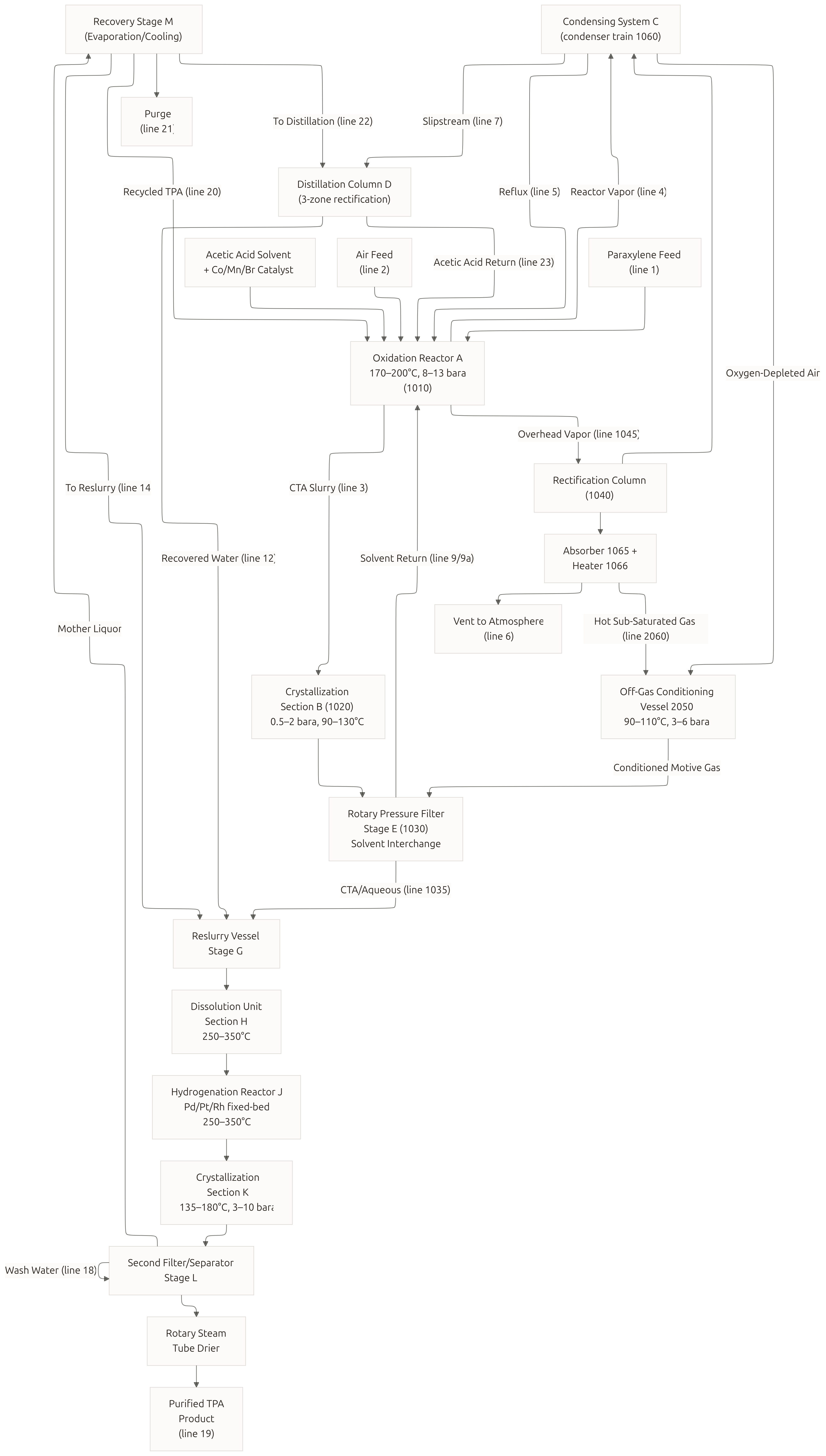
Oxidation — Paraxylene, acetic acid solvent, and dissolved Co/Mn/Br catalyst are fed via line 1 into stirred oxidation Reactor A, with air introduced via line 2, at 150–250°C (typically 170–200°C) and 5–30 bara (typically 8–13 bara), oxygen concentration 0–8 vol% in reactor off-gas.
-
Reactor heat removal / vapor recovery — Exothermic reaction heat is removed by evaporating acetic acid/water via line 4 to condensing system C; most condensate returns to Reactor A via line 5, non-condensables vent via line 6, and a slipstream (line 7) proceeds to distillation column D.
-
Off-gas conditioning (EP4021881B1's key innovation) — Reactor overhead vapor (line 1045, ~160–165°C, 7–11 bara) passes through rectification column 1040 and condenser train 1060. A portion of the resulting saturated oxygen-depleted air is diverted at point A1 (after condensers) through flow control valve 2020 and pressure control valve 2030 into off-gas conditioning vessel 2050 (a vapor-liquid separator with demister). This is blended with a small hot sub-saturated gas stream (line 2060, temperature-controlled by valve 2040, taken after absorber 1065/heater 1066) to raise the gas 5–10°C above its dew point, yielding conditioned motive gas at 90–110°C, 3–6 bara, dew point 70–150°C — used specifically to avoid hydrogen bromide fog/corrosion risk.
-
Crystallization — Reactor product (line 3) passes to crystallization section B/vessels 1020, a staged train progressively reducing pressure/temperature to 0.5–2 bara, 90–130°C, producing a CTA-in-acetic acid slurry.
-
First filtration / solvent interchange — The CTA slurry is fed to one or more rotary pressure filters (Stage E / unit 1030), where the conditioned off-gas (from step 3) drives counter-current washing, exchanging acetic acid mother liquor for an aqueous medium — eliminating the need for CTA drying/reslurry. Exchanged solvent returns to Reactor A via line 9/9a/1036; the CTA/aqueous stream exits via line 1035 to the purification section.
-
Dissolution — The aqueous CTA stream is reslurried (Stage G, using recycle water via lines 12/12a, 13, 14, 15) and heated in Section H to 250–350°C to form a CTA aqueous solution (typically 20–50 wt% TPA).
-
Hydrogenation (CTA purification reactor) — The solution is contacted with hydrogen over a fixed-bed supported noble-metal catalyst (platinum, rhodium, or preferably palladium on carbon) at 250–350°C in Reactor J, reducing 4-carboxybenzaldehyde (4-CBA) and other impurities.
-
Second crystallization — The hydrogenated solution is cooled in Section K (staged crystallizers) to 100–220°C (typically 135–180°C) and 3–10 bara, precipitating purified terephthalic acid (PTA) crystals.
-
Second filtration / product recovery — PTA crystals are separated from mother liquor at Stage L using an integrated filter (belt filter, centrifuge, or rotary pressure filter per EP4021881B1), washed with water from column D (line 12b), recovery Stage M (line 17), and/or fresh water (line 18), then recovered via line 19.
-
Drying — Per EP4021881B1's claimed improvement, the washed wet PTA cake is dried in a rotary steam tube drier to produce final dry PTA product (an update from earlier belt-filter/centrifuge-only designs in US5698734A).
-
Mother liquor / catalyst recovery loop — Aqueous mother liquor from Stage L passes to recovery Stage M (evaporation/cooling) to recover a less-pure TPA precipitate, recycled to Reactor A via line 20; remaining liquor is split between distillation column D (line 22), reslurry Stage G (line 14), and purge (line 21).
-
Acetic acid rectification — Distillation column D (three zones: ~5 theoretical stages upper, ~45 middle, ~5 lower) fractionally separates acetic acid/water from reactor vapor and process mother liquors; acetic acid/heavies return to Reactor A via line 23; recovered water re-enters the process via line 12.
Equipment List
| # |
Equipment |
Patent Source |
Function |
| 1 |
Oxidation Reactor (Reactor A / 1010) |
US5698734A, EP4021881B1 |
Paraxylene + air + acetic acid + Co/Mn/Br catalyst → CTA slurry |
| 2 |
Condensing System (C / condenser train 1060) |
US5698734A, EP4021881B1 |
Condenses reactor off-gas vapor for reflux/recycle |
| 3 |
Rectification Column (1040) |
EP4021881B1 |
Concentrates acetic acid from reactor vapor |
| 4 |
Off-Gas Conditioning Vessel (2050) + valves (2020, 2030, 2040) |
EP4021881B1 |
Vapor-liquid separator conditioning off-gas as filtration motive gas |
| 5 |
Absorber (1065) + Off-gas Heater (1066) |
EP4021881B1 |
VOC/CO removal from off-gas prior to atmospheric discharge |
| 6 |
Crystallization Vessels (Section B / 1020) |
US5698734A, EP4021881B1 |
Staged flash cooling by pressure letdown |
| 7 |
Rotary Pressure Filter(s) (Stage E / 1030) |
US5698734A, EP4021881B1 |
First filtration/solvent interchange (acetic acid → aqueous medium) |
| 8 |
Reslurry Vessel (Stage G) |
US5698734A |
Reslurries CTA in aqueous medium |
| 9 |
Heater/Dissolution Unit (Section H) |
US5698734A |
Heats CTA slurry to 250–350°C to dissolve |
| 10 |
CTA Purification (Hydrogenation) Reactor (Reactor J) |
US5698734A, EP4021881B1 |
Fixed-bed Pd/Pt/Rh catalytic hydrogenation of impurities |
| 11 |
Second Crystallization Section (Section K) |
US5698734A, EP4021881B1 |
Staged cooling to crystallize purified PTA |
| 12 |
Second Filter/Separator (Stage L) |
US5698734A |
Separates and washes PTA crystals |
| 13 |
Rotary Steam Tube Drier |
EP4021881B1 |
Final PTA cake drying |
| 14 |
Evaporation/Recovery Stage (Stage M) |
US5698734A |
Recovers less-pure TPA precipitate for recycle |
| 15 |
Distillation Column D |
US5698734A |
Fractionates acetic acid/water from process liquors |
| 16 |
Belt Filter Unit (Pannevis-type) |
US5698734A |
Alternative integrated separation/wash device (Stages E, L) |
| 17 |
Centrifuge (Figs 3–4 designs) |
US5698734A |
Alternative integrated separation/wash device |
| 18 |
Impingement Separator/Mesh Demister |
EP4021881B1 |
Gas-liquid separation in off-gas conditioning |
Process Performance
IPT states its P8 platform delivers a variable cost improvement of greater than US$20 per tonne compared to plants licensed just a few years prior, and up to a US$40-per-tonne advantage versus competing technologies. Hengli Petrochemical's fourth PTA line using P8 technology (2.5 million tonnes/year) was confirmed by IPT to have "met all performance guarantees" upon startup in January 2020. Successful demonstration of the latest P8 platform was also confirmed on Jiaxing Petrochemical's second PTA line in 2018.
Economic Performance
IPT emphasizes a "focus on process simplification, value engineering and layout optimization," resulting in a compact design with significantly improved capital productivity relative to earlier technology vintages. The technology is also marketed on sustainability grounds, citing low energy and water usage and reduced waste generation compared to prior-generation designs.
Commercial Experience and Deployments
IPT's P8/P8++ technology has been licensed extensively across China and internationally: Hengli Petrochemical (multiple lines, including a fifth line agreed in 2018 and fourth line confirmed operational in 2020), Fujian Billion Petrochemicals (2.5 Mt/yr, 2018), Jiangsu Honggang Petrochemical (2.4 Mt/yr, 2018), Jiangsu Jiatong Energy (dual PTA lines, 2020), SASA Polyester Sanayi in Turkey (1.5 Mt/yr, the largest single-stream design capacity licensed by INVISTA to date, 2020), Sinopec Yizheng (3 Mt/yr third line, 2021), and Pan-Asia PET Resin in Saudi Arabia — IPT's first Middle East license (1.25 Mt/yr, 2019).
References
- bp — bp licenses its latest generation PTA technology to Dongying Weilian Chemical (May 27, 2020)
- Yarns & Fibers — Invista introduces its latest new PTA technology P8 for polyester market (Apr 28, 2015)
- Koch Tech Solutions/INVISTA IPT — SINOPEC Yizheng selects INVISTA P8++ PTA Technology press release
- S&P Global — KTS (INVISTA) P8++ Technology for Purified Terephthalic Acid (2025)
- chemwinfo/INVISTA IPT — Jiangsu Honggang Petrochemical PTA license press release (Nov 17, 2018)
- Chemical Online/INVISTA IPT — Hengli Petrochemical PTA Line Performance press release
- Apparelviews/INVISTA IPT — Hengli using P8 technology from INVISTA for fifth PTA line (Sep 28, 2018)
- PCIAW/INVISTA IPT — Fujian Billion Petrochemicals P8 licensing announcement (2018)
- BusinessWire/INVISTA IPT — Jiatong Energy Dual PTA Lines press release (Sep 6, 2020)
- Indian Chemical News/INVISTA IPT — SASA to license Invista polyester technology, Turkey (Sep 5, 2020)
- ChemEngOnline/INVISTA IPT — INVISTA signs first Middle East PTA license, Pan-Asia PET Resin (Mar 13, 2019)
- INVISTA — Successful demonstration of INVISTA's latest P8 PTA technology in China (May 24, 2018)
- Google Patents — US5698734A
- Google Patents — EP4021881B1