INEOS's PTA technology — originally developed by Amoco Corporation before its 1999 merger with BP, and now owned by INEOS following the 2020 divestiture of BP's Aromatics business — represents the foundational technology platform underlying the majority of the world's commercial PTA production capacity. This profile draws on technology-owner sources (BP, Amoco, INEOS) and publicly available patent documentation.
Process History
The INEOS PTA process traces its origins to 1955, when Scientific Design/Mid-Century Corporation discovered a homogeneous oxidation catalyst system combining cobalt(II) and manganese(II) salts with a bromide source — a chemistry that became known as "MC oxidation". Amoco's predecessor, Standard Oil Company, acquired the Mid-Century technology in 1956, marking the formal start of Amoco's PTA business. Standard Oil researchers developed the critical purification technology (catalytic hydrogenation to remove 4-CBA) by 1963, and the first Amoco PTA process was commercialized by 1965.
Leadership in the technology intensified in the early 1960s when key purification patents were filed, and Amoco went on to build and license PTA plants globally for decades. Major milestones include the first paraxylene plant in Texas City (1967), a plant in Geel, Belgium (1969), the Cooper River, USA facility — the world's largest PTA plant at the time (1978) — expansion into Asia beginning with Taiwan's CAPCO (1979), the Kuantan, Malaysia plant (startup 1996), Zhuhai #1 in China (2003), Zhuhai #2 (2008), and Zhuhai #3 (2015). Following the 1999 Amoco-BP merger, the technology continued under the BP brand until INEOS acquired BP's global Aromatics business, including this technology, in 2020.
Process Summary and Chemistry
The BP/Amoco process is a two-step technology: (i) homogeneous catalytic liquid-phase oxidation of para-xylene to crude terephthalic acid (CTA), followed by (ii) heterogeneous catalytic hydrogenation purification of CTA to PTA. The core oxidation reaction, as presented in BP's own technical materials, converts para-xylene with oxygen to terephthalic acid, releasing water and heat:
Para-xylene + 3 O2 → Terephthalic acid + 2 H2O + Heat
The oxidation employs a cobalt/manganese/bromide (Co/Mn/Br) homogeneous catalyst system dissolved in acetic acid solvent. Because complete oxidation of both methyl groups on para-xylene rarely reaches 100% completion, the crude oxidation product invariably contains partially oxidized intermediates — principally 4-carboxybenzaldehyde (4-CBA) and para-toluic acid — that must subsequently be removed via a dedicated purification/hydrogenation step.
Step-by-Step Technology Description
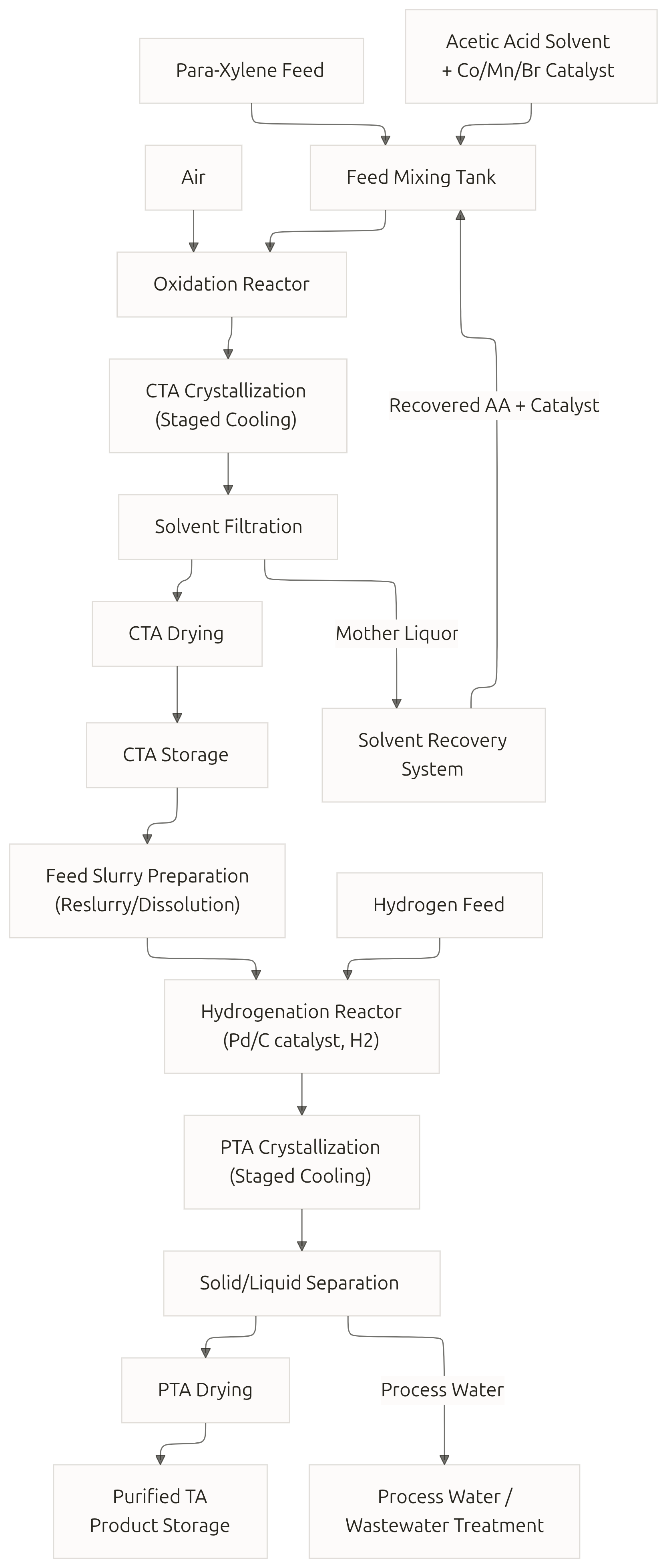
1. Feed mixing — Para-xylene, acetic acid solvent, and Co/Mn/Br catalyst are combined in a feed mixing tank prior to oxidation.
2. Oxidation reaction — The mixed feed and air are charged to the oxidation reactor, where para-xylene undergoes exothermic catalytic oxidation to terephthalic acid, releasing water and heat.
3. Crystallization (CTA stage) — The oxidation reactor effluent is depressurized and cooled through a staged crystallization train, precipitating a crude terephthalic acid (CTA) slurry while unreacted xylene and water flash off.
4. Solvent filtration and product drying (CTA stage) — The CTA slurry undergoes solvent filtration to separate solids from the acetic acid mother liquor, followed by drying to yield crude terephthalic acid product routed to intermediate storage.
5. Solvent recovery — Acetic acid and catalyst recovered from the filtration step are returned to the oxidation reactor via a solvent recovery system, closing the solvent loop.
6. CTA dissolution / feed slurry preparation — Stored CTA is redissolved/reslurried in an aqueous medium to prepare the feed for the purification section.
7. Hydrogenation reaction — The aqueous CTA solution is contacted with hydrogen over a fixed-bed catalyst (typically palladium on carbon), selectively reducing 4-CBA to the more soluble para-toluic acid.
8. Crystallization (PTA stage) — The hydrogenated solution is cooled through staged crystallization, precipitating purified terephthalic acid (PTA) crystals while impurities such as para-toluic acid remain dissolved in the mother liquor.
9. Solid/liquid separation — PTA crystals are separated from the process water/mother liquor stream, with the aqueous filtrate routed to water treatment or recycle.
10. Drying — The separated PTA cake is dried and conveyed to product storage as finished purified terephthalic acid.
Equipment List
| # |
Equipment |
Function |
| 1 |
Feed Mixing Tank |
Combines para-xylene, acetic acid solvent, and catalyst prior to oxidation |
| 2 |
Oxidation Reactor |
Site of exothermic catalytic oxidation of para-xylene to CTA |
| 3 |
CTA Crystallizer(s) (staged) |
Depressurizes/cools reactor effluent to crystallize CTA |
| 4 |
Solvent Filtration Unit |
Separates CTA solids from acetic acid mother liquor |
| 5 |
CTA Dryer |
Dries filtered CTA cake for storage |
| 6 |
Solvent Recovery System |
Recovers and recycles acetic acid and catalyst to the oxidation reactor |
| 7 |
CTA Storage |
Intermediate storage of crude terephthalic acid |
| 8 |
Feed Slurry Preparation Vessel |
Reslurries/dissolves CTA in aqueous medium ahead of hydrogenation |
| 9 |
Hydrogenation Reactor |
Fixed-bed Pd/C catalytic reduction of 4-CBA to para-toluic acid |
| 10 |
PTA Crystallizer(s) (staged) |
Cools hydrogenated solution to crystallize purified PTA |
| 11 |
Solid/Liquid Separator |
Separates PTA crystals from process water/mother liquor |
| 12 |
PTA Dryer |
Final drying of PTA product cake |
| 13 |
PTA Product Storage |
Finished product storage/bagging |
| 14 |
Utility Unit (demineralized water,
cooling water, nitrogen, hot oil furnace/steam boilers) |
Supports plant-wide utility needs |
| 15 |
Wastewater Treatment Unit
(equalization, anaerobic/
aerobic systems, sludge dewatering, incinerator) |
Treats process effluent streams |
Process Performance
INEOS' latest-generation PTA technology, as deployed at facilities such as Zhuhai 3, is reported by BP to deliver substantial environmental performance improvements relative to conventional 1990s-era PTA technology: 65% fewer greenhouse gas emissions, 75% less water discharge, and 95% less solid waste disposal. BP has also stated that this latest-generation technology yields significant reductions in both operational and capital costs compared with conventional PTA technology, based on internal company benchmarking.
Economic Performance
BP/Technip's alliance materials indicate that INOES's PTA technology carries significantly lower capital and operating costs compared with conventional PTA plant designs, a competitive positioning that has supported BP's continued technology licensing success in competitive global bidding processes, such as the 2019–2020 selection by Dongying Weilian Chemical. Specific unit capital cost or operating cost figures were not disclosed in the technology-owner sources reviewed for this profile.
Commercial Experience and Deployments
INEOS (through Amoco, then BP, now INEOS) is one of the largest PTA producers and licensors globally. Historically, BP reported total PTA licensing/ownership capacity that made it the leader in the global PTA industry, with 76% of all capacity ever built using this technology still operating today. Key deployments and licensing agreements include:
-
Cooper River, USA (1978) — world's largest PTA facility at the time
-
Geel, Belgium (1969, expanded/upgraded 2015)
-
CAPCO, Taiwan (1979)
-
PT Amoco Mitsui PTA Indonesia (1997)
-
Kuantan, Malaysia (startup 1996; 500,000 MT/year, debottlenecked to 600,000 MT/year in 1997)
-
Zhuhai #1, #2, #3, China (2003, 2008, 2015) — Zhuhai 3 alone produces 1.25 million t/y
-
Dushan Energy, Pinghu, Zhejiang, China (started up October 2019)
-
Dongying Weilian Chemical, China (licensed 2020, production targeted Q2 2022)
-
JBF Industries, India (1.25 million t/y)
-
Oman International Petrochemical Industries (1.1 million t/y)
-
Merak, Indonesia (upgraded 2021)
As of the 2004 BP Chemicals company data, BP's PTA capacity across the Americas, Europe, and Asia totaled 6,800 kilotonnes annually
Note on scope: This profile relies on technology-owner materials (BP, Amoco/BP Chemicals Malaysia, INEOS) and one directly related patent (US8933266B2, a UOP/Boreskov Institute joint-research patent addressing the same Co/Mn/Br oxidation chemistry family, cited here for chemistry/impurity detail rather than as a BP-owned document).
References