Continuous bulk (mass) polymerization of styrene to general-purpose polystyrene (GPPS) and high-impact polystyrene (HIPS)
Polystyrene is today produced almost exclusively by continuous bulk (mass, or modified-bulk solution) free-radical polymerization of styrene: both GPPS and HIPS are produced by continuous-mass radical polymerisation of styrene[7], and over 85% of world PS and impact-PS capacity reportedly operates on the continuous bulk route, with suspension polymerization surviving mainly for expandable polystyrene (EPS)[2][6]. The technology is mature and universally practised, but it is not a single licensed process: several companies (Versalis, TotalEnergies, INEOS, Toyo/Mitsui and, more recently, Chinese contractors) each offer their own continuous-mass process packages, built around the same generic flow scheme — rubber dissolution (for HIPS), prepolymerization, finishing reactors, vacuum devolatilization with monomer recycle, and pelletizing[5][6]. Single-line capacities from roughly 10,000 to 250,000 t/a are offered by licensors[11], with Chinese references citing operating continuous-bulk lines of 20–160 kt/a[2].
1. Process history and ownership
1.1 Early history
Styrene polymerization was scientifically recognized in the 19th century (Blyth and Hofmann, 1845), but industrialization had to wait for Staudinger's macromolecular hypothesis (1920) to provide the conceptual framework[5]. BASF, then part of I.G. Farben, installed the first production plant (~100 t/a) in 1930, and the first injection-moulded polystyrene articles followed in 1933; semi-plant-scale work at Dow Chemical in the US showed commercial promise in 1934[4]. I.G. Farben achieved commercial success at Ludwigshafen around 1931 with a reactor that extruded polystyrene through a heated tube into a cutter, producing pellets — an early continuous process[1]; Chinese industry-history records, citing Sinopec Press and Science Press publications, date the industrialization of continuous bulk polymerization by I.G. Farben to 1933 and the first US industrial kettle-type bulk polymerization to 1938[2]. Dow introduced polystyrene to the US market in 1937[3].
Most mass processes used in the mid-20th century were variations of the Wolff tower process developed in Germany before World War II: styrene was thermally prepolymerized without initiator at 80 °C for about two days to 33–35% conversion, then transferred to a tower ~7.6 m (25 ft) high fitted with heating/cooling jackets and internal coils, held at about 100 °C at the top, 150 °C in the centre and 180 °C at the bottom, the high bottom temperature raising conversion while boiling off residual styrene; the tower base formed the hopper of an extruder[4]. Rubber-modified HIPS emerged in the 1950s, initially using hot-polymerized SBR, later replaced by solution-polymerized polybutadiene dissolved in the styrene feed — the basis of the modern grafting process[4][5].
1.2 Technology owners and licensors
Continuous mass PS polymerization is a multi-licensor technology field. The technology owners/licensors that can be verified from public sources are:
| Owner / licensor |
Offering (verified public evidence) |
| Versalis S.p.A. (Eni) |
Proprietary continuous mass GPPS and HIPS technologies, produced in Versalis-owned plants since the 1970s (75 kt/a GPPS unit in Italy; two HIPS plants in Italy and Belgium); licensed units in Hong Kong (75 kt/a, on-stream since the early 1990s) and Brazil (GPPS 50 kt/a and HIPS 70 kt/a, started up 2000); single-line solutions up to 200 kt/a offered[8][9]. In December 2021 Versalis agreed to license its continuous mass technology for a 70 kt/a styrenic unit to Supreme Petrochem Ltd (India)[10]. |
| TotalEnergies (via Technip Energies / Badger Licensing) |
Technip Energies is the exclusive worldwide licensor of Total's polystyrene technologies (GPPS and HIPS), a continuous mass process using CSTR and/or plug-flow reactors with thermal or chemical initiation, devolatilization and pelletization, in single lines from 10,000 to 250,000 t/a; Total is described as the second largest polystyrene producer worldwide with seven operating sites and nearly 1.5 million t/a capacity[11]. |
| INEOS (INEOS/Lummus Technology) |
INEOS Technologies' polystyrene and EPS technologies are used across Europe, Russia, China and the Middle East; E.Styrenics (Egypt, 200 kt/a on two 100 kt/a lines) states it uses the INEOS/Lummus technology for HIPS and GPPS[12]. INEOS's continuous-bulk HIPS process family is also documented by its Chinese patent CN101516936B[22]. (Note: current-day INEOS Styrolution is not verified as a direct open-market licensor; license evidence credits "INEOS Technologies/Lummus".) |
| Toyo Engineering Corp. / Mitsui Chemicals |
Continuous bulk GPPS (single specially designed reactor with proprietary heat-transfer system) and HIPS (rubber dissolution, prepolymerizer establishing rubber morphology, series of specially designed reactors) process descriptions published[25][26]. |
| Chinese domestic technology owners |
Guangdong Huanqiu Guangye Engineering (under China Huanqiu/CNPC) self-developed a second-generation PS proprietary technology applied in PetroChina Guangxi Petrochemical's 300 kt/a unit (1 GPPS + 2 HIPS switchable lines of 100 kt/a each, construction start October 2023, designer/EPC Huanqiu Guangye)[13]. Changzhou Ruihua Chemical Engineering Technology delivered a 200 kt/a GPPS complete process package to Heze Yuhuang Chemical (startup mid-October 2021) and a 100 kt/a PS package to Shengteng Technology (2021), and holds granted patent CN113980191B on continuous rubber-modified (HIPS) polystyrene preparation[14][15]. Japanese continuous rubber-modified styrene resin technology (Mitsui Toatsu) was already protected in China in the 1990s (CN1102835A)[24]. A recent domestic continuous HIPS design patent is CN114395067B (2023)[23]. |
| Producer-owned technologies (not offered/licensed on the open market — not verified) |
Chimei group PS plants (Zhenjiang 550 kt/a permitted PS capacity; Zhangzhou line started March 2023, bringing group PS capacity to ~920 kt/a) run on the group's own technology[30][31]. Dow, BASF and other major historical producers developed their own processes[4][5]; no public licensing offers for GPPS/HIPS from Dow, SABIC, LG Chem or Formosa were found. |
2. Process summary, chemistry and catalysis
2.1 Chemistry
The polymerization is a conventional free-radical chain reaction on the styrene monomer (homopolymer for GPPS; graft copolymerization onto dissolved polybutadiene for HIPS). Initiation is either thermal or chemical. Thermal initiation proceeds without any initiator: two styrene molecules undergo a Diels–Alder-type dimerization, and the resulting adduct (an auxiliary radical source and, importantly, a chain-transfer agent) generates the radicals that start polymerization[29][5]. Chemical initiation uses free-radical initiators — typically peroxides (e.g. benzoyl peroxide, tert-butyl perbenzoate, tert-butyl peroctoate, tert-butyl peroxy-2-ethylhexanoate) or azo compounds (AIBN) — selected so that their 1-hour half-life falls slightly below the reaction temperature; peroxides are used at about 0.05–0.5 wt% on monomer[5][17][22]. Bifunctional (two-peroxide-group) initiators, widely adopted commercially from the 1980s (Dow converted its plants in the late 1970s), boost the achievable rate at a given molecular weight, and combinations with multifunctional
There is no catalyst in the conventional sense. Molecular weight and conversion-rate control rely on:
- reaction temperature (the rate roughly doubles per 10 °C; molecular weight falls as temperature rises)[5];
- initiator type and concentration[5][19];
- chain-transfer agents — C4–C18 mercaptans, notably n-dodecyl mercaptan (TDM) — at 0.01–0.3 wt% on monomer, or about 100–300 ppm in combination with crosslinkers such as divinylbenzene in patented schemes[17][19];
- polymerization regulators such as α-methylstyrene dimer and diluents (ethylbenzene, toluene, cumene), which also serve as heat sinks[6][17][22].
The reaction is strongly exothermic: the heat of polymerization is about 71 kJ/mol (~700 J/g), corresponding to an adiabatic temperature rise of roughly 350 °C for pure styrene[29][5]. Since polystyrene degrades rapidly above ~250 °C and molecular weight decreases rapidly with temperature, a fully adiabatic process is impractical without at least ~50% diluent; commercial reactors therefore remove heat via jackets/coils, boiling (autorefrigerated) operation, or cold-feed dilution[5]. The termination reaction is diffusion-controlled and the polymerization auto-accelerates with conversion (gel effect), which intensifies runaway hazard[29][5].
2.2 HIPS rubber chemistry
In HIPS, 3–12 wt% of polybutadiene rubber (styrene content of the HIPS feed about 88–97%[6]; BASF patents prefer 4–15% elastomer on monomer[17]) is dissolved in the styrene. The rubber and polystyrene are incompatible, so as polymerization proceeds two phases form; graft copolymer (PS–g–PB) generated from the earliest moments of phase separation compatibilizes the phases and controls rubber-particle morphology[28]. At the phase-inversion point the polystyrene-rich phase becomes continuous and the rubber particles (with occluded polystyrene, "salami" morphology) become fixed; particle sizes of 0.5–5 µm, optimally 1–2 µm, toughen the matrix[5]. Reactor agitation and residence time around phase inversion are critical to particle sizing[5][28].
3. Step-by-step technology description
The generic continuous bulk process (EPA AP-42 reference flow[6], elaborated with patent-verified conditions) comprises the following steps:
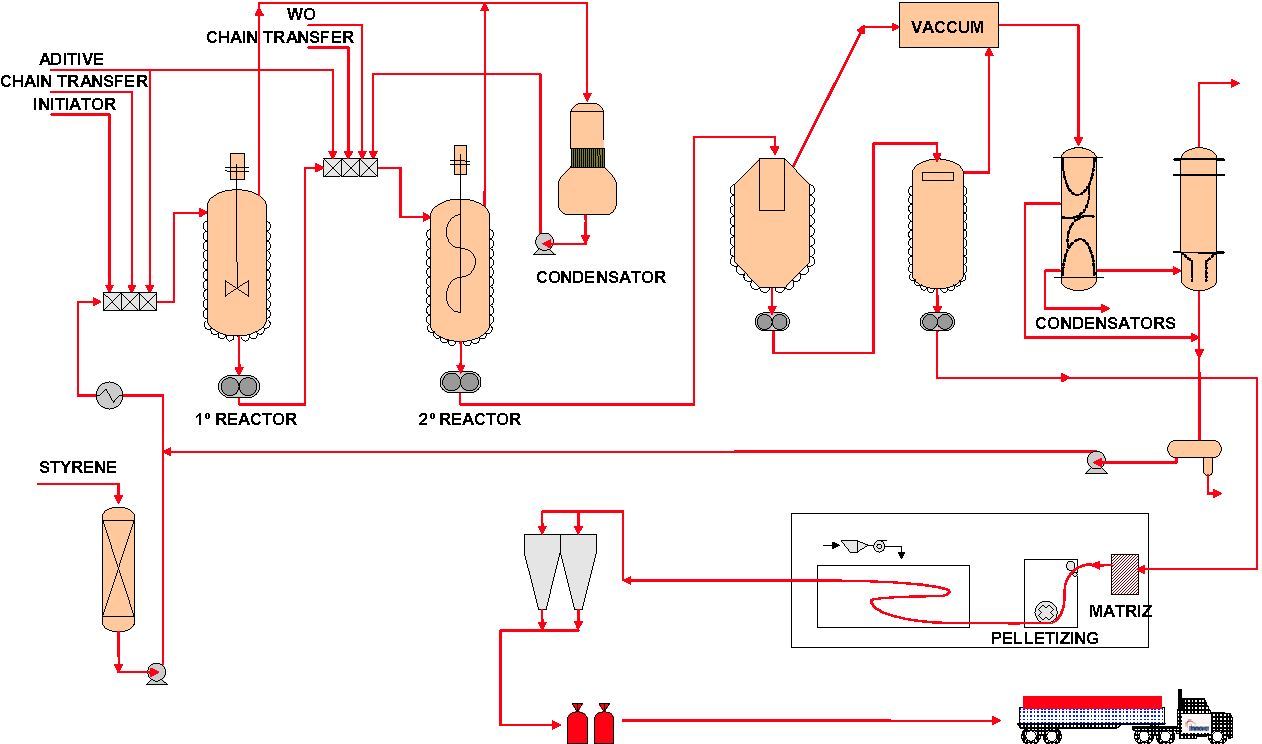
Figure 1 —Process Flow Diagram of an industrial continuous-mass PS plant with two auto-refrigerated reactors[40]
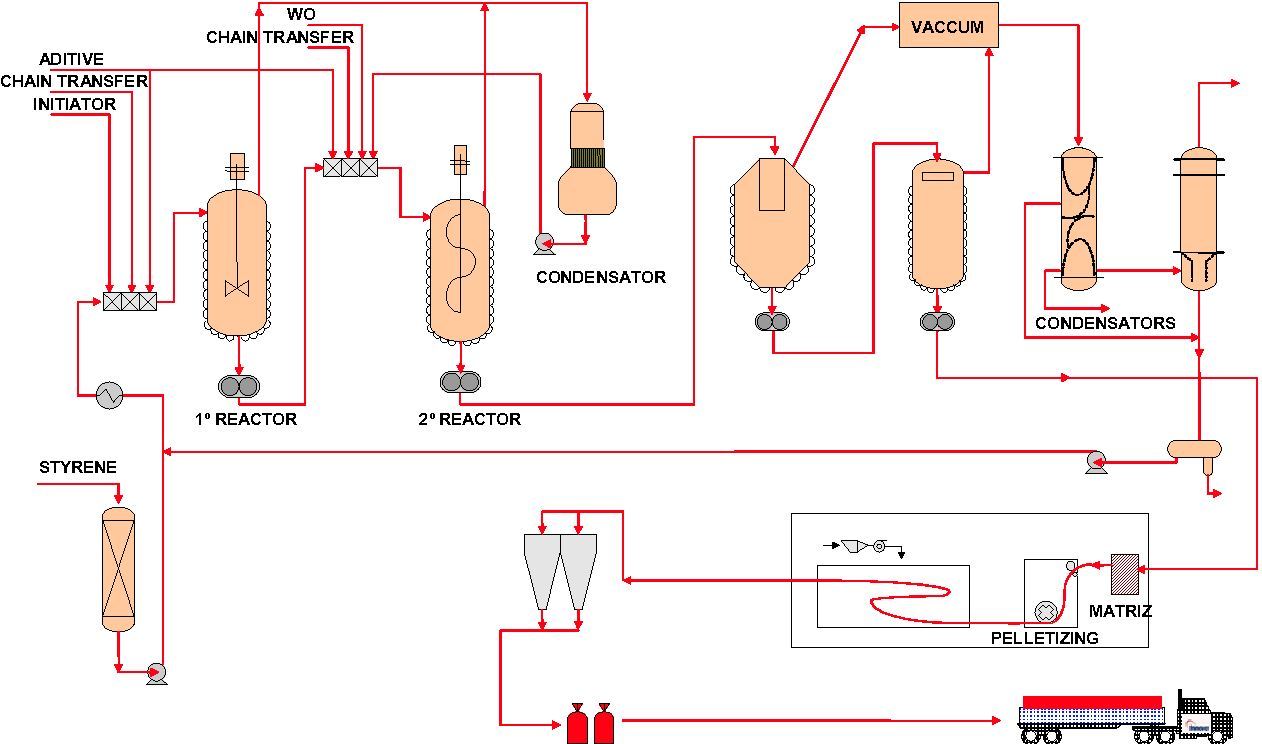
Equipment list (as depicted, in flow order):
1. STYRENE — monomer feed vessel (vertical, lower left)
2. Inline heat exchanger on the styrene feed (unlabeled — per article text: controls first-reactor feed temperature)
3. Feed static mixer — receives ADITIVE, CHAIN TRANSFER, INITIATOR
4. 1° REACTOR — stirred, jacketed (auto-refrigerated) + bottom transfer pump
5. Second static mixer — receives WO (likely whitewater/withdrawn overheads — not defined in the article) + second CHAIN TRANSFER feed
6. 2° REACTOR — stirred, jacketed (auto-refrigerated) + bottom transfer pump
7. CONDENSATOR — reactor-overhead condenser; condensate returns to the feed line upstream of the feed exchanger
8. Devolatilizer vessel 1 — jacketed, overhead to vacuum + bottom pump (unlabeled)
9. Devolatilizer vessel 2 — jacketed, overhead to vacuum + bottom pump (unlabeled)
10. VACUUM system + CONDENSATORS group (2 vessels) + small receiver pot with pump — monomer/volatiles recovery, no distillation column shown
11. PELLETIZING section with MATRIZ (die) and one inline unit (likely a melt pump/booster)
12. Two cone-bottom hoppers (pellet collection/silos, unlabeled) → truck (product dispatch)
Step 1 — Feed preparation and rubber dissolution (HIPS)
Styrene monomer, polybutadiene (for impact grades), mineral oil (lubricant/plasticizer), small amounts of recycled polystyrene, antioxidants and other additives are charged from storage into the feed dissolver/mixer in proportions set by the product grade[6]. Ground rubber bales dissolve in agitated styrene tanks over roughly 12 hours (AP-42 batch description: 4–8 h agitation); two dissolver tanks often operate in parallel, one feeding the reactor while the other dissolves the next rubber charge[5][6]. Chain-transfer agent and solvent (ethylbenzene, typically 2–25 wt% on monomer in patented schemes) are dosed here[17][22].
Step 2 — Prepolymerization
Blended feed is pumped continuously to the reactor system; the initial reactor (prepolymerizer) converts the feed to modest conversion[6]. Verified windows: INEOS CN101516936B specifies the pre-conversion CSTR at 80–120 °C (preferably 80–110 °C), with styrene:rubber feed ratios of 85:15–98:2; BASF US4567232 prescribes a first stirred-kettle zone with residence time ≤35 min (preferably 5–25 min) at 80–180 °C[17][22]. For HIPS the first reactor operates with rubber as the continuous phase to graft the rubber before phase inversion; a second reactor operating just above the inversion point sizes the particles[5]. Shear rates of 20–50 s?¹ in the phase-inversion reactor and conversion typically 15–40% are specified by INEOS[22]. Blend and feed options are further documented by Shell's 1972 HIPS patent, which describes taking the styrene (optionally with minor acrylonitrile/alkyl acrylate) to 30–55% conversion at 90–120 °C, separately polymerizing the rubber solution at 5–17 wt%/h to 13–30% conversion and admixing the streams before final polymerization[20], and by a 1993 scheme in which a mixture of progressively decomposing peroxides is used to reach 20–40% conversion in a prepolymerization vessel at 93–132 °C with final polymerization completed in an extruder[21].
Step 3 — Finishing polymerization
Polymerization to successively higher conversion proceeds in subsequent reactors in series — either stirred autoclaves or tower reactors[6]. BASF's preferred arrangement is a two-kettle/two-tower cascade with isothermal kettles and isothermal or rising-temperature towers, optionally extended by tube reactors to 60–90% conversion[17]. The BASF HIPS example runs kettle 1 at 115 °C (7.0% conversion), kettle 2 at 120 °C (19%), then towers at 135 °C (50%) and 146 °C (78.4%), completing to 88% solids[17]. A modern GPPS plant, as described by Meister & Cummings, would use a CSTR at 50–70% solids followed by devolatilization; Total's licensed process offers CSTR and/or plug-flow reactors with thermal or chemical initiation[5][11]. The bulk polymerization pressure is 0.1–10 MPa absolute (preferably 0.1–6 MPa) per FINA EP2014684, and the melt leaving the reactors contains 5–40 parts unreacted monomer plus oligomers per 100 parts polymer[18]. In the Toyo/Mitsui GPPS scheme a single specially designed reactor with proprietary heat-removal achieves essentially complete polymerization at exit; the HIPS scheme uses several reactors in series at carefully controlled constant temperature[25][26].
Step 4 — Devolatilization and monomer recycle
The polymer melt (residual styrene, ethylbenzene impurity, dimers/trimers/oligomers) is pumped to vacuum devolatilization; most monomer and volatiles are removed, condensed and routed to a styrene recovery unit, whose purified overhead returns to the feed dissolver (monomer recycle)[6]. Modern designs use two successive flash/falling-strand stages at 200–280 °C (preferably 220–260 °C): a first stage at 0.1–20 kPa (preferably 0.5–15 kPa) absolute reducing residuals to 1,000–10,000 ppm, and a second stage at 0.1–10 kPa (preferably 0.1–4 kPa) bringing residual styrene below 1,000 ppm, preferably below 500 ppm and in aggressive schemes below 100 ppm; superheated water (180–240 °C) may be injected between stages as stripping agent[18]. Devolatilization temperatures of 210–250 °C are typical, with residence time minimized because polymer/oligomer degradation regenerates styrene (e.g. ~95 ppm/h additional styrene at 230 °C in a melt containing 300 ppm styrene dimer)[5]. Conventional flash devolatilization cannot economically push residuals significantly below ~200 ppm without a stripping agent[5]. Total styrene conversion before devolatilization is typically ≥80%[22]. Devolatilization under lower vacuum pressure is more effective than raising temperature for reducing residual volatiles[27].
Step 5 — Finishing and pelletizing
Molten polystyrene from the devolatilizer (heated to 250–280 °C in AP-42's description) is extruded through a stranding die plate into a cold water bath; the solidified strands are cut into pellets and conveyed to storage[6]. Residence time from devolatilizer to die is minimized to limit monomer regeneration; plasticizer and heat-sensitive additives are often mixed in after devolatilization, just before pelletizing[5]. A world-scale line may produce up to ~10,000 kg/h of polymer[5].
Summary of verified parameter ranges
| Parameter |
Verified value(s) |
Source |
| Rubber (polybutadiene) in HIPS feed |
3–12 wt% (styrene 88–97%); BASF patent: 4–15 wt% preferred of elastomer on monomer, PB Mw 70,000–350,000 |
[6] [17] |
| Solvent (ethylbenzene) in feed |
2–25 wt% on monomer (BASF); INEOS lists ethylbenzene, toluene, xylenes, cumene as diluents |
[17] [22] |
| Rubber dissolution time |
~12 h in agitated dissolver tanks (continuous); 4–8 h (AP-42 batch description) |
[5] [6] |
| Prepolymerization temperature |
80–120 °C (INEOS, pref. 80–110 °C); BASF kettle 1 at 115 °C in example |
[17] [22] |
| First-zone residence time |
≤35 min, pref. 5–25 min (BASF); example 7–12 min; phase-inversion shear 20–50 s?¹ (INEOS) |
[17] [22] |
| Reactor train temperatures |
BASF example: 115 → 120 → 135 → 146 °C; overall window 80–180 °C; Fina profile starts ~110 °C with rising steps |
[17] [19] |
| Reactor pressure |
0.1–10 MPa abs (pref. 0.1–6 MPa) |
[18] |
| Conversion per stage |
BASF: 7% → 19% → 50% → 78.4% (→ 88% solids); first two zones pref. 6–30%; tube reactors to 60–90%; total ≥80% before devolatilization (INEOS) |
[17] [22] |
| Initiator |
Peroxides 0.05–0.5 wt% (benzoyl peroxide, tert-butyl perbenzoate, tert-butyl peroctoate, TBPE); bifunctional initiators commercially since ~1980; multifunctional combinations in patents |
[5] [17] [19] [22] |
| Chain-transfer agent |
Mercaptans 0.01–0.3 wt%; n-dodecyl mercaptan ~100–300 ppm in patented schemes; α-methylstyrene dimer as regulator |
[17] [19] [22] [6] |
| Devolatilization |
Two stages, 200–280 °C (pref. 220–260 °C); stage 1: 0.5–15 kPa abs → 1,000–10,000 ppm; stage 2: 0.1–4 kPa abs → <500 or <100 ppm; optional superheated-water (180–240 °C) stripping |
[18] |
| Extrusion melt temperature |
250–280 °C (AP-42) |
[6] |
| Residual styrene in product |
Typically <500 ppm at <10 mmHg abs and >230 °C final-stage conditions; <100 ppm achievable; conventional flash floor ~200 ppm without stripping agent |
[5] [18] |
4. Technology performance
4.1 Yield and raw-material consumption
Overall styrene conversion before devolatilization is typically ≥80%[22], with all unreacted monomer and solvent recovered, purified and recycled to the feed[6]. Versalis quotes a raw-material consumption of 1,005–1,008 kg styrene per tonne of GPPS for its licensed continuous mass process[8]. No comparable public per-tonne consumption or energy-consumption figure (kg oil equivalent/t) from a citable source was identified for the industry at large — see caution below.
4.2 Product quality and selectivity
The process delivers crystal-clear GPPS (mass polymerization gives high clarity and very good electrical insulation characteristics, at the cost of a broad molecular-weight distribution driven by the exotherm management)[4]. Molecular-weight distribution (Mw/Mn ≈ 1.9 for thermally initiated PS) is tuned by reactor staging and temperature sequencing[5]. For HIPS, rubber-particle morphology (0.5–5 µm, occlusions) is the key performance variable and is set by the prepolymerization section — BASF's patent data show that extending first-kettle residence from ~12 to 50 min degrades notched impact strength from 12.1 to 6.2 kJ/m²[5][17]. Food-contact GPPS/HIPS resin in China is governed by GB 4806.7-2023 with the volatiles test method GB 31604.4-2016[35][36]; a draft revision of the old GB 9692-88 resin standard (uploaded OCR copy of the consultation draft, not promulgated) indicated residual styrene ≤0.15% and ethylbenzene ≤0.05% — draft-stage values only[39].
4.3 Environmental performance
Continuous-bulk plants are essentially closed-loop: condensers recover unreacted styrene for reuse. EPA AP-42 documents total uncontrolled VOC emission factors of about 3.34 g VOC/kg product for plants using steam-jet vacuum systems versus about 0.21 g VOC/kg for plants using mechanical vacuum pumps — the devolatilizer condenser vent dominating (2.96 g/kg vs 0.05 g/kg); plant designs minimizing emissions have reported as little as 0.0012 g VOC/kg product for the extruder quench vent[6]. In China, synthetic-resin plants operate under GB 31572-2015 (with its No.1 modification effective 2024-07-01) and styrene-sector plants under GB 31571-2015 (VOC and benzene-series limits)[37][38].
4.4 Safety
The dominant hazard is thermal runaway of the exothermic polymerization: heat of polymerization ~71 kJ/mol, gel-effect auto-acceleration, and a reaction rate that doubles per 10 °C make heat-removal margin the central design issue; calorimetric studies (DSC, adiabatic ARP/VSP2) quantify runaway onset as a function of monomer mass fraction, and polymerization thermal runaways form a recurring share of US runaway incidents (1980–2001)[29][5]. A practical stability rule of thumb is that the reactor stays inherently stable while the temperature difference between polymer and heat-transfer fluid remains below ~10 °C[5]. In continuous bulk reactors, dead zones must be eliminated because wall layers of polymer build up and grow (a 1-inch pilot pipeline scaled directly to commercial size plugged within a day in the early 1960s)[5]. Styrene monomer storage is a separate runaway risk: the 2020 LG Polymers Visakhapatnam tank accident (13 deaths) during restart after a COVID shutdown is the canonical case of styrene self-polymerization in storage, widely referenced in Chinese emergency-management literature[33]; styrene-tank polymer build-up and countermeasures are also documented in the Chinese plant literature[34].
5. Selected industrial applications
- Versalis-owned continuous mass units in Italy (80 kt/a GPPS on-stream since 2011; 80 kt/a and 45 kt/a HIPS since 1981/1992) and Belgium (75 kt/a since 1979/1989); licensed units in Hong Kong and Brazil (2000)[8][9].
- E.Styrenics, Egypt: 200 kt/a PS (two 100 kt/a lines, one GPPS/HIPS swing) on INEOS/Lummus technology[12].
- PetroChina Guangxi Petrochemical: 300 kt/a PS (1 GPPS + 2 HIPS switchable 100 kt/a lines, 60–110% flexibility), domestic second-generation technology by Guangdong Huanqiu Guangye; construction start October 2023[13].
- Heze Yuhuang Chemical (China): 200 kt/a GPPS package by Changzhou Ruihua, successful startup October 2021 (production later halted in 2022 after an incident and a weak PS market)[15].
- Zhenjiang Chimei (Jiangsu): 550 kt/a permitted PS capacity within a ~2.2 Mt/a styrenics site; Chimei's Zhangzhou PS line started March 2023 (group PS ~920 kt/a)[30][31].
- PetroChina Dushanzi: PS unit with HIPS line pushed to 95% load in 2020 (highest since 2011), operating without licensor support[32].
References
List of references temporarily available here.