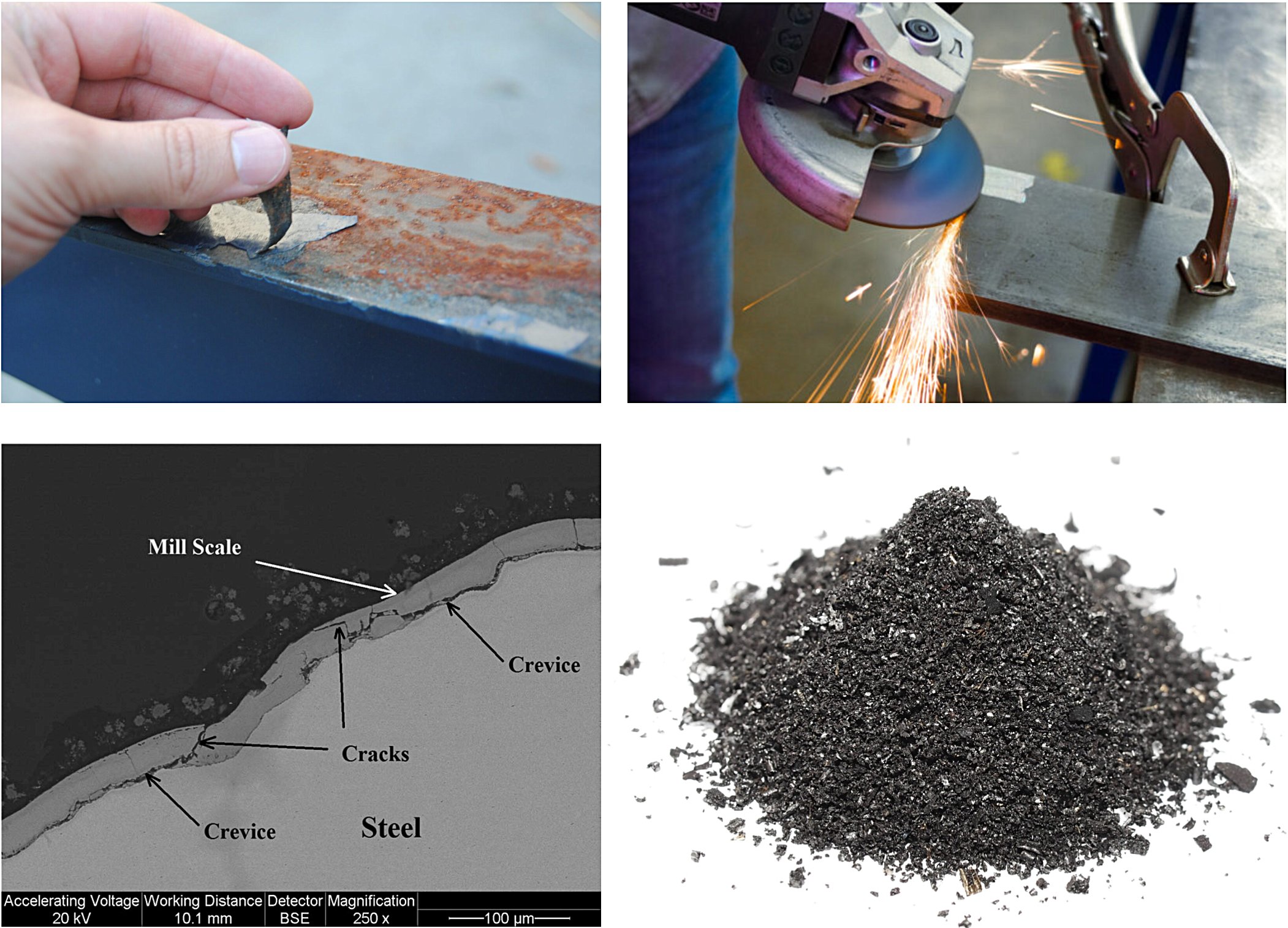

Mill scale is a hard, brittle, bluish-black iron oxide by-product that forms on the outer surface of steel during hot rolling, when steel billets, slabs, or blooms are processed at temperatures above 1,000°C. It is one of the most significant secondary iron-bearing materials in the global steel industry, generated in volumes of 1–2% of the weight of steel rolled and traded internationally as a high-value raw material input for iron and steelmaking.
Identity & Classification
| Property |
Value |
| Common Name |
Mill scale |
| Theoretical Fe Content |
68–72% Fe |
| Bulk Density |
~5.7 t/m³ |
| Specific Gravity |
5.0–5.2 |
| Melting Point |
~1,370 °C |
| Color |
Bluish-black |
| Texture |
Hard, flaky, brittle |
| Solubility |
Insoluble in water; soluble in strong acids |
| Magnetic Property |
Weakly magnetic
(Fe₃O₄ dominant at ambient temperature) |
Mill scale is classified under customs and trade regulations as a steel manufacturing residue (HS 2619), but under EU REACH and waste framework regulations it qualifies as a by-product rather than waste when it meets defined utilisation criteria — meaning it is sold rather than disposed of.
Composition
Mill scale is not a single chemical compound but a three-layer mixed iron oxide structure whose composition varies with processing temperature and cooling rate:
| Layer |
Position |
Phase |
Formula |
Typical Share |
| Inner |
Adjacent to steel |
Wüstite |
FeO |
~50–70% at formation temperature |
| Middle |
Intermediate |
Magnetite |
Fe₃O₄ |
~30–40% |
| Outer |
Surface |
Hematite |
Fe₂O₃ |
~1–5% |
At ambient temperature, the FeO layer partially disproportionates during cooling (4 FeO → Fe + Fe₃O₄), making magnetite the dominant phase in collected mill scale. The bulk composition of ambient-temperature mill scale is approximately:
- Fe₃O₄ (magnetite) — 50–70%
- FeO (wüstite) — 20–30%
- Fe₂O₃ (hematite) — 5–10%
- Metallic Fe (traces) — 1–5%
- Minor impurities — silica (SiO₂), manganese oxides, rolling oil residues
Formation
Mill scale forms through the high-temperature oxidation of the steel surface as it passes through the rolling mill stands. The process is continuous:
- Steel slab exits the reheating furnace at ~1,200–1,300°C with an initial scale layer
- High-pressure water descalers blast off primary scale before rolling
- New scale forms almost instantaneously on the freshly exposed steel surface
- Secondary and tertiary scale accumulates through subsequent rolling passes
- Scale flakes off under roller pressure and is collected in scale pits and flume systems beneath the mill
Relationship to Iron Oxides
Mill scale is the most industrially produced mixed iron oxide material in the world. Its chemical complexity directly reflects the thermodynamic phase relationships of the Fe-O system — the three-layer structure mirrors the equilibrium sequence FeO (innermost, highest temperature) → Fe₃O₄ (intermediate) → Fe₂O₃ (outermost, lowest temperature, in contact with atmosphere). It is registered under its own CAS number (65996-74-9) as a UVCB substance, distinct from all three constituent iron oxide phases, and cross-references the profiles for FeO, Fe₃O₄, and Fe₂O₃ individually.
Commercial Status & Trade
Mill scale functions as a fully traded secondary raw material with an established global market:
- Actively exported by major steel-producing countries — India, China, Ukraine, Brazil, and Turkey are the leading suppliers
- Imported primarily by Southeast Asian, Middle Eastern, and African consumers for iron ore sintering
- Market price typically tracks at 60–80% of iron ore fines value, reflecting its high Fe content
- Traded in bulk quantities; dedicated mill scale brokers and trading companies operate internationally
- India alone generates an estimated 8–10 million tonnes per year of mill scale
Industrial Applications
Mill scale's high Fe content (~70% Fe) and relatively low cost make it a valuable secondary raw material:
- Sinter plants — blended with iron ore fines as an iron-rich flux in blast furnace burden preparation; the largest single end use
- Pellet plants — incorporated into iron ore pellet feed to boost Fe grade
- Cement manufacturing — added as an iron correction material in clinker production
- Reduced iron powder — converted to Fe₂O₃ by oxidation roasting, then hydrogen-reduced to produce metallic iron powder for powder metallurgy
- Magnetite production — processed into synthetic Fe₃O₄ for water treatment and dense media separation
- Ferroalloy and foundry — used as an iron source in specialty alloy and foundry applications
Surface Treatment Implications
Mill scale presents a critical challenge in steel fabrication. While it initially acts as a barrier against atmospheric corrosion, it is electrochemically cathodic to the underlying steel — any crack or break in the scale causes accelerated localised corrosion of the exposed steel beneath. It must therefore be completely removed by blast cleaning (Sa 2.5 or Sa 3 standard), acid pickling, or mechanical grinding before painting, coating, galvanising, or welding.
References
- Satyendra, Ispat Guru (May 25, 2017). Mill Scale
- Michaelis D., Waste Optima (Sep 12, 2025). Mill Scale Recycling: From Steel Waste to Valuable Resource
- Anglo Pacific (Nov 25, 2024). Mill Scale
- Wikipedia. Mill scale (Page version: Nov 5, 2025)
- MillScale.org (Mar 20, 2012). Mill Scale
- Corrosion Alliance (Sep 4, 2021). What is a mill scale and do i have to remove it before coating