Process history
LO-CAT is a patented liquid redox system using a chelated-iron solution to convert hydrogen sulfide (H2S) into elemental sulfur, developed by Merichem® Company and presently owned by Merichem Licencing LLC.[1][13][16] The patent record traces related sulfur-separation IP back at least to the mid-1990s: US5651896A ("Sulfur separation system with interface control") was filed in 1995 and published in 1997.[9] Later Merichem-related patents extended the platform, including US20130123561A1 ("High pressure reduction-oxidation desulfurization process") and US8367009B2 ("Three phase sulfur separation system with interface control") in 2013, and Merichem's 2014 announcement of US 8,597,375 on three-phase sulfur separation.[10][11][4]
Process summary, chemistry and catalysis
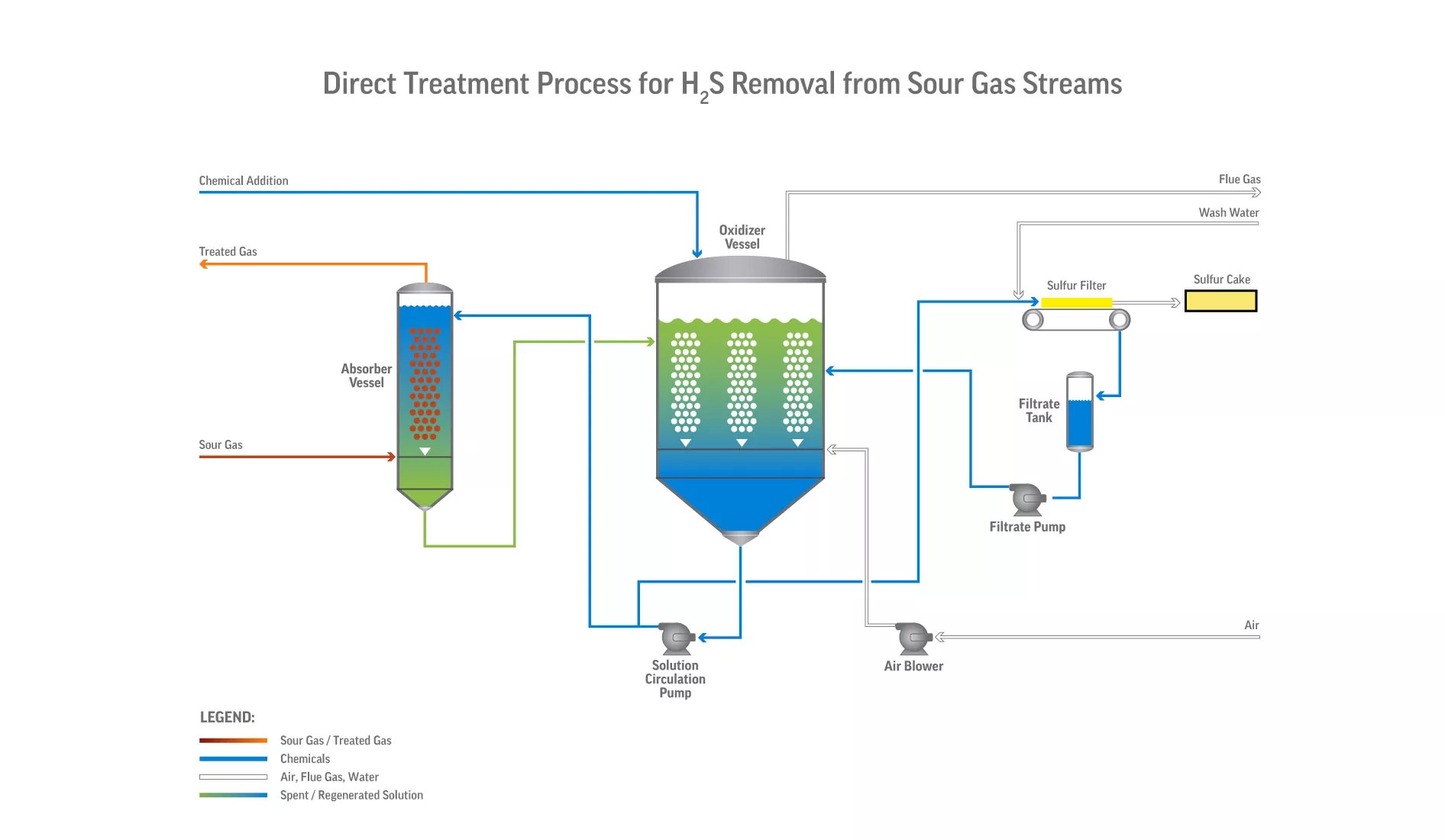
LO-CAT is an aqueous liquid-redox H2S removal / sulfur recovery process. In Merichem's description, H2S is converted to elemental sulfur using a chelated iron catalyst in water; the catalyst is continuously regenerated with air.[1][2] The chemistry is explained as follows:[2]
Absorber: H2S + 2 Fe+++ → S° + 2 Fe++ + 2H+
Oxidiser: ½ O2 + H2O + 2 Fe++ → 2 OH- + 2 Fe+++
The process runs at near-ambient temperature and the working solution is maintained at pH 8–9; NaOH or KOH is used for pH control.[2] KOH is preferred when CO2 in the feed gas is high.[2]
Bottom line: LO-CAT is a mature, patented chelated-iron liquid redox sulfur-recovery platform for medium-tonnage H2S service. The primary sources support ambient-temperature operation, high turndown, >99% to 99.9%+ H2S removal, sulfur cake production, and qualitative economic advantages versus scavengers and Claus plants for the right duty window.[1][2][7]
Step-by-step technology description
Figure 1 — LO-CAT® process flow diagram for elevated pressure refinery desulfurization [15]
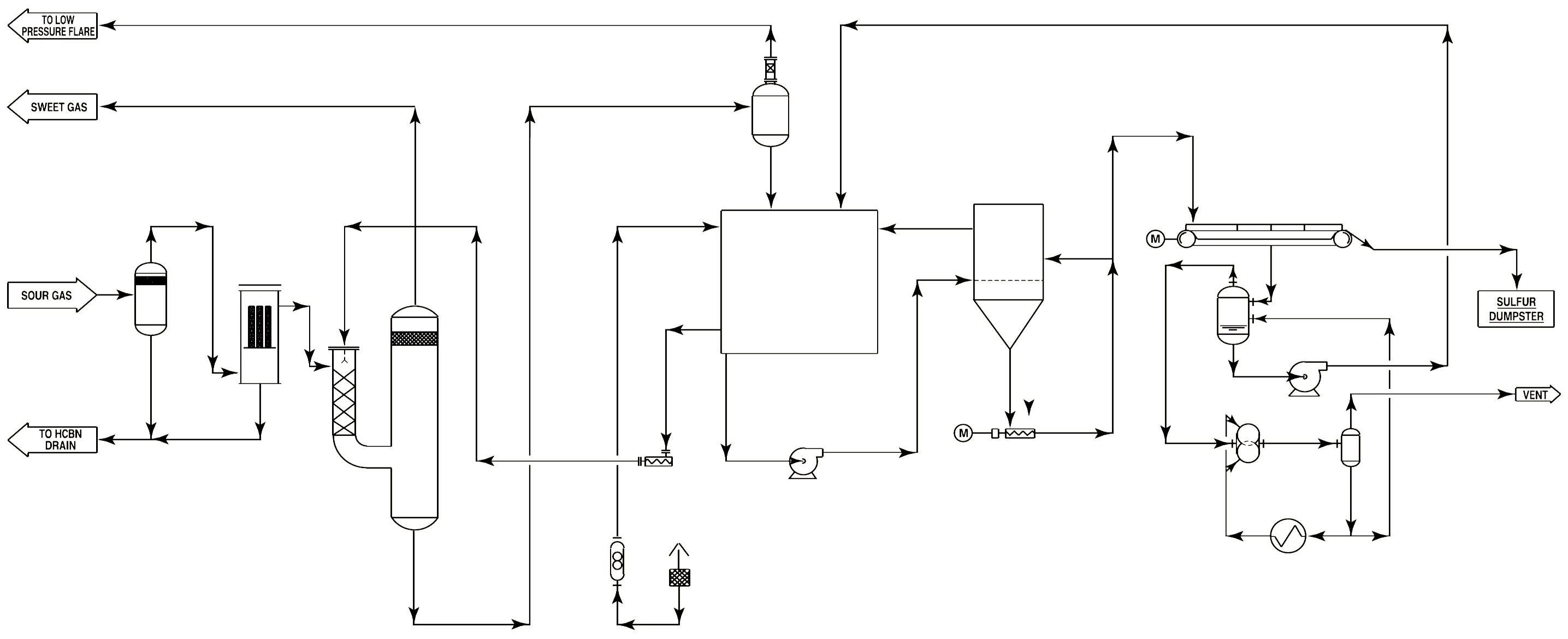
The process flow below is assembled from the Merichem product page, the Merichem technical article, and patent-derived engineering detail.[1][2][3][4][9][10][11][14][15]
- Feed conditioning. Sour gas first passes through a knock-out drum or coalescing filter to remove entrained liquids and solids.[2] Field experience shows this step matters in practice: at the MOL Hungarian Oil & Gas LO-CAT II unit in Szeged, unanticipated liquid-hydrocarbon condensate carried over from a mixed-phase pipeline caused foaming and floating sulfur until the sour-gas transfer line was retrofitted with a drainage boot and, later, a larger knockout pot.[15]
- Absorber contact. The gas enters an absorber (or, in the LO-CAT II configuration, static mixer absorbers) and contacts an aqueous solution of chelated iron. H2S is absorbed and converted to elemental sulfur and water through the redox reaction.[2][15] A two-phase stream of sweet gas and reduced LO-CAT solution then enters an absorber separator, where gas and liquid separate.[15]
- Treated-gas handling. Treated gas exits the absorber (via a mist eliminator in the LO-CAT II configuration) and passes through a knock-out pot; an optional water wash may be used to recover entrained solution and protect downstream equipment.[2][15] In elevated-pressure refinery service, the gas is subsequently cooled to remove water and recompressed for further processing.[15]
- Rich-solution letdown. The reduced LO-CAT solution from the separator passes through a pressure-reducing valve and, in high-pressure service, a flash drum that removes methane and other combustible components before the oxidiser; in low-pressure service, a pump may instead be needed to route solution to the oxidiser.[2][15] US20130123561A1 describes an alternative high-pressure configuration in which the oxidiser is instead operated above the absorber's own pressure (preferably about 5–10 psi higher, both above 100 psig), using pressurised air for regeneration; this eliminates the pressure-reducing step altogether and avoids the associated foaming, gas losses and control-valve erosion that a conventional flash drum can introduce.[11]
- Rich-solution regeneration. Solution from the absorber flows to the oxidiser, where sparged air re-oxidises the ferrous iron back to the ferric state, regenerating the catalyst for reuse in the absorber.[2][15] The oxidiser off-gas handling may involve a knock-out pot to recover entrained solution; in most cases the vent contains <1 ppm H2S and is directly vented. If the feed contains harmful or undesirable species such as RSH, COS, NH3 or hydrocarbons, the vent is instead routed to a seal pot and thermal oxidation unit.[2]
- Sulfur recovery / solids separation. A slipstream of the oxidised circulating solution is routed to a settler where sulfur is allowed to settle before being transferred as slurry to a filter (belt filter, bag filter or pressure filter) to recover sulfur cake and concentrate the sulfur into a solid; filtrate is returned to the oxidiser.[2][15] US5651896A and US8367009B2 describe the underlying separator hardware in more detail: a three-phase vessel (gas / redox-solution / molten sulfur) whose interface level is sensed by differential pressure between two elevation points and controlled via a steam-jacketed outlet valve, with the separator's overall gas-phase pressure regulated independently to prevent boiling, carryover, freezing or plugging at the sulfur outlet.[9][10] US8367009B2 further teaches that sulfur quality deteriorates when molten sulfur remains in contact with redox liquor for too long, or across too large an interface area, so the vessel geometry is designed to let residence time and interface area vary with throughput rather than staying fixed (and oversized) at turndown.[10]
- Solution management. The process loses some catalyst, chemicals and salts in the sulfur cake; these are replaced with fresh make-up chemicals. If extreme contamination occurs, operators may perform a bleed-and-replace procedure until the solution returns to specification.[2]
- Autocirculation option. For non-combustible gas streams (for example amine acid gas), Merichem describes an autocirculation scheme (Video) in which absorber and oxidiser are combined in a single vessel.[1]
Equipment / configuration list
- Feed knock-out drum or coalescing filter, including auxiliary condensate drainage boot / knockout pot where liquid entrainment is expected[2][15]
- Absorber / static mixer absorber section[2][15]
- Absorber separator for gas / liquid disengagement downstream of the absorber[15]
- Mist eliminator on the treated-gas outlet[15]
- Rich-solution circulation pump (low-pressure configurations)[2]
- Pressure-reducing valve ahead of the flash drum[15]
- Flash drum, for high-pressure service, to remove methane and other combustible components before regeneration[2][15]
- Oxidiser / regeneration vessel with air sparging system[2][15]
- Oxidiser off-gas knock-out pot, with optional seal pot and thermal oxidation unit for feeds containing RSH, COS, NH3 or hydrocarbons[2]
- Sulfur separator / settler with differential-pressure interface-level control and a steam-jacketed sulfur outlet valve[9][10]
- Sulfur filter (belt filter, bag filter or pressure filter) for sulfur cake recovery, with filtrate return to the oxidiser[2][15]
- Chemical make-up system for chelating agent, iron, and NaOH or KOH[2]
- Optional combined absorber-oxidiser vessel for the autocirculation configuration[1]
- Downstream gas cooling and recompression train, where elevated discharge pressure is required[15]
Technology performance, selectivity and safety
Performance
- Merichem states 99.9%+ H2S removal in a single stage.[1][2]
- The 2022 Merichem project announcement states >99.9% removal and up to 100% turndown.[7]
- The technical paper states commercial units can remove greater than 99% H2S and, with proper pH / catalyst / residence-time control, can meet 4 ppmv or less outlet H2S.[2]
- Typical application range in the technical paper is >0.5 tpd and <20 tpd sulfur removal; below several hundred pounds/day is often not economical.[2]
- At the MOL Hungarian Oil & Gas Szeged unit, gas flow was scaled up from an original design toward 60,000–100,000 normal m³/hr, with a modest sulfur load of about 50 kg/day owing to low feed-gas H2S concentration; reported H2S removal efficiency at that installation is 90%, sufficient to meet pipeline-quality gas specifications.[15]
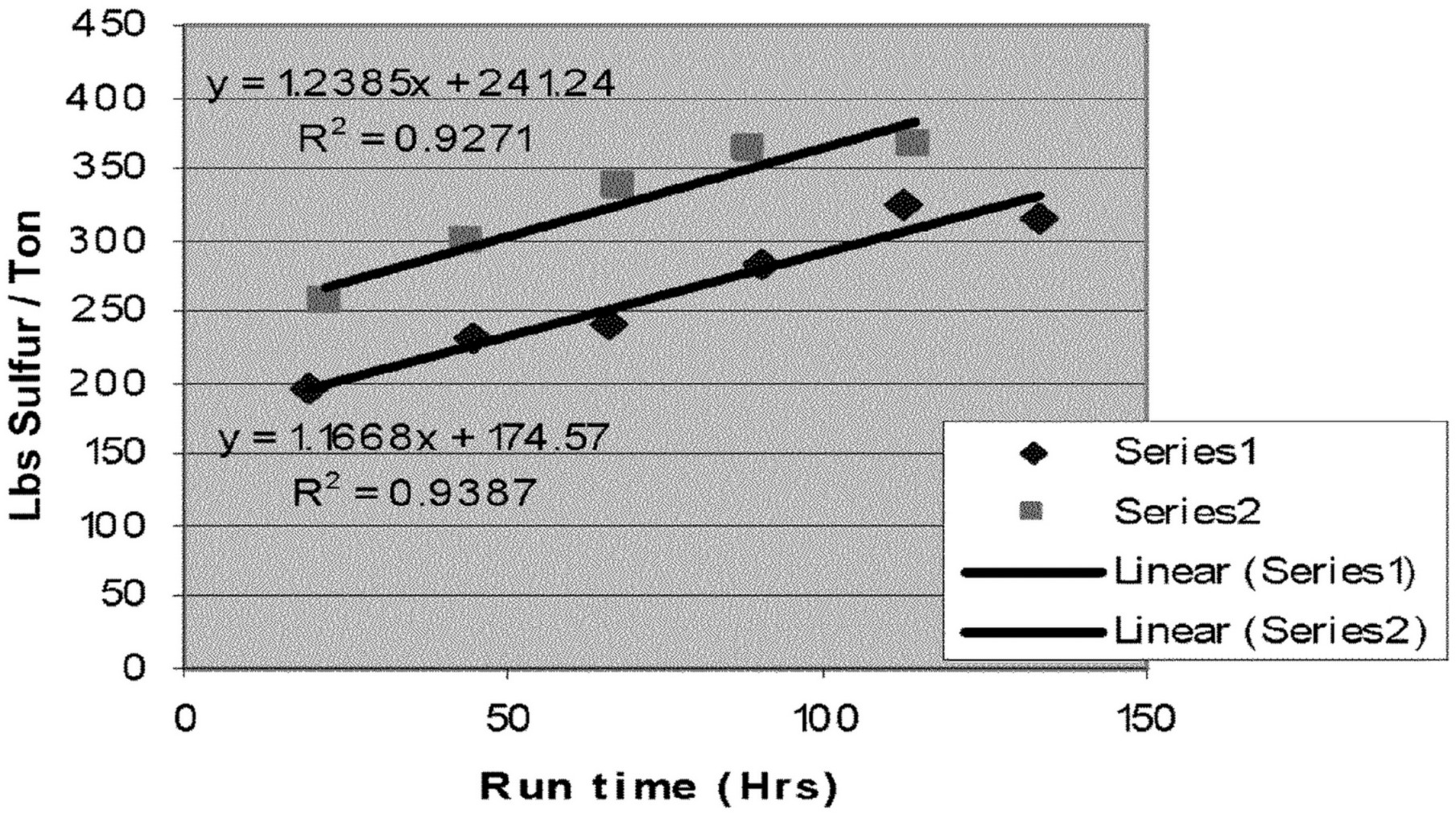
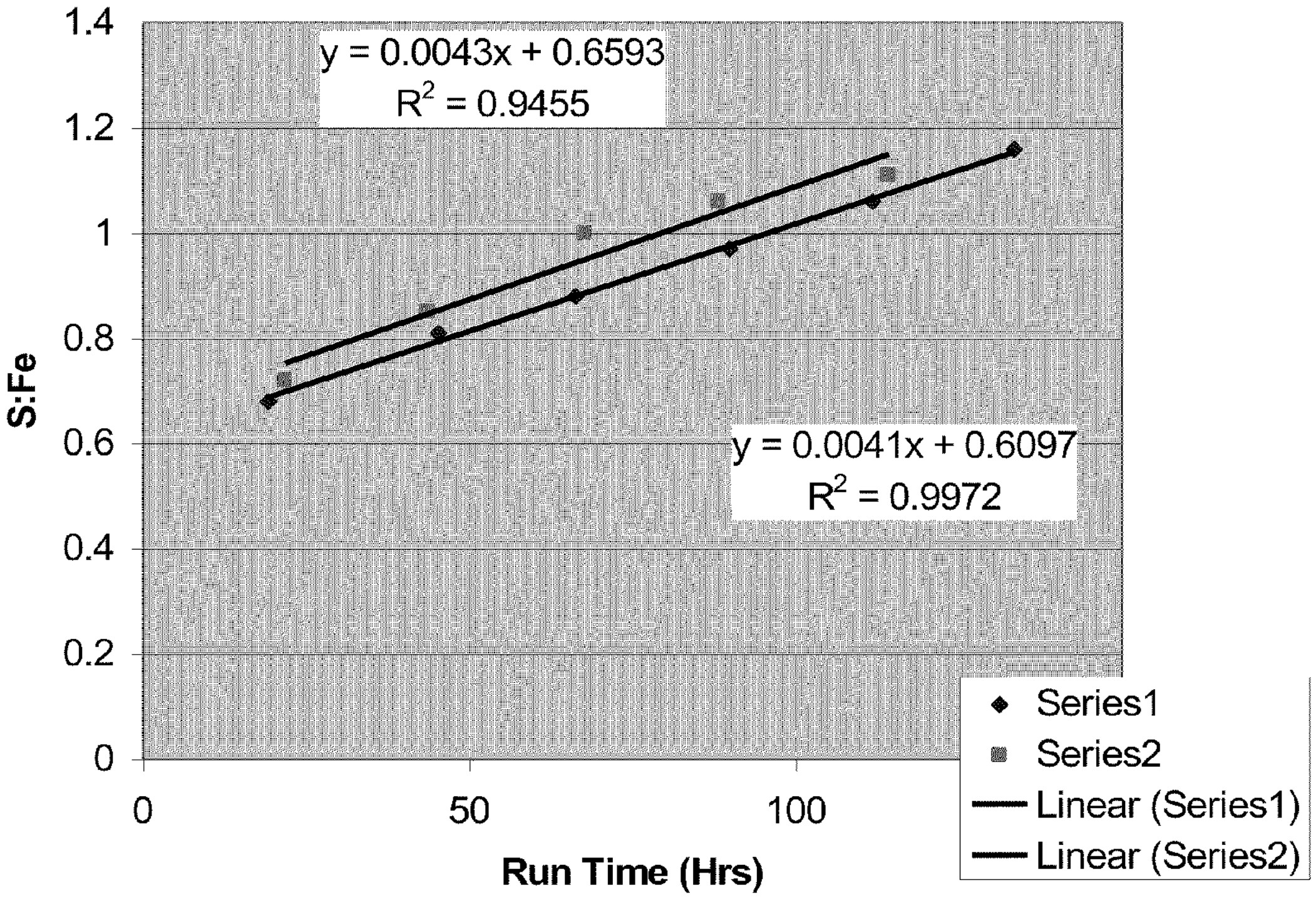
- US8968692B2, describing a separate but related regenerable iron-based H2S removal medium, includes two figures with direct relevance to LO-CAT-style solution/media management: Fig. 2a is a graph of sulfur accumulation in the iron matrix across 1–6 successive air regeneration cycles, and Fig. 2b plots the resulting sulfur-to-iron (S:Fe) ratio over the same regeneration cycles. Both show linear behaviour with regeneration number, indicating the medium does not lose effectiveness across repeated cycles — evidence for the practical robustness of iron-chelate redox chemistry under repeated regeneration that underlies LO-CAT's own catalyst-regeneration step.[13]
| |
Figure 2a — Sulfur accumulation in the iron matrix across 1–6 successive air regeneration cycles[13] |
Figure 2b — resulting sulfur-to-iron (S:Fe) ratio over the same regeneration cycles[13] |
| |
 |
 |
Selectivity / impurity behaviour
- The process is selective for H2S; removal rates of mercaptans, COS, CS2 and similar sulfur species are not significant and these species generally remain in the treated gas.[2]
- Liquid hydrocarbons or amine contamination can cause foaming and operational issues.[2] This is corroborated by the MOL Hungarian Oil & Gas experience, where excessive liquid hydrocarbon carryover directly caused foaming and floating sulfur until mitigated by hardware changes.[15]
Safety / EHS
- The process operates at near-ambient temperature, which Merichem and the technical paper both frame as a safety advantage.[1][2]
- Merichem marketing material says the process uses no toxic chemicals and produces no hazardous waste byproducts.7]
- The technical paper is more nuanced: it notes thiosulfate and sulfate can build up and may require blowdown in some cases.[2]
- Sulfur cake is described as a non-dusting, transport-safe solid that generally does not require degassing.[2]
Comparative economic performance
Sources support only qualitative economics; no verified CAPEX / OPEX numbers, yield economics, or a published cost curve could be retrieved:
- Merichem states LO-CAT has lower OPEX vs. scavengers and lower CAPEX vs. Claus plants.[1]
- The technical paper says liquid redox can provide significant economic advantages over amine-based sulfur recovery because the amine, Claus and tail-gas systems may be replaced by a single-step liquid redox system in direct-treat service.[2]
- The 2016 project note says the LO-CAT plant offered low total cost of operations compared to various H2S scavenger systems.[5]
- The same paper places LO-CAT in the economic middle ground between high-tonnage Claus service and non-regenerable scavengers for very dilute streams.[2]
Commercial experience and deployments
- Merichem's 2016 Texas announcement said the technology had been licensed to over 225 companies worldwide.[5]
- Merichem reported a European refinery application in 2022 where LO-CAT served as the SRU, designed to remove about 4 metric tpd of sulfur from acid gas containing up to about 7 mol% H2S, with 18 months of operation discussed in the paper.[6]
- In 2022 Merichem announced a contract for LO-CAT to treat landfill gas at Tunnel Hill and Sunny Farms in Ohio; the page states the project used LO-CAT to remove H2S from landfill gas and convert it to elemental sulfur.[7]
- In 2024 Merichem said LO-CAT was a key factor in an ENR Midwest Award of Merit for Ohio landfill desulphurization projects, and that Merichem had designed and fabricated four trains of LO-CAT technology capturing and sequestering nearly 100% of the H2S.[8]
- Merichem's product page also points to a Coso case study for 22 years of reliable sulfur removal.[1]
- MOL Hungarian Oil & Gas Co. selected a LO-CAT® II Desulfurization System for its production unit in Szeged, Hungary, custom-designed for direct treatment of sour associated and process gas streams at elevated operating pressures and relatively high CO2 partial pressures.[15]
References
- LO-CAT® | Sulfur Recovery Solution - H2S Removal — Merichem Technologies product page (modified Jun 5, 2026).
- Separating Sulphur — Merichem Technologies page (Dec 9, 2021); reprinted from Hydrocarbon Engineering.
- H2S Removal | Proven Solutions, Safer Handling | Merichem — Merichem Technologies product overview (modified Jun 14, 2026).
- MERICHEM® Awarded US Patent No. 8,597,375 — Merichem Technologies (Jan 10, 2014).
- MERICHEM® Awarded New LO-CAT® Project in Texas — Merichem Technologies (Oct 4, 2016).
- Green Refinery Challenges: Small-scale Sulfur Recovery — Merichem Technologies (Feb 23, 2022).
- WIN Waste Innovations Invests in Merichem Company's LO-CAT® Sulfur Recovery Technology for Environmentally Sound Waste Disposal — Merichem Technologies (Feb 11, 2022).
- LO-CAT Technology a Key Factor in ENR Award — Merichem Technologies (Nov 26, 2024).
- US5651896A - Sulfur separation system with interface control — Google Patents (publication date Jul 29, 1997).
- US8367009B2 - Three phase sulfur separation system with interface control — Google Patents (publication date Feb 5, 2013).
- US20130123561A1 - High pressure reduction-oxidation desulfurization process — Google Patents (publication date May 16, 2013).
- WO2021034498A1 - Systems and method for sulfur recovery within a gas processing system comprising co-current contactors and a sulphur recovery unit — Google Patents (publication date Feb 25, 2021).
- US8968692B2 - Regenerable removal of sulfur from gaseous or liquid mixtures — Google Patents (publication date Mar 3, 2015).
- Merichem Technologies — Corporate site (accessed Sep 26, 2019)
- LO-CAT® II Process for Elevated Pressure Refinery Desulfurization — Digital Refining (Sep 15, 2010).
- Black Bay Energy Capital Acquires Process Technologies & Catalyst Business from Merichem Company — Merichem Technologies (Jan 3, 2024)