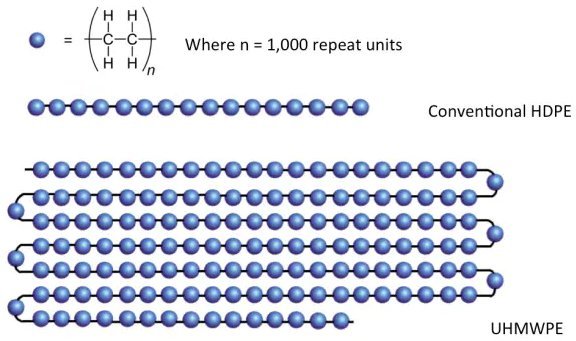
UHMWPE (also known as HMPE or high-modulus polyethylene) is a subset of thermoplastic polyethylene characterized by extremely long polymer chains with a molecular mass typically between 2 and 6 million daltons — roughly ten times that of standard high-density polyethylene (HDPE). It is produced via Ziegler-Natta or metallocene catalyst systems and appears commercially as a fine white powder. The longer chains transfer load more efficiently to the polymer backbone, producing exceptional mechanical and surface properties.
Key Physical & Mechanical Properties
| Property |
Value / Notes |
| Density |
0.926–0.934 g/cm³ |
| Tensile Strength at Break |
~48 MPa (7.9 ksi) |
| Elongation at Break |
~350% |
| Shore D Hardness |
62–66 |
| Melting Range |
138–142°C (280–289°F) |
| Water Absorption |
Negligible (nil) |
| Coefficient of Friction |
Comparable to PTFE |
| Volume Resistivity |
5 × 10¹⁴ ohm·cm |
UHMWPE holds the highest impact strength of any thermoplastic currently manufactured. Its wear resistance is 7× greater than carbon steel, 27× greater than copper, and 4× greater than Nylon 66. It is odorless, tasteless, non-toxic, self-lubricating, and has negligible water absorption.
Manufacturing Process
UHMWPE is produced commercially via dedicated slurry-phase polymerization processes using Ziegler-Natta catalysts, operating at low temperature and pressure. The resulting polymer is recovered as a fine white powder, which is then further processed by compression molding, ram extrusion, or gel-spinning — conventional melt processing routes used for standard polyethylenes are not applicable due to UHMWPE's extremely high melt viscosity.
Product Forms & Grades
UHMWPE is commercially available in several grades and forms:
-
Grades: PE 300, PE 500, PE 1000 (increasing molecular weight and performance)
-
Forms: Sheets, rods, tubes, films, profiles, fibers, powder
-
Specialty variants: Medical-grade (highly crosslinked), fiber grade (gel-spun), battery separator films, food-grade (NSF51/FDA compliant), antistatic and conductive grades (with carbon black loading)
Applications
Industrial & Engineered Components
Used in wear strips, conveyor liners, chutes, bulk storage hopper linings, gears, bearings, idler sprockets, and star wheels for bottling and food processing machinery. Its self-lubricating surface eliminates the need for external lubrication in high-wear environments.
High-Strength Fibers (UHMWPE Fiber)
Gel-spun UHMWPE fiber (e.g., Dyneema® by Avient/DSM, Spectra® by Honeywell) is used in bulletproof vests, cut-resistant gloves, high-performance mooring ropes, and marine cordage. With a specific gravity of only 0.97 and breaking tenacity of ~28 g/d, it floats on water and outperforms steel wire on a weight-for-weight basis.
Medical / Biomedical
Medical-grade UHMWPE (often crosslinked to reduce oxidative wear) is the standard bearing material for hip, knee, and shoulder joint implants. Its biocompatibility, chemical resistance, and fatigue toughness make it irreplaceable in orthopedic surgery.
Battery Separators
UHMWPE films serve as porous separators in lithium-ion and lead-acid batteries. Each gigawatt-hour of lithium-ion cell capacity consumes an estimated 50–60 tons of UHMWPE separator material, making EV growth a powerful demand driver at a projected 7.1% CAGR.
Defense & Ballistics
A 25 mm (1-inch) thick slab of UHMWPE can stop a 0.38-caliber pistol slug, making it a viable structural ballistic material.
Major Producers & Capacity
As of 2025, global UHMWPE resin production capacity is estimated at 400,000–500,000 tons/year, with China accounting for approximately 50% of total capacity. Key producers include:
For UHMWPE fiber specifically, the high-end market is dominated by Avient (Dyneema®), Honeywell (Spectra®), and Toyobo (Izanas®), which hold a near-monopoly on advanced fiber technology.
Market Outlook
The global UHMWPE market was valued at approximately USD 2.4–2.6 billion in 2024 and is projected to grow to USD 6.7–8.4 billion by 2034–2036, at a CAGR of approximately 9.5–10%. Key growth drivers are EV battery separators, medical implants, and high-performance fiber demand. A notable risk is capacity oversupply in China, where at least 14 new projects totaling 750,000 t/y of additional capacity are in the pipeline for 2025–2030, likely exerting downward pressure on resin prices and producer margins.
Limitations
- Poor processability: Cannot be melt-processed by conventional extrusion or injection molding due to extremely high melt viscosity; typically ram-extruded, compression molded, or gel-spun
- Creep susceptibility: Under sustained load, especially at elevated temperatures, UHMWPE is prone to slow deformation
- Upper service temperature: Continuous use is typically limited to below ~80–100°C; melting occurs at ~138–142°C
- UV degradation: Without carbon black or UV stabilizers, it degrades under prolonged sunlight exposure
References
- Wikipedia – Ultra-high-molecular-weight polyethylene
- Celanese – GUR UHMWPE Polymer Guide (White Paper GUR-003) —
- Plastic Products Inc. – UHMW Polyethylene
- Sangir Plastics – UHMWPE Technical Data Sheet
- Boedeker Plastics – UHMW-PE Natural Specifications
- Ceetak Ltd – UHMWPE Material
- PBY Plastics – UHMWPE High-Performance Plastics
- AZoM – Ultra-High Molecular Weight Polyethylene
- PMC/NIH – Polymer synthesis methods for UHMWPE
- Academia.edu – Synthesizing UHMWPE Using Ziegler-Natta Catalyst System
- RSC Publishing – Strategies for enhancing the processability of UHMWPE (2025)
- HDIn Research – UHMWPE Market Analysis (2025)
- Market Research Future – UHMWPE Market Size & Share Report
- Reports and Data – UHMWPE Market Report
- ResearchNester – Ultra-High Molecular Polyethylene Market
- Braskem – UTEC UHMWPE Brochure
- Prof-Research – Top 12 Manufacturers in UHMWPE Fiber Market
- Fiber-Line – UHMWPE Lightweight & Abrasion Resistant
- Sigma-Aldrich – Polyethylene UHMWPE Powder, CAS 9002-88-4
- Fisher Scientific – Safety Data Sheet: Polyethylene UHMW (Rev. Dec-2025)
- Wikidata – Ultra-high-molecular-weight polyethylene (Q575823)
- NIST – Reference Material RM 8456, UHMWPE





 CAS Number
 EC Number
 IUPAC Name