
Product
Lloydminster-type crude
Abbreviation
LLB
Names
Loyd Blend;
Insight Articles
#PS810
canada llb lloydtypecrude lloydblend cenovusenergy asphalt heavysourcrude
Main Product
Crude Oil
Segment
Extractive Industry Products
Main-Family
Fossil Hydrocarbons
Sub-Family
Liquid Feedstock
Physical State

Liquid

Description

Lloydminster-type crude (also marketed as Lloyd Blend / LLB) is a conventional heavy, high-sour crude produced at the Alberta–Saskatchewan border region, distinct from oil sands bitumen in its production method and molecular character, yet comparable in API gravity and processing demands. It is one of Canada's longest-produced heavy streams, with field history dating back to 1926.


Origin & Geology

The Lloydminster area straddles the Alberta–Saskatchewan provincial border, centred on the town of Lloydminster (~300 km east of Edmonton). Oil is produced from the Lower Cretaceous Mannville Group — a sequence of deltaic and fluvial sands subdivided into the Dina, Sparky, Silverdale, and Colony formations. These shallow sands (typically 300–700 m depth) hold 3.34 billion barrels of oil-in-place in the Alberta segment alone, with cumulative production exceeding 176 million barrels as of 2022.

The Lloydminster field was discovered in 1939 and has been operated by various majors over time — Cenovus Energy is today the dominant operator via 12 thermal SAGD-based assets plus legacy cold-production wells.


What "Lloydminster-type Crude" Means

"Lloydminster-type" is an industry term covering several related conventional heavy crude streams gathered from fields in the Lloydminster fairway, including:

  • Lloyd Blend (LLB) — the primary pipeline grade, gathered by Husky Midstream (Cenovus) and priced at Hardisty

  • Lloydminster Kerrobert (LKB) — a sub-stream with slightly different quality

  • Federated (FED) — a heavier conventional stream from the same area

  • Midale Blend — southeastern Saskatchewan contribution

  • Imperial Sour Blend — gathered by Imperial Oil from overlapping Mannville formations

These streams are conventional crude (not diluted bitumen/dilbit) — they flow at reservoir temperature without steam or diluent, though CHOPS and SAGD thermal methods are applied to enhance rates.


Key Physical Properties — Lloyd Blend (LLB)

Parameter Typical Value
API Gravity 20.5° – 21.5°
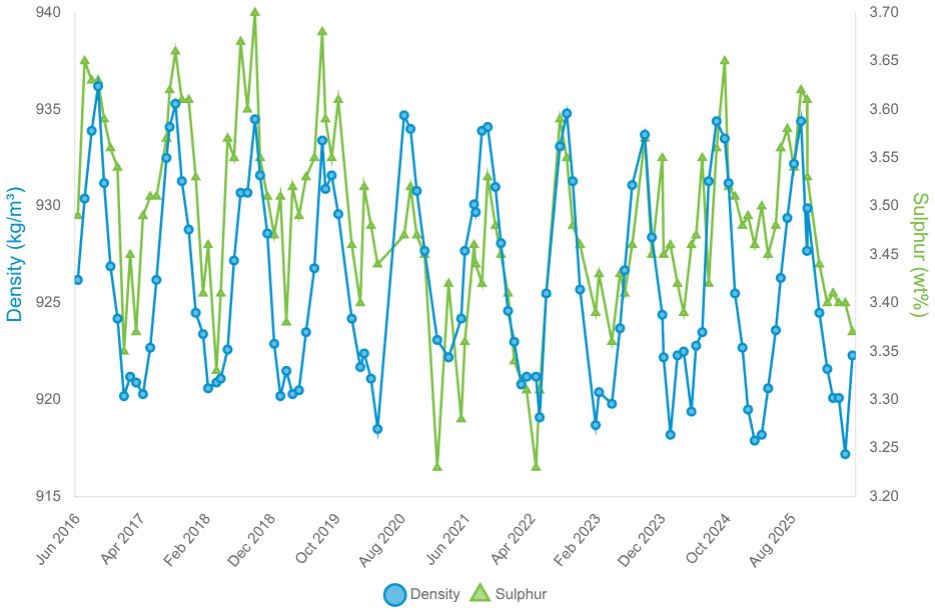
Density ~925 – 935 kg/m³
Sulfur Content 3.3 – 3.6% wt
Micro Carbon Residue (MCR) ~9.5 – 10.5% wt
TAN (Total Acid Number) Moderate (naphthenic acids present)
Vanadium Lower than bitumen blends
Pour Point Similar to WCS range
Viscosity Moderate; pipeline-spec without diluent at operating temp


On CrudeMonitor's September 2025 batch (LLB-1321), the stream showed increased density, sulfur, MCR, and metals vs prior months, with reduced BTEX and C6–C8 light ends — reflecting the variability inherent to multi-pool blending from the Mannville fairway.


Production Methods

Unlike oil sands bitumen which requires either mining or steam-intensive SAGD to mobilize, Lloydminster heavy crude production uses a range of methods:

  • CHOPS (Cold Heavy Oil Production with Sand) — the traditional method exploiting foamy oil drive and high-permeability sands, widely applied historically across the Mannville

  • SAGD (Steam-Assisted Gravity Drainage) — Cenovus operates 12 thermal SAGD assets in the Lloydminster area for tighter/deeper zones

  • EOR (Enhanced Oil Recovery) — polymer and steam flood pilots ongoing

  • Waterflood — applied to maintain reservoir pressure in conventional pools

CHOPS is uniquely suited to the shallow, high-porosity Mannville sands, where wormhole networks formed by sand production create drainage conduits that dramatically improve productivity without steam energy costs.


Infrastructure & Refining Hub

Lloydminster is uniquely positioned at the border of two provinces and hosts its own dedicated heavy oil processing infrastructure:

This co-location of production, upgrading, and refining in the Lloydminster area makes it a uniquely integrated heavy oil hub — unlike most Alberta heavy streams that must travel hundreds of kilometres to a refinery.


Refinery Requirements

Lloydminster-type crude is categorized as heavy sour and requires high complexity processing:

The dominant end-products are asphalt, ULSD, gasoline, and petroleum coke depending on the refinery configuration.


Lloydminster vs. WCS

While Lloyd Blend and WCS appear nearly identical on basic quality metrics (API, sulfur), Lloydminster-type crude is a single-source conventional stream with no condensate diluent added, whereas WCS is a formulated multi-component blend — a distinction that matters for refinery unit feed consistency and downstream processing predictability.


Insight Articles
Your insights will be shown here

LLB Density and Sulfur Content (June 2016—May 5, 2026) via CrudeMonitor https://www.crudemonitor.ca/crudes/crude.php?acr=LLB
Identifiers

logo PubChem ID
-1
Chemical- / Crude Data

Sulfur Content (wt%)
3.45
Specific Gravity
0.93

API Gravity
21
Country
Crude Data

API Gravity
21
Country
Product Settings

Default
Status
A
Content provided by
Transaction Name Date
Modified by UserPic   Kokel, Nicolas 6/15/2026 4:05 PM
Added by UserPic   Kokel, Nicolas 6/15/2026 3:41 PM