Balikpapan Refinery Upgrade: Indonesia's Flagship Energy Security Project


Technical Specifications
The project significantly enhances Balikpapan refinery complexity and product yield through several major process units:
- 90,000 bpsd Residue Fluid Catalytic Cracker (RFCC) using Axens R2R™ technology to convert heavy residues into gasoline, LPG, and propylene
- 48,000 bpsd Selective Hydrogenation Unit (SHU) with Axens Prime-G+™ technology for ultra-clean gasoline production
- 80,000 bpsd Middle Distillate Hydrotreater using Axens Prime-D™ technology for Euro V diesel
- 120,000 m³/h Steam Methane Reformer (SMR) for hydrogen production, supplied by Air Liquide
- 33,000 bpd Continuous Catalyst Regeneration (CCR) unit and 47,000 bpd hydrocracking unit with Honeywell UOP technology
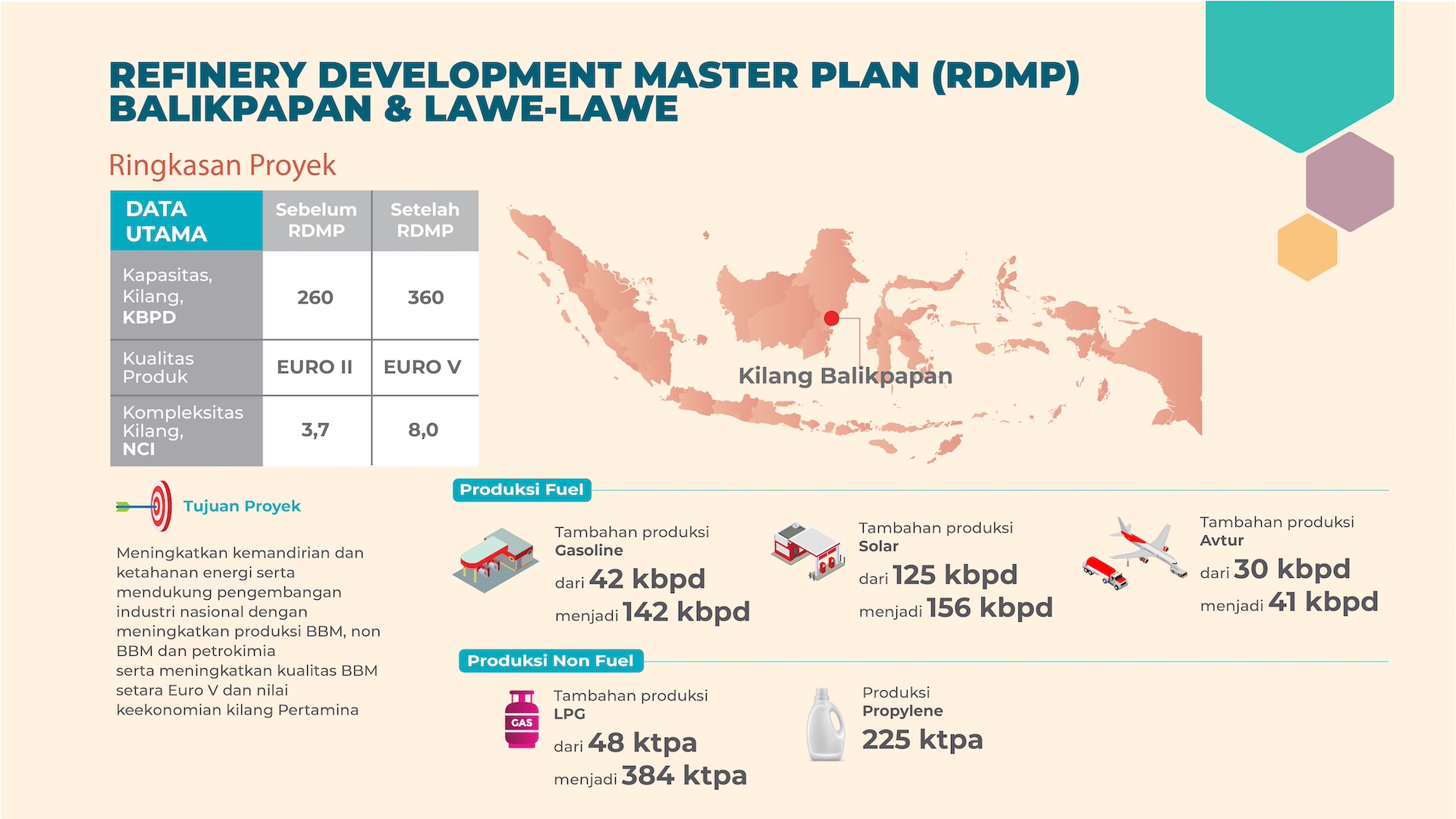
The upgrade increases the Nelson Complexity Index from 3.7 to 8.0 and raises product yield from 75.3% to 91.8%, while improving fuel quality from Euro II to Euro V standards.
Production Capacity Impacts
The refinery will produce significantly enhanced volumes across multiple product streams:
| Product | Previous Capacity | New Capacity | Increase |
|---|---|---|---|
| Total fuel output | 197,000 bpd | 339,000 bpd | +142,000 bpd |
| Gasoline production | ~16 million KL/year | 5.8 million KL/year | Major upgrade |
| LPG | 48,000 tonnes/year | 384,000 tonnes/year | +336,000 tonnes |
| Propylene | 0 | 225,000-230,000 tonnes/year | New capacity |
| Total petrochemicals | 0 | 283,000 tonnes/year | New capacity |
Strategic Import Reduction Targets
Energy Minister Bahlil Lahadalia outlined ambitious import elimination goals tied to the refinery's commissioning:
- Diesel: Import ban effective 2026, with potential 3-4 million KL surplus when combined with B50 biodiesel mandate
- Gasoline: Expected to reduce imports from 24 million KL to 19 million KL annually (21% reduction)
- LPG: 4.9% reduction in imports
- Jet fuel: Targeted import elimination by 2027
Strategic Assessment
Energy Security Enhancement: The Balikpapan RDMP represents a critical pillar in Indonesia's broader refining modernization strategy, which aims to increase total national capacity from 1.18 million bpd to 1.9 million bpd by 2030. With domestic fuel demand at approximately 1.6 million bpd, this expansion meaningfully closes the supply gap that has historically required substantial imports.
Technology Platform Advancement: The project incorporates world-class conversion technologies from multiple licensors (Axens, Honeywell UOP, Air Liquide), establishing a modern technology platform that enables processing of higher-sulfur crude slates while producing cleaner fuels. This flexibility is strategically important as Indonesia seeks to optimize crude sourcing economics.
Petrochemical Integration: The addition of 225,000-230,000 tonnes/year of propylene capacity creates new downstream integration opportunities in the plastics value chain. This positions Pertamina to participate in higher-margin petrochemical markets beyond traditional fuel production.
EPC Execution: The project was executed through a Joint Operation led by PT Rekayasa Industri with WorleyParsons as PMC and Bechtel handling FEED studies. The 53-month construction timeline (starting February 2019) experienced COVID-19-related delays but achieved mechanical completion in late 2025.
Regional Context: Indonesia's total refining capacity now reaches approximately 1.15 million bpd distributed across six major refineries, with Cilacap (348,000 bpd) and Balikpapan (360,000 bpd) as the flagship facilities. Pertamina's parallel RDMP projects at Cilacap and Balongan position Indonesia to achieve fuel self-sufficiency targets within the current administration's timeline.
The Balikpapan upgrade fundamentally repositions Indonesia's refining sector from a capacity-constrained, import-dependent system to one approaching self-sufficiency in transportation fuels while adding petrochemical production capabilities.
Note: This analysis builds upon information from the following sources: Hydrocarbon Processing, Reuters, Enerdata, Indonesia Business Post, Offshore Technology, Argus Media, Antara News, Xinhua, The Jakarta Post, Petromindo, IDN Financials, NS Energy Business, Axens, Pertamina Balikpapan official communications, and PT Rekayasa Industri.
#indonesia #pertamina #balikpapan #refinery