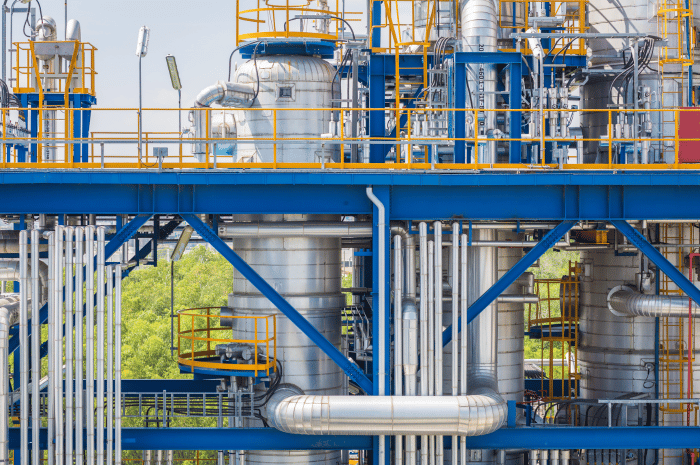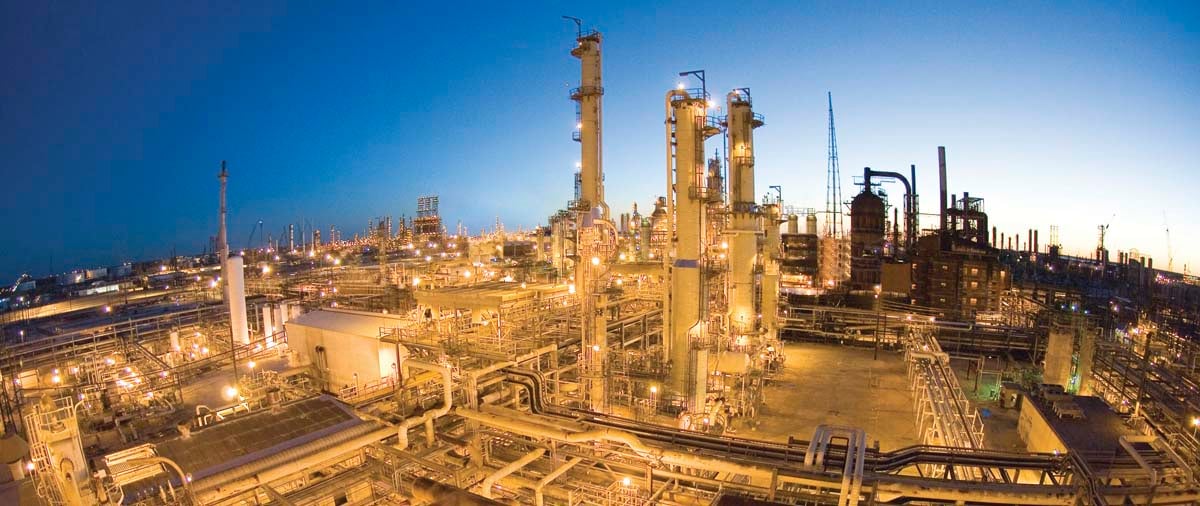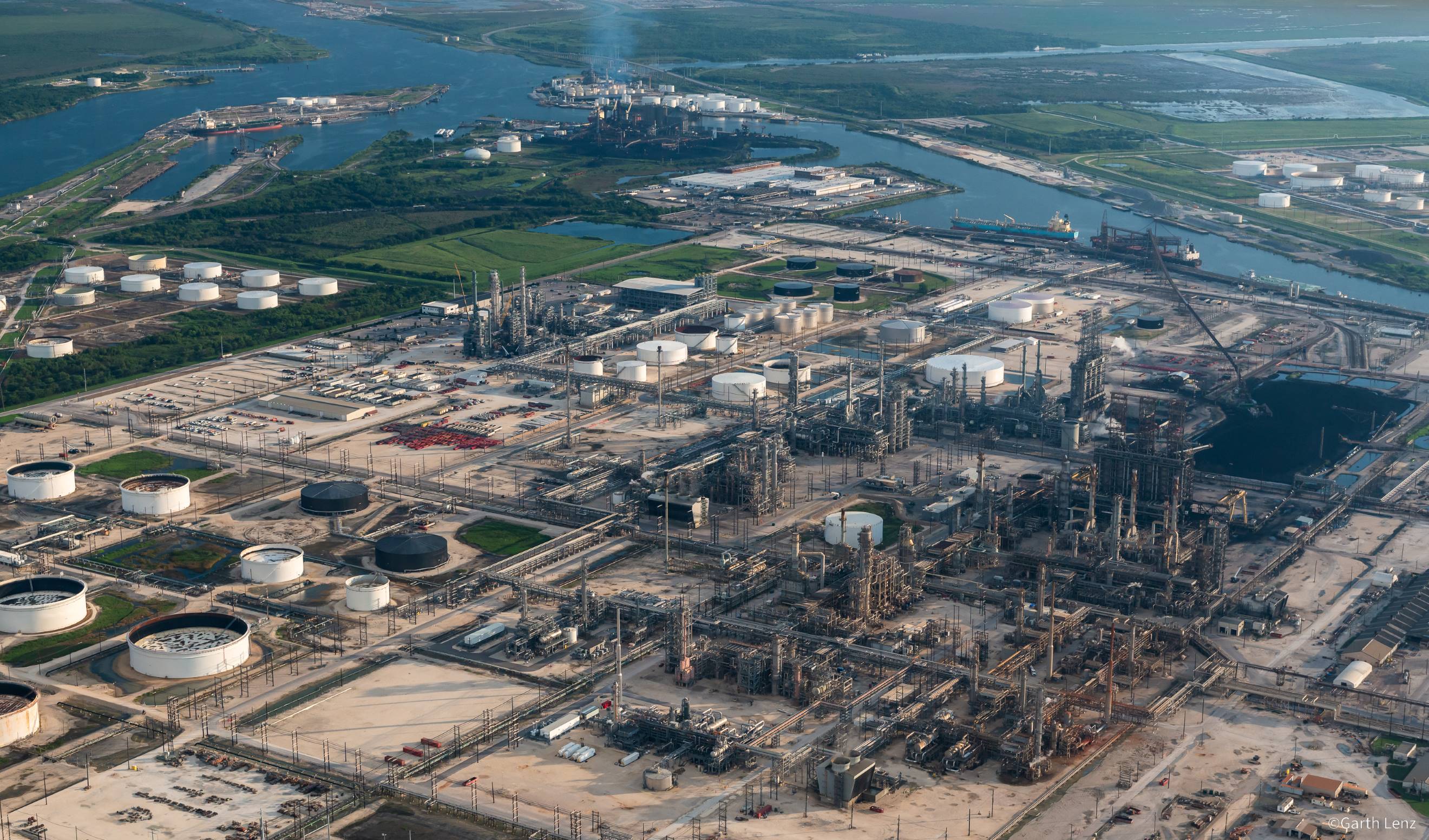
Photo: Valero Port Arthur Refinery | ©Garth Lenz (Sep 17, 2024) via Oil & Gas Watch
The Valero Port Arthur Refinery is one of the largest and most complex petroleum refining facilities in the United States, and serves as the flagship asset within Valero Energy Corporation's extensive refining portfolio. Located on approximately 4,000 acres along the Port Arthur Ship Channel in southeast Texas — about 90 miles east of Houston — the refinery has a nameplate throughput capacity of approximately 375,000 barrels per day (bpd) / ~20.2 million tonnes per year*, with deep-conversion, heavy-sour crude processing capabilities. The facility processes heavy, high-sulfur crude oils — including Mexican Maya and Venezuelan grades — and produces gasoline, diesel, jet fuel, petroleum coke, sulfur, and petrochemical feedstocks. In addition to its conventional refining operations, the site hosts the Diamond Green Diesel (DGD) Port Arthur plant, a 50/50 joint venture between Valero and Darling Ingredients and one of the world's largest renewable diesel and sustainable aviation fuel (SAF) producers. The refinery employs approximately 770–800 workers and generates over $28 million annually in local property taxes.
*assuming an average 21° API estimate
Historical Overview
Origins and Gulf Oil Era (1901–1984)
The Port Arthur refinery is among the oldest continuously operating petroleum refineries in North America. It was founded in the wake of the Spindletop oil discovery in January 1901, when a consortium of Pittsburgh businessmen formed the J.M. Guffey Petroleum Company to commercialize the new Texas crude. Gulf Refining Company was chartered on November 10, 1901, and constructed the original refinery at Port Arthur to process Spindletop crude into gasoline, kerosene, and engine oil. In 1907, the Guffey interests were merged into Gulf Oil Corporation. By 1955, Gulf Oil was the largest producer of ethylene in the United States, and by 1960, the Port Arthur facility was processing over 270,000 bbl/d of crude oil into roughly 600 different products. Gulf Oil was acquired by Chevron Corporation in 1984, and ownership of the Port Arthur site passed to Chevron.
Clark Refining and Premcor Era (1995–2005)
In 1995, Clark Refining & Marketing purchased the refinery from Chevron, retaining the facility as its primary asset. Clark rebranded itself as Premcor Inc. in 2000. Under Premcor's stewardship, approximately $850 million was invested in the facility around 2001, including the installation of a delayed coking unit and a hydrocracker to unlock the refinery's ability to economically process heavy, sour crude oil. A subsequent project in 2006 expanded the original delayed coker from 80,000 bpd to 105,000 bpd and increased overall throughput capacity from 250,000 bpd to 310,000 bpd. At the time of the Valero acquisition, the Port Arthur facility was Premcor's flagship refinery, with a throughput capacity of 250,000 bpd and an estimated replacement value of approximately $4.4 billion.
Valero Era (2005–Present)
Valero Energy Corporation acquired Premcor Inc. in 2005 for approximately $8 billion, adding Port Arthur along with refineries in Memphis, Tennessee, Delaware City, Delaware, and Lima, Ohio. Since acquisition, Valero has invested more than $3 billion in significant environmental and capacity projects at Port Arthur. A major milestone was the construction and commissioning of a new 50,000–57,000 bpd hydrocracker (Unit 943) that started operations in December 2012, enabling production of ultra-low-sulfur diesel (ULSD) and bringing refinery capacity to approximately 335,000 bpd. In 2018, Valero announced a $975 million project to build a second coker train, which was completed in April 2023, adding 55,000 bpd of coking capacity and further expanding the refinery's ability to process incremental volumes of sour crude and residual feedstocks. An upgrade to the large crude distillation unit (AVU-146) began in February 2026 to boost its capacity from approximately 235,000 bpd to 260,000 bpd. On March 23, 2026, an explosion and fire occurred at the Unit 243 diesel hydrotreater (47,000 bpd), resulting in a temporary full-plant shutdown and triggering a precautionary shelter-in-place for surrounding residents; Valero began restarting most units within two days.
Crude Oil Feedstocks
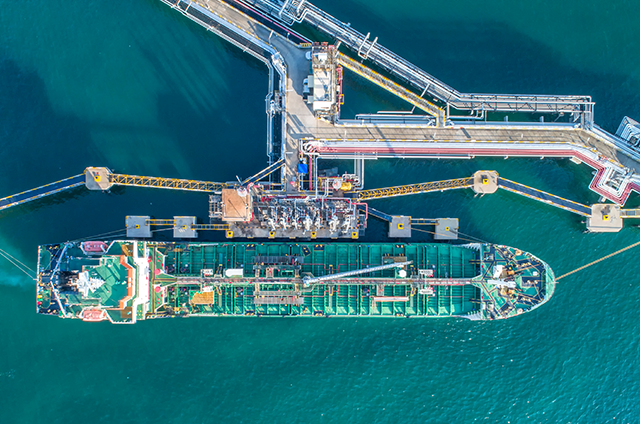
The Port Arthur refinery is uniquely configured to process 100% sour crude oil, of which up to 80% can be heavy sour grades. This capability makes it one of the most feedstock-flexible refineries in the country. Crude is received via the Valero dock on the Port Arthur Ship Channel, the Port Neches dock (with crude transferred by the Valero-owned Lucas pump station ~13 miles from the refinery), and by pipeline. Principal crude grades processed have historically included:
- Mexican Maya (heavy sour, ~22°API, ~3.3% sulfur) — the original anchor crude under a long-term Pemex supply agreement
- Venezuelan grades (Merey, Boscan, and similar heavy sours) — Port Arthur was one of the largest U.S. receivers of Venezuelan crude prior to sanctions, and Valero resumed Venezuelan crude purchases from authorized sellers in early 2026
- Canadian heavy sour (e.g., Western Canada Select and Lloydminster-type grades) — a significant swing supply following Venezuelan sanctions
- Medium sour and light tight oils — processed as diluents and blenders with heavy grades
Following the startup of the new coker in 2023, the refinery's capacity to process incremental sour crude and residual feedstocks was increased by approximately 102,000 bpd.
Processing Capacity and Asset Overview
The refinery operates a full suite of conversion and treating units, making it one of the deepest-conversion heavy-crude facilities in the U.S. Gulf Coast. Current key unit capacities are summarized below based on available operational data.
| Unit |
Designation |
Capacity (bpd) |
Technology Type |
Licensor |
CDU –
Large |
AVU-146 |
~260,000 (post-2026 upgrade) |
Atmospheric distillation |
N/A
(engineering) |
VDU –
Large |
Within
AVU-146 |
— |
Vacuum
distillation |
N/A
(engineering) |
CDU –
Small |
AVU-147 |
~115,000 |
Atmospheric distillation |
N/A
(engineering) |
VDU –
Small |
After
AVU-147 |
— |
Vacuum
distillation |
N/A
(engineering) |
DCU –
Original |
Unit 843 |
~100,000 |
Delayed
coking |
Likely Foster Wheeler (unconfirmed) |
DCU –
New (2nd) |
— |
~55,000 |
Delayed
coking |
Not publicly confirmed |
| FCCU |
FCCU |
~75,000 |
Conventional FCC (gasoline mode) |
Not publicly confirmed |
HCU –
New |
HCU 943 |
~57,000 |
Unicracking (fixed-bed hydrocracking) |
UOP
(Honeywell
UOP) |
HCU –
Older |
HCU 942 |
~45,000 |
Fixed-bed hydrocracking |
Not publicly confirmed |
Diesel
HTU |
Unit 243 |
~47,000 |
Fixed-bed hydrotreating |
Not publicly confirmed |
Gasoline
HTU
(Gulfiner) |
Unit 45 |
~45,000 |
FCC gasoline hydrotreating |
Not publicly confirmed |
| CCRU |
Platformer |
~50,000 |
CCR Platforming (continuous catalytic reforming) |
UOP
(Honeywell
UOP) |
| Alkylation Unit |
— |
~16,900 |
HF (hydrofluoric acid) alkylation |
UOP or ConocoPhillips (unconfirmed) |
| SRU |
SRU 543, 545, + others |
— (×4 trains) |
Claus process |
Not publicly confirmed |
| Sat. Gas Recov. Unit |
SGRU |
— |
Absorption / fractionation |
Not publicly confirmed |
| H₂ Prod. – SMR (ext.) |
Air Products PA II |
— |
Steam methane reforming + VSA CO₂ capture |
Air Products & Chemicals |
Hydrogen Supply and Utilities
The Port Arthur refinery's extensive hydroprocessing infrastructure requires substantial external hydrogen supply. Air Products & Chemicals Inc. has been the primary hydrogen supplier to the refinery since 1996, operating two steam methane reformer (SMR) hydrogen production facilities on or adjacent to the refinery site:
-
Port Arthur II H₂/Cogeneration Facility: Started up in early 2007, this facility produces high-purity hydrogen, steam, and electricity in an integrated cogeneration configuration. It was recognized as one of POWER magazine's Top Plants of 2007.
-
Carbon Capture Project: In April 2013, Air Products commissioned the first-ever commercial-scale SMR incorporating vacuum-swing adsorption (VSA) carbon capture technology at its Port Arthur hydrogen facilities. This project captures approximately 1 million metric tons of CO₂ annually from the SMR operations.
-
2011 Expansion: In 2011, Valero awarded Air Products a contract for over 200 million standard cubic feet per day (scfd) of additional hydrogen to support both the Port Arthur and St. Charles refinery hydrocracker expansions.
Products and Distribution
The Port Arthur refinery produces a broad slate of transportation fuels and petrochemicals:
- Gasoline: Conventional, premium, and reformulated (RFG) grades, produced pre-oxygenate blending
- Ultra-Low-Sulfur Diesel (ULSD): Major product stream enabled by the hydrocracker and multiple hydrotreaters
- Jet fuel / Aviation turbine fuel: Produced via kerosene hydrotreater
- Petroleum coke: Solid byproduct of the delayed coking units; sold as fuel substitute for coal
- Elemental sulfur: Recovered from sour crude processing via Claus SRUs
- Petrochemical feedstocks: Including propylene, LPG, and light naphthas
- Liquid petroleum gas (LPG): Propane and butane from the saturate gas recovery unit
Products are distributed via the Colonial Pipeline, Explorer Pipeline, and TEPPCO Pipeline, as well as by vessel from the refinery's docks on the Port Arthur Ship Channel.
Environmental and Regulatory Profile
The refinery operates under Texas Commission on Environmental Quality (TCEQ) air permits and National Pollutant Discharge Elimination System (NPDES) wastewater permits. Since Valero's acquisition in 2005, more than $3 billion has been invested in environmental projects, including a flare gas recovery system, flue gas desulfurization units, and the addition of ULSD-producing hydroprocessing capacity. Unauthorized emissions have been reduced by approximately 96% since 2002 according to Valero. In 2019, the Texas Attorney General filed a lawsuit against Valero alleging excessive air emissions at Port Arthur from 2014 onward, citing at least 38 permit violations; Valero stated its commitment to cooperate with regulatory authorities.
Recent Operational Events
-
February 2026: Startup of planned upgrades to the AVU-146 CDU to boost capacity from ~235,000 bpd to ~260,000 bpd, with specific improvements to bottoms processing capability
-
March 23, 2026: Explosion and fire in diesel hydrotreater Unit 243 (47,000 bpd) triggered a full plant shutdown; a precautionary shelter-in-place order was issued and subsequently lifted after air monitoring confirmed no community air quality threat
-
March 25, 2026: Valero began restarting the refinery two days after the explosion, with all units except Unit 243 diesel hydrotreater restarted in phases
-
April–May 2026: Gradual normalization of throughput; the coker, hydrocrackers, reformer, and one distillate hydrotreater came back online in early April, followed by the FCC, larger CDU, and alkylation unit; the Unit 243 diesel hydrotreater sustained extensive damage with an uncertain rebuild timeline, and an adjacent kerosene hydrotreater is expected back online by Q3 2026
References
- Valero Energy Corporation — Port Arthur Refinery Fact Sheet (Mar 2020)
- Historical Marker Database — Marker #12562: The Port Arthur Refinery (Gulf Refining Company) (Erected 2001 by Texas Historical Commission; last retrieved Jun 2026)
- NOAA Office of Response and Restoration — Over a Century after Texas Strikes Oil, Marsh Restoration Completed at Old Refinery Site (Nov 7, 2022)
- Company-Histories.com — Premcor Inc. — Company History (last retrieved Jun 2026)
- Oil & Gas Journal — Valero closes its Premcor acquisition (Sep 1, 2005)
- Hydrocarbon Processing — Valero Port Arthur Refinery Profile (via ProQuest; Sep 2012)
- Offshore Technology — Market Data: Port Arthur I coking refinery, the US (Oct 26, 2021)
- Oil & Gas Journal — Valero breaks ground on Port Arthur refinery project (Aug 12, 2008)
- Oil & Gas Journal — Valero lets $1.2 billion in refinery expansion contracts (Aug 6, 2008)
- Hydrocarbon Online — Valero Starts Up New Hydrocracker Unit at Port Arthur Refinery (Dec 17, 2012)
- Coking.com — Valero Port Arthur Plans Second Coker (Mar 29, 2018)
- Oil & Gas Journal — Valero commissions Port Arthur refinery's delayed coking project (Apr 27, 2023)
- Reuters — Valero starts up production on new Port Arthur, Texas coker — sources (Apr 5, 2023)
- Inspectioneering — Valero Starts up Production on New Coker at Its Port Arthur Refinery (Apr 4, 2023)
- Reuters — Valero Port Arthur, Texas, refinery restarts large crude unit — sources (Feb 25, 2021)
- Inspectioneering — Valero Overhauling HCU, SRU at its Port Arthur Refinery (Aug 6, 2019)
- PR Newswire — Air Products to Supply Additional Hydrogen for Two Gulf Coast Valero Refineries (Jun 5, 2011)
- Oil & Gas Journal — Air Products starts up Port Arthur hydrogen plant (Jan 2007)
- POWER Magazine — Port Arthur II Integrated Hydrogen/Cogeneration Facility, Port Arthur, Texas (Sep 14, 2007)
- SSRN / IEAGHG — Brickett L. et al. — The Carbon Capture Project at Air Products' Port Arthur Hydrogen Production Facility (Oct 25, 2018)
- Energies Media — Valero to modernize crude distillation unit at its Port Arthur refinery in February 2026 (Dec 9, 2025)
- Hydrocarbon Processing — Valero plans CDU upgrades at Port Arthur, Texas (U.S.) refinery in February (Dec 2025)
- Reuters — Valero shuts Texas refinery after explosion rocks diesel unit, sources say (Mar 24, 2026)
- Reuters — Valero begins restart of Port Arthur, Texas refinery, sources say (Mar 25, 2026)
- Reuters — Valero partially restarts Port Arthur, Texas refinery after blast — sources (Apr 16, 2026)
- Oil & Gas Journal — Valero's Port Arthur Refinery Faces Uncertain Timeline for Diesel Hydrotreater Rebuild (Apr 29, 2026)
- Reuters / MarketWatch — Valero Sees 2Q Production Affected by Port Arthur, Texas, Refinery Restart — OPIS (Apr 30, 2026)
- BIC Magazine — Valero sued by Texas AG over Port Arthur air quality violations (Jul 23, 2019)
- Inspenet — Valero buys Venezuelan crude for refinery in Port Arthur (Jan 30, 2026)
- Supply Status — Valero Port Arthur Refinery Explosion (Updated April 2026) (last retrieved Jun 2026)