E-Gas is a pressurized, oxygen-blown, slurry-fed, two-stage entrained-flow gasification technology originally developed from Dow Chemical's Destec process, later marketed by ConocoPhillips and Phillips 66, then CB&I, and now owned by Lummus Technology following the CB&I/McDermott corporate succession. The best-documented commercial reference remains the Wabash River Coal Gasification Repowering Project in Indiana, a U.S. DOE Clean Coal Technology demonstration that converted high-sulfur coal and later petroleum coke into fuel gas for IGCC power generation.
Technically, E-Gas differs from single-stage slurry-fed gasifiers through a two-stage configuration: most of the coal/water slurry and oxygen react in a high-temperature slagging first stage; the remaining slurry is injected into the hot raw syngas in a second stage, where it undergoes devolatilization and endothermic gasification. This lowers raw gas temperature, recovers sensible heat chemically, reduces oxygen demand, and improves cold-gas efficiency relative to conventional one-stage slurry gasification. Public sources describe operating pressures in the several-hundred-psig range, first-stage temperatures high enough to maintain molten slag (~2,400–2,700 °F / 1,315–1,480 °C), and second-stage outlet temperatures around 1,900 °F / 1,040 °C, though exact commercial design conditions vary by feedstock and project.
Lummus Technology's current commercial offering, marketed under the trademark E-Gas Plus®, is presented on Lummus's website as part of its Refining / Residue Upgrading portfolio, described as designed to produce syngas and steam from petroleum coke, coal, or refinery residues [1]. Lummus does not publish a detailed public process brochure comparable to the older DOE/CB&I/ConocoPhillips material, so most independently verifiable technical detail available in the public domain still concerns the classic E-Gas process rather than confirmed E-Gas Plus®-specific configuration changes.
Largest known deployment: The technology (licensed as E-Gas by Phillips 66 in 2012) was selected by Reliance Industries Limited for its petroleum coke and coal gasification complex at the Jamnagar refinery, Gujarat, India — described at the time as among the largest gasification projects in the world, feeding a chemicals complex and the refinery's gas-turbine power generation units [2][3].
Key findings
- Technology identity: E-Gas is a two-stage, oxygen-blown, entrained-flow, slurry-feed gasifier for coal, petroleum coke, and similar carbonaceous solids.
- Lineage: Developed from the Dow/Destec gasification process; marketed as E-Gas by ConocoPhillips and later Phillips 66; technology and marks passed through CB&I, then McDermott, to Lummus Technology, which now markets the current commercial version as E-Gas Plus® [1].
- Best-documented deployment: The Wabash River IGCC project near Terre Haute, Indiana, remains the principal open-source commercial reference; DOE and NETL reports provide the most detailed public technical information [4][5].
- Largest-scale deployment: Reliance Industries' Jamnagar refining complex, India — the world's largest single refining site — selected E-Gas technology in 2012 for gasification plants converting petroleum coke and coal into syngas for chemicals feedstock and refinery power [2][3].
- Core chemistry: Partial oxidation, steam gasification, water-gas shift, Boudouard reaction, devolatilization/pyrolysis, sulfur conversion to H2S/COS, and ash fusion to slag.
- Distinctive feature: The second stage injects additional slurry into first-stage hot syngas, using sensible heat to gasify/pyrolyze feed, increasing syngas chemical energy while reducing oxygen consumption.
- Efficiency: The 2012 Phillips 66 announcement itself describes E-Gas as offering "high system efficiencies, minimized water consumption and very low emissions," among the cleanest and most efficient commercial technologies for coal/petcoke-based power and syngas production [3]. Public DOE/NETL sources independently report E-Gas/IGCC performance competitive with other IGCC systems, with high sulfur removal.
- Environmental profile: The process yields a concentrated syngas stream cleanable before combustion or synthesis; sulfur can be recovered as elemental sulfur or sulfuric acid; slag is typically vitrified and potentially marketable or disposable as low-leachability solid material.
- Economics: Compared with pulverized-coal combustion, IGCC/gasification tends to have higher capital cost and complexity but better pollutant control and optionality for hydrogen, chemicals, CO2 capture, and refinery integration. Compared with dry-feed gasifiers, slurry feed is mechanically simpler but suffers an efficiency penalty from water evaporation; E-Gas's two-stage design partly offsets that penalty.
- E-Gas Plus®: Confirmed as Lummus Technology's current registered trademark for its residue/petcoke/coal gasification offering [1], but Lummus's public site does not disclose a detailed technical process description of what specifically differs from classic E-Gas. Any claims about E-Gas Plus® performance parameters beyond the general syngas/steam production statement should be treated as unconfirmed pending direct Lummus documentation.
- Design differentiators: dry char recycle (ungasified carbon in slag and cyclone char is educted back into the first stage, avoiding a wet char/wastewater stream and minimizing carbon loss), a separate fire-tube syngas cooler generating high-pressure steam, and continuous slag removal without lock-hoppers — together supporting reported carbon conversion above 99% on petroleum coke feed.
- Scale: single-train capacity has been quoted up to roughly 3,000 metric tons per day (mTPD) on bituminous coal or petroleum coke, and up to roughly 4,000 mTPD on sub-bituminous coal.
Detailed analysis
1. Technology history and ownership lineage
Dow / Destec origins. The E-Gas process traces back to Dow Chemical's gasification development work and the Destec process. Destec Energy commercialized the two-stage slurry-fed gasifier used at Dow's Louisiana facilities and later at Wabash River. DOE and NETL historical material identifies the Wabash gasifier as the Destec/E-Gas gasification technology [4][5].
The most important publicly documented project is the Wabash River Coal Gasification Repowering Project, Terre Haute, Indiana — a U.S. DOE Clean Coal Technology demonstration using the Destec gasifier, later known as E-Gas, that repowered an existing steam plant into an IGCC configuration [4].
ConocoPhillips / Phillips 66 / CB&I / Lummus. After Destec, the technology was associated with ConocoPhillips and, following the 2012 ConocoPhillips/Phillips 66 split, with Phillips 66 — which retained the E-Gas mark and licensed it commercially, including to Reliance Industries in 2012 [3]. The technology and marks subsequently passed to CB&I; CB&I's technology business, including Lummus Technology, later became part of McDermott. Lummus Technology was subsequently sold to a joint venture of The Chatterjee Group and Rhône Capital, with the transaction completed on June 30, 2020 [6]. Lummus's current website markets E-Gas Plus® under "Resid Gasification" within its Refining / Residue Upgrading process technologies [1], confirming the trademark has passed to Lummus, though a dedicated technical brochure equivalent to the older DOE/ConocoPhillips material is not currently published.
Uncertainty: Publicly accessible corporate history does not always clearly distinguish between ownership of the trademark, process know-how, active licensing rights, and current commercial offering scope. For a definitive answer on E-Gas Plus®'s specific technical differentiation, Lummus Technology would need to confirm current licensing scope directly.
2. What E-Gas is: technical summary
E-Gas is a pressurized, oxygen-blown, slurry-fed, two-stage entrained-flow gasification process converting coal, petroleum coke, and other carbonaceous solids into synthesis gas.
Raw syngas consists mainly of:
- CO, H2, CO2, H2O vapor
- H2S and COS from sulfur in the feed
- N2/Ar depending on oxygen purity and feed nitrogen
- Trace NH3, HCN, chlorides, particulates, metals, and mercury, depending on feedstock
The gasifier produces molten ash as slag, which is quenched, solidified, and removed. NETL describes E-Gas as a two-stage slurry-feed gasifier in which most feed and oxygen enter the first stage, while a smaller portion of slurry enters the second stage to improve efficiency [5].
3. Technology chemistry
Main oxidation reactions (heat-supplying):
C + ½O2 → CO
C + O2 → CO2
H2 + ½O2 → H2O
Partial oxidation to CO is desired; complete oxidation to CO2 generates heat but reduces syngas heating value.
Steam gasification (endothermic):
C + H2O → CO + H2
Water-gas shift (equilibrium, temperature/pressure/residence-time dependent; downstream shift reactors may be added if hydrogen or CO2 capture is desired):
CO + H2O ⇆ CO2 + H2
Boudouard reaction (endothermic, favored at high temperature):
C + CO2 → 2CO
Methanation / hydrocarbon formation (limited at entrained-flow gasification temperatures):
C + 2H2 → CH4
Raw syngas methane is usually low compared with lower-temperature fixed-bed gasification.
Sulfur and nitrogen chemistry. Sulfur in coal or petroleum coke is converted mainly to H2S and COS. Nitrogen species may form N2, NH3, and HCN. These are removed or converted in downstream syngas cleanup systems.
Ash behavior. Mineral matter melts in the first-stage high-temperature zone and exits as molten slag. After quenching, it forms a glassy vitrified solid, as documented in DOE Wabash reports discussing slag handling as part of plant operation [4].
4. Step-by-step process description
Figure 1 — E-Gas Process Flow Diagram [11]
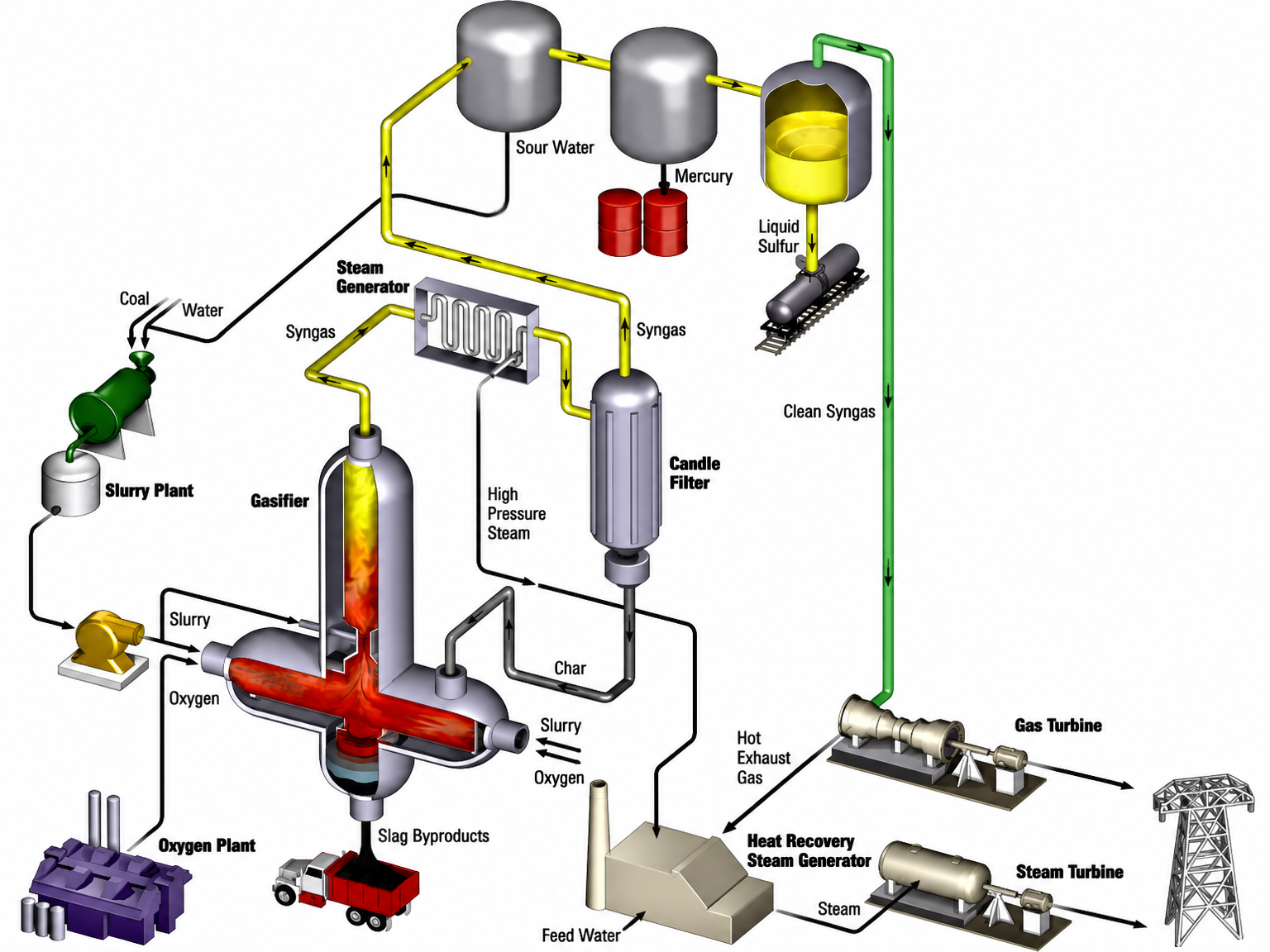
The exact configuration depends on feedstock and downstream use, but a typical E-Gas/Wabash-type process consists of the following steps.
Step 1 — Feed preparation. Coal or petroleum coke is crushed and ground, then mixed with water to form a pumpable slurry. Typical public-domain ranges: slurry solids often around 60–70 wt%, depending on feed grindability, ash, moisture, and rheology; feed size fine enough for entrained-flow conversion; flux additive may be used if ash fusion behavior requires adjustment. Exact slurry concentration and particle-size distribution are project-specific and often proprietary.
Step 2 — Oxygen supply. High-purity oxygen (typically around 95 vol% O2) is supplied from a cryogenic air separation unit. Oxygen-blown gasification avoids the nitrogen dilution associated with air-blown gasification and produces medium-heating-value syngas suitable for IGCC, hydrogen, ammonia, methanol, Fischer-Tropsch, or refinery applications.
Step 3 — First-stage gasification. Most of the slurry feed and nearly all of the oxygen enter the first stage through burners. Public descriptions commonly indicate pressurized operation (commonly hundreds of psig), high temperature sufficient to melt ash (often reported ~2,400–2,700 °F / 1,315–1,480 °C), slagging conditions, and short residence time typical of entrained-flow gasifiers. Approximate feed split often cited: roughly 75–80% of slurry to the first stage, 20–25% to the second stage. The first stage is a highly reducing, oxygen-limited reactor: feed carbon is partially oxidized to CO and CO2, water and char participate in gasification reactions, and mineral matter melts and flows downward as slag [4][5].
Step 4 — Slag removal. Molten slag exits the bottom of the first stage through a slag tap into a water quench or slag handling system and solidifies into glassy granules. Key equipment: slag tap, quench chamber or slag bath, lockhopper/depressurization system, slag dewatering and handling. The resulting slag is typically much less leachable than raw ash because metals are immobilized in a vitrified matrix, though beneficial-use or disposal status depends on local testing and regulation.
Step 5 — Second-stage slurry injection (the distinctive E-Gas feature). The remaining slurry is injected into the hot raw syngas exiting the first stage. Functions of the second stage: uses sensible heat from first-stage syngas; evaporates slurry water; pyrolyzes/devolatilizes fresh coal or coke; gasifies additional carbon; lowers raw syngas temperature before downstream heat recovery; improves cold-gas efficiency; reduces oxygen consumption compared with a single-stage slurry gasifier. Public descriptions commonly cite second-stage outlet temperatures around 1,900 °F / 1,040 °C, depending on feed and design. Unconverted char carried out with the raw syngas is recovered downstream and recycled dry back to the first stage together with unconverted carbon recovered from the slag, rather than being purged as a wet by-product — a design choice that avoids generating an additional wastewater stream and helps push overall carbon conversion above 99% on petroleum coke feed.
Step 6 — Syngas cooling and heat recovery. Raw syngas is cooled after the gasifier; in IGCC service heat recovery is important because it generates high- or intermediate-pressure steam for the combined cycle. Typical cooling sections may include radiant syngas cooler, convective syngas cooler, fire-tube or water-tube heat exchangers, boiler feedwater economizers, and steam drums/circulation systems. Some designs use full quench instead of extensive heat recovery. The Wabash-type E-Gas IGCC configuration used syngas cooling and heat recovery integrated with the power block [4].
Step 7 — Particulate removal and wet scrubbing. Raw gas contains entrained char, ash fines, soot, and soluble contaminants, cleaned via cyclones or hot-gas filters (design-dependent), wet scrubbers, soot/ash water systems, black-water treatment, and clarifiers/filters/recycle water systems.
Step 8 — Acid gas cleanup. Sulfur species are removed before combustion or synthesis, typically via:
- COS hydrolysis, if required: COS + H2O → H2S + CO2
- Acid gas removal using amine or physical solvent systems, depending on pressure and syngas composition
- Sulfur recovery by Claus unit, sulfuric acid plant, or other sulfur recovery system
In IGCC service, cleaned fuel gas is sent to a combustion turbine; in chemical service, additional cleanup may remove sulfur to very low levels.
Step 9 — Syngas use. Possible uses include IGCC power generation, hydrogen production, ammonia, methanol, oxo alcohols, Fischer-Tropsch liquids, refinery fuel gas, reducing gas, and CO-rich synthesis gas. At Wabash, syngas was primarily used as fuel for a gas turbine in an IGCC configuration. At Jamnagar, syngas was intended as feedstock for a new chemical complex and as fuel for the refinery's existing gas-turbine power generation units [3].
5. Major equipment list
Feed preparation: coal/petcoke receiving system, crushers, pulverizers/mills, slurry preparation tanks, agitators, slurry transfer pumps, slurry storage tanks, feed metering system, optional flux addition system.
Oxygen system: air separation unit, oxygen compressor or booster, oxygen preheat/control system, nitrogen system for purging/inerting.
Gasification island: first-stage gasifier vessel, refractory lining/hot-face protection system, oxygen/slurry burners, second-stage slurry injectors, slag tap, continuous (lock-hopper-free) slag quench and removal system, slag dewatering system, dry char recovery and recycle system, high-pressure instrumentation and safety interlocks.
Heat recovery: dedicated fire-tube radiant syngas cooler generating high-pressure steam, convective syngas cooler, steam drums, boiler feedwater circulation pumps, economizers, superheaters/reheaters (integration-dependent), sootblowers/online cleaning devices (if applicable).
Syngas cleanup: particulate removal devices, venturi or packed wet scrubbers, black-water handling system, clarifiers, filters, sour-water stripper, COS hydrolysis reactor, acid gas removal unit, sulfur recovery unit, tail-gas treating unit (if required).
Power or synthesis block:
- For IGCC: gas turbine, heat recovery steam generator, steam turbine, generator, fuel gas saturator or diluent nitrogen system (NOx-control-dependent).
- For chemicals or hydrogen: shift reactors, CO2 removal, methanation or polishing, pressure swing adsorption or membrane separation, synthesis loop (product-dependent).
6. Operating parameters and conditions
Public references do not disclose a complete Lummus design envelope; the Wabash/Destec/E-Gas literature provides representative values.
| Parameter |
Representative public range / value |
Notes |
| Feed |
Coal, petroleum coke, blends |
Wabash processed high-sulfur bituminous coal and later petroleum coke blends |
| Feed form |
Water slurry |
Slurry-fed entrained gasifier |
| Slurry solids |
~60–70 wt% typical |
Feed-dependent |
| Oxidant |
High-purity oxygen |
Usually from cryogenic ASU |
| Pressure |
Several hundred psig |
Wabash commonly described in the ~400 psig class |
| First-stage temperature |
~2,400–2,700 °F / 1,315–1,480 °C |
High enough for slagging |
| Second-stage outlet temperature |
~1,800–2,000 °F / 980–1,095 °C |
Often cited near 1,900 °F |
| Carbon conversion |
High, often >95% in entrained gasification |
Exact value depends on feed and recycle |
| Raw syngas |
CO, H2, CO2, H2O, H2S, COS |
Composition feed- and operating-dependent |
| Ash disposition |
Vitrified slag |
Quenched and removed |
Sources: DOE/NETL Wabash reports and NETL gasification summaries [4][5].
7. Process efficiency and performance
Cold-gas efficiency. Cold-gas efficiency is the fraction of feed heating value converted into chemical heating value of the cleaned or raw syngas. Slurry-fed entrained-flow gasifiers are penalized by the need to evaporate slurry water; E-Gas addresses this through second-stage slurry injection, converting part of the first-stage sensible heat into additional syngas. Public sources generally characterize E-Gas as having higher cold-gas efficiency than single-stage slurry gasifiers.
| Technology type |
Efficiency tendency |
Reason |
| Single-stage slurry entrained gasifier |
Lower than dry-feed systems |
Slurry water must be evaporated; more oxygen required |
| E-Gas two-stage slurry gasifier |
Better than one-stage slurry gasifier |
Second-stage feed uses hot syngas sensible heat |
| Dry-feed entrained gasifier |
Often higher efficiency |
Less water introduced with feed |
| Fixed-bed slagging gasifier |
Can have high methane and efficiency but different feed constraints |
Lower temperature, longer residence time |
IGCC performance. The Wabash River IGCC project demonstrated that E-Gas syngas could fuel a commercial gas turbine, with DOE reporting low emissions compared with conventional coal-fired generation and providing extensive operating experience on gasifier availability, syngas cooling, hot-gas path integration, and feedstock flexibility [4]. Phillips 66's own 2012 characterization of the technology described it as offering "high system efficiencies, minimized water consumption and very low emissions," positioning it among the cleanest and most efficient commercial technologies for coal/petcoke-based power and syngas production [3].
Important caveat: Wabash was a first-of-a-kind repowering demonstration, so its availability and cost record should not be interpreted as purely representative of mature nth-of-a-kind performance.
8. Environmental profile
Air emissions. Gasification allows contaminants to be removed from syngas before combustion, generally enabling lower emissions of SO2, NOx, particulate matter, and mercury/trace metals (with appropriate polishing systems). At Wabash, sulfur removal was a major advantage given high-sulfur coal feed and a clean fuel gas product for the turbine; DOE Clean Coal Technology reports cite high sulfur removal and low SO2 emissions relative to conventional combustion [4].
CO2. Gasification does not inherently eliminate CO2, but can make CO2 capture easier than post-combustion capture if the syngas is shifted:
CO + H2O → CO2 + H2
CO2 can then be removed at elevated pressure before combustion or hydrogen use — one of the strategic advantages of gasification for hydrogen or low-carbon power concepts.
Solid waste. The main solid byproduct is vitrified slag, generally lower in leachability than fly ash from pulverized coal combustion; beneficial use or disposal depends on chemical testing and local regulation.
Water. Slurry-fed gasification and wet scrubbing require significant water management: slurry water, quench water, black water, sour water, blowdown streams, dissolved salts and trace contaminants. Water treatment can be a significant cost and reliability factor.
9. Comparative economic performance
Versus pulverized-coal combustion. Advantages: lower SO2/NOx/particulate emissions potential, easier pre-combustion sulfur removal, potential for CO2 capture after shift, co-production flexibility (power, H2, chemicals, steam), ability to process low-value refinery coke or high-sulfur coal. Disadvantages: higher capital cost and complexity, large ASU requirement, gasifier refractory/slagging maintenance, syngas cleanup complexity, availability risk (especially in early projects).
Versus Air Products-type single-stage slurry gasification. Potential E-Gas advantages: better heat integration through second-stage feed injection, lower oxygen consumption for equivalent feed conversion, higher cold-gas efficiency, lower raw syngas temperature entering cooling equipment. Potential disadvantages: more complex reactor internals and feed injection configuration, additional control complexity from staged feed split, smaller public commercial reference base than some competing technologies.
Versus Air Products-type dry-feed entrained gasification. Potential E-Gas advantages: slurry feed is mechanically simpler than high-pressure dry solids feeding, good fit for certain coals and petroleum coke, two-stage design mitigates slurry efficiency penalty, proven in Wabash IGCC service. Potential disadvantages: water in slurry reduces efficiency relative to dry feed, higher CO2 and lower syngas heating value may result from water addition, more wastewater handling, potentially lower efficiency for low-moisture, high-heating-value feedstocks than dry-feed alternatives.
Refinery and petrochemical economics. For refineries, gasification can monetize low-value petroleum coke, asphalt, or residue into hydrogen, power, steam, CO-rich syngas, methanol or ammonia feedstock, and sulfur byproduct. The economic case depends on petcoke/residue opportunity cost, natural gas price, hydrogen value, power value, CO2 regulation or credit value, sulfur price, capital cost, required availability, and integration with refinery steam, power, and hydrogen networks.
10. Deployments and commercial experience
Dow/Louisiana experience. Dow's Louisiana gasification experience is generally cited as an early commercial basis for Destec/E-Gas technology, though public information is less detailed than for Wabash. The Dow/Destec lineage is discussed in DOE and NETL gasification references [4][5].
Wabash River IGCC. Location: Terre Haute, Indiana, USA. Technology: Destec/E-Gas two-stage slurry-fed gasifier. Application: IGCC repowering. Feed: initially high-sulfur bituminous coal; later petroleum coke and coal/coke blends. Output: syngas for combustion turbine, steam integration with existing power plant. Program: U.S. DOE Clean Coal Technology demonstration [4]. The project demonstrated gasification of high-sulfur coal, low SO2 emissions through syngas sulfur removal, IGCC integration with gas turbine and steam cycle, feed flexibility including petroleum coke experience, and operational challenges typical of first-of-a-kind gasification systems.
Reliance Industries, Jamnagar, India. In May 2012, Phillips 66 announced that Reliance Industries Limited — operator of the world's largest single refining complex (1.3 million barrels/day aggregate capacity at the time) — had selected Phillips 66's E-Gas Technology for planned gasification plants at Jamnagar, Gujarat [2][3]. Described at announcement as "the largest gasification project in the world," the plants were designed to convert petroleum coke and coal into synthesis gas, feeding a new chemical complex and fueling the refinery's existing gas-turbine power generation units [3]. Phillips 66 licensed the E-Gas technology and provided process engineering design and technical support for the gasification process area [3]. GE supplied gas turbines (three 9E units) for the associated power generation package [7]. The complex is referenced by Reliance as housing the world's largest petcoke gasifier [2]. The project is understood to comprise a multi-train "polygeneration" configuration of roughly ten gasification trains on petroleum coke feed, targeted at combined power, hydrogen, substitute natural gas (SNG), and chemicals production, with construction reported as starting in 2013 for start-up around 2015.
Other deployments. Beyond Wabash River and Jamnagar, the E-Gas lineage includes a smaller number of additional commercial and near-commercial references spanning different owners, feedstocks, and syngas end-uses: an early single-train unit operated by Dow on sub-bituminous coal for power (in service from the late 1980s); a substitute-natural-gas (SNG) project in South Korea on sub-bituminous coal, configured with multiple parallel trains; and a hydrogen/chemicals-oriented project in China gasifying bituminous coal. Independent, publicly verifiable operating data for these additional projects are more limited than for Wabash River.
Conclusion: Wabash River remains the primary open-technical reference, while Jamnagar is the best-documented large-scale commercial deployment by installed capacity.
12. E-Gas Plus®: what can and cannot be established
Lummus Technology's website confirms E-Gas Plus® as a live, currently marketed trademark, presented under "Resid Gasification" within its Refining / Residue Upgrading process technology portfolio, described as designed to produce syngas and steam from petroleum coke or coal and refinery residues [1].
Trademark status: USPTO records (Registration No. 6,047,809, filed Jul 23, 2015, registered May 5, 2020, first commercial use Sep 30, 2016) confirm E-Gas Plus® as the currently live, federally registered mark, owned by Lummus Technology LLC. Plain "E-Gas" is treated in this profile as the historical/legacy process name (used commercially since 1987 under Dow/Destec/ConocoPhillips/Phillips 66) rather than as a separately live registered mark in its own right.
Open questions / debates in the field
1. What exactly distinguishes E-Gas Plus® from E-Gas? Lummus's current marketing confirms E-Gas Plus® as an active syngas/steam-producing technology for petcoke, coal, and residues [1], but does not disclose whether "Plus" denotes a specific reactor, feed-flexibility, or heat-recovery improvement, or is primarily a rebranding of the inherited ConocoPhillips/CB&I asset. Public data remain insufficient to determine this with confidence.
2. Slurry-feed simplicity versus dry-feed efficiency. E-Gas's slurry feeding is simpler and proven at pressure, but water addition reduces thermal efficiency; the two-stage design offsets this. The debate is whether that offset is sufficient to compete with dry-feed gasifiers in modern low-carbon hydrogen or chemical projects.
3. IGCC economics. The Wabash project demonstrated technical feasibility but also illustrated the capital intensity and complexity of IGCC. With low natural gas prices in North America and growth in renewables, coal/petcoke IGCC has struggled economically unless linked to hydrogen, chemicals, CO2 capture, or waste/residue monetization — the refinery-integration model exemplified at Jamnagar remains a stronger economic case than stand-alone power IGCC.
4. CO2 capture readiness. Gasification is often described as CO2-capture-ready because syngas can be shifted and CO2 removed at pressure; however, adding shift, CO2 removal, compression, transport, and storage increases cost and may reduce net efficiency.
5. Feedstock future. The historical E-Gas value proposition was coal and petcoke conversion. In a decarbonizing energy system, future relevance may depend on refinery residue conversion with carbon capture, blue hydrogen, waste gasification, and biomass/coal or biomass/petcoke co-gasification. Public evidence specifically linking E-Gas Plus® to these newer applications is limited.
Key sources cited
- Lummus Technology — E-Gas Plus® Technology for Coal, Petcoke & Resid Conversion (Internet Archive webpage capture: Oct 8, 2024)
- Reliance Industries Limited — Petroleum Refining & Marketing, Jamnagar Refineries (accessed: Sep 18, 2026)
- Phillips 66 — Phillips 66's E-Gas Technology Selected for Reliance Industries' Gasification Project (May 21, 2012)
- National Energy Technology Laboratory (NETL) / OSTI — Wabash River Coal Gasification Repowering Project (Sep 1, 2000)
- NETL — Gasification Technology / Gasifipedia resources (accessed: Sep 18, 2026)
- Lummus Technology — The Chatterjee Group, Rhône Capital Complete Joint Acquisition of Lummus Technology (Jun 30, 2020)
- Flenco — Reliance Petcoke Gasification Project (last modified: Mar 27, 2024)
- USPTO — E-Gas Plus® trademark record (Registration No. 6,047,809) (registered: May 5, 2020)
- Elsevier — Higman C. & van der Burgt M., Gasification, 2nd Ed. (2008)
- Global Syngas Technologies Council — Global Syngas Technologies Council resources (accessed: Sep 18, 2026)
- ConocoPhillips — Phil Amick, McIlvaine Company Webinar: E-Gas™ Technology for Coal Gasification (Jun 5, 2008)