|
|
Mr. Sanjay Gupta, former CEO (P) -Dangote Refinery & Petrochemical Project & former-C&MD, Engineers India Limited, a Govt. of India Undertaking, has been associated with the Hydrocarbon Industry for over four and a half decades and has been actively involved in the conceptualization, detailing and implementation of Mega projects with billions of US dollars stake. Universally acknowledged in the industry as a stalwart of his field, he is seen with respect for his knowledge and authority on the subject. |
Overview
In the fast changing Geopolitical Scenario, India has been steady in bringing about a strong and consistent growth to its Economy. While it has remained the fastest growing nation for a while, it is evident from the current trends that this growth momentum will be sustained. Significantly, the growth story of any country is critically dependent on the growing energy needs and the methods that a country adopts to cater to the same. Alongside, there is pressure to ensure that the energy requirements have to be met in an Environment friendly manner with the efforts on to reduce the impact of the greenhouse gases consistently.
India is demonstrating with great finesse and skill, as to how this has to be addressed. It is well known that Indian fossil fuels exploration/discovery till date has been a question mark, leading to consistent imports to the tune of 85% of its crude and more than 50% of natural gas requirements. While the country continues to import large quantities of crude, by 2027 it is slated to have a refining capacity of 310 MMTPA. Slowly but steadily the country has emerged as a Refining hub, which caters not only to the large domestic demand but also exports a substantial quantity of refined products. India sources its crude from as many as 40 countries and exports a lot of refined products to Europe and elsewhere.
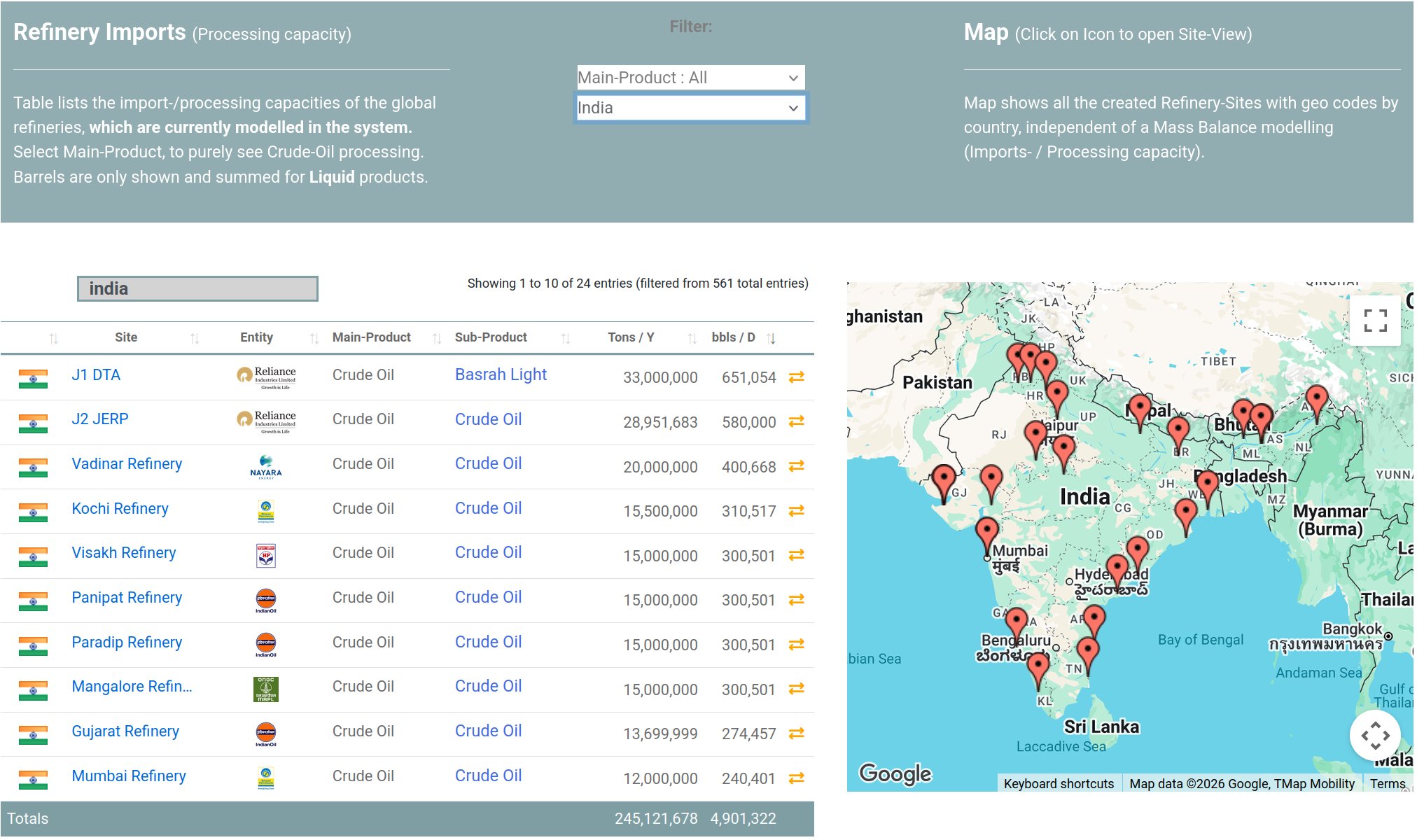
Indian Refinery Mapping on ppPLUS as of August 2026
Alongside the Refining Industry, the Petrochemical Industry has also developed substantially. Since gas is only available in limited quantities there are only 2 to 3 gas cracking facilities in India, whereas there are as many as 6 to 7 multi-feed crackers of varying capacity. Typically, naphtha is one of the major feeds to the crackers though kerosene and LPG too, in small quantities are used to augment the Cracker feedstock diet. This trend is likely to continue.
India continues to import a lot of LNG to cater to the requirements of the fertilizer, power and chemical Industry. Of late city gas distribution is being encouraged, such that LPG could be gradually phased out to be utilized for higher value addition.
Trends
In general, over a period as the Refining Industry matured the product patterns of the refineries has been altering. LPG continues to be produced from the refineries to serve the requirements of cooking fuel. Gasoline and Aviation Turbine Fuel are capped. Kerosene has been phased out, more or less, and Diesel is open. However now the demand patterns are altering even further. While the distillate requirements are easing out, the demand for Petrochemicals has been consistently in the region of 6-8% CAGR. To cater to the Petrochemical demand, both the Aromatic and Olefin complexes have been horizontally added in the Refining complexes. The recent trend of course is the emergence of integrated complexes, where the Crackers in particular, are conceived as part of the complex configuration from the initial stages, to provide flexibility of product pattern. Typically, these complexes may have a crude to petrochemical production ratio of 35% to 45 % depending upon the configuration and the product requirements. This enables rationalization of production of distillates from the Refinery while petrochemicals are also produced while disruptions on account of Electrification, EVs and renewable energy are addressed variously. This trend is likely to continue.
The other changing trend is the possibility of reduction of the carbon foot print of the complexes. Gas Integration is the first measure which is being adopted. This would not only reduce the carbon footprint, but would also reduce the firing of liquid fuels such as naphtha and fuel oils to produce Hydrogen, power and steam in the complexes. CO2 abatement, blue hydrogen, carbon capture from captive power plants, FCC, Crackers are all being looked at carefully. The captured CO2 could be converted to Urea/ methanol as Green Hydrogen becomes cheaper. Ethanol/SAF can also be produced. Also the tail gases of the SMR plants could be used to produce ethanol. Of course, a large part of this work will happen as the process of Green Hydrogen falls below $ 2/kg.
In a similar league integration of Bio Refineries and Waste-to-Fuel projects through Gasification route to Refineries are other integration possibilities that are likely to happen in India to support larger scale of bio projects.
Proposed Configuration
The proposed configuration is evolved in the back ground of the above. Integration of bio-refineries though has not been considered at the moment.
| Refining capacity | 20 MMTPA |
| Crude Slate | 50:50 Arab Heavy: Arab Light API 22-28 |
| Natural gas | Complex Fuel, FEED to SMR for Hydrogen and Captive Power Plant |
| Complex Configuration | Integrated complex with Petrochemical Min 45% production |
Refinery Configuration and key Considerations
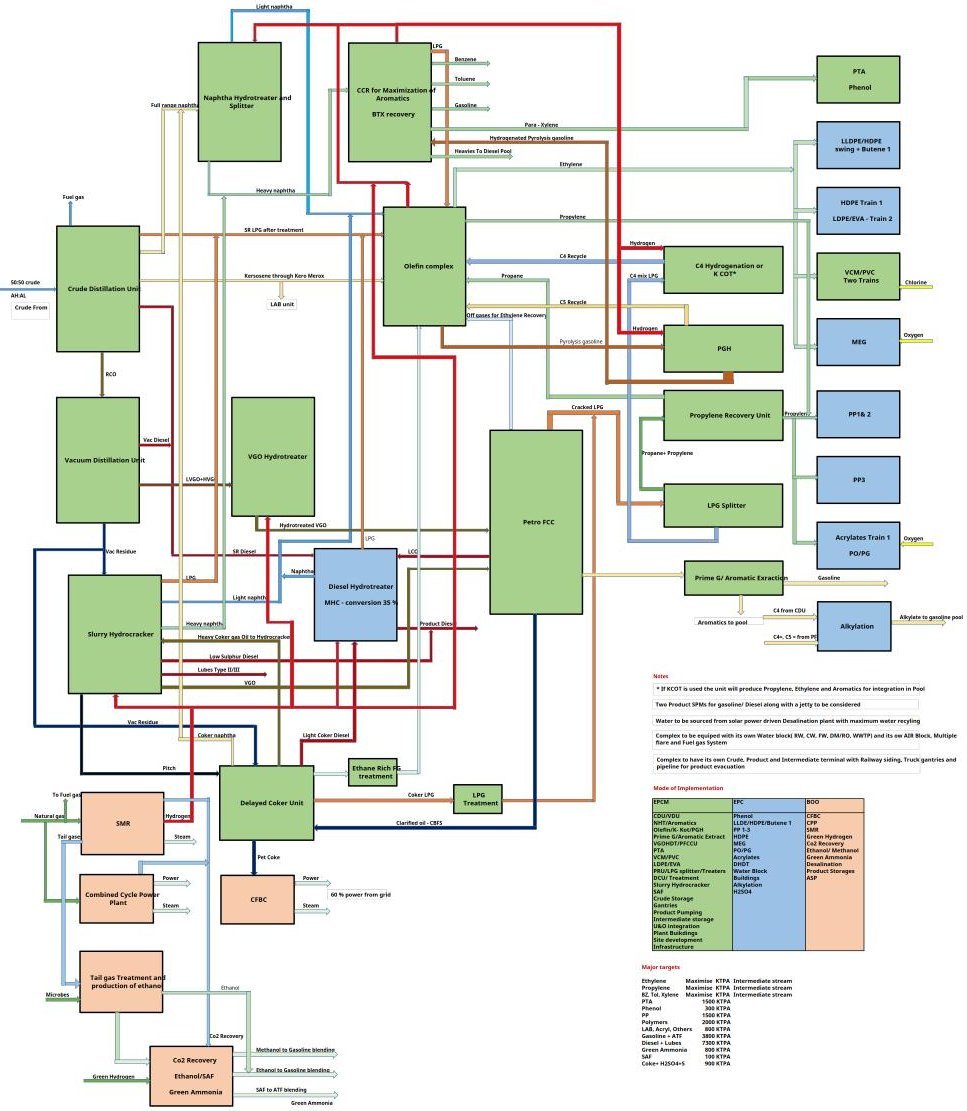
Indicative Configuration of a Grass Root Integrated DREAM Refinery
1. Single train CDU of 20 MMTPA capacity. For heavier and sour crudes (S 3-4 %) this possibly is the maximum capacity that can be considered for a single crude column configuration in a grass roots facility.
2. A single vacuum column considered in VDU with a provision to recover Vac Diesel.
3. A single Train of VGO hydro-treater considered with hydrotreated feed routed to Petro FCC for a propylene production of 20% plus. About 80 % of VGO to be considered as Feed to PFCC. All LPG and naphtha produced from VGO hydrotreater to be routed to Olefin complex.
4. The Vacuum Residue from the vacuum column to be split as feed to Slurry Hydrocracker and Delayed Coker Unit. The SHCU to be designed with 92% conversion and could be equipped with an SDA. The Hydrocracker in SHCU, however, to be designed to receive the HCGO as additional Feed from DCU or alternatively this could also be routed to VGO Hydrotreater. The Pitch from SHC to be routed to DCU. Also the Hydrocracker could be configured to produce Grade II and Grade III lubes. The VGO produced from SHC to be routed to Petro FCC. The idea is to maximize PFCC capacity for maximization of Propylene and Ethylene from high severity PFCCU.
5. Balance VR to be routed to DCU with a capacity restriction of 2.4-3.0 MMTPA with a two coke Chamber design. The CLO from FCC and Pitch from SHC shall be the other Feed to Coker. 30% Petcoke recovered from Coker shall be route to CFBC to generate power and steam. All LPG from DCU shall be routed to Cracked LPG stream from PFCCU for recovery of propane and C4 mix. LCGO shall be routed to Diesel Hydrotreater, whereas HCGO shall be routed to Hydrocracker in SHC or VGO hydrotreater. Coker naphtha shall be routed to naphtha Hydrotreater and splitter in the MS block.
6. The Naphtha Hydrotreater will receive the SR naphtha from CDU and the Coker naphtha from Coker. This will be hydrotreated and split. Light naphtha will be routed to Olefin complex and the Heavy Naphtha shall be routed to CCR designed to maximize production of Aromatics.
7. CCR will receive heavy naphtha from Splitter, Hydrocracker and maximize production of Aromatics. The Unit will receive all the Hydrotreated Pyrolysis Gasoline from Cracker to recover Benzene, Toluene, and Para Xylene. Gasoline and Diesel blenders shall be generated from CCR. The Para Xylene will be maximized and routed to PTA as feed. Toluene shall be converted to Xylenes.
8. Petro FCC shall be the central upgrader designed to produce a minimum of 20% of propylene from the unit. The Propylene shall be recovered in the PRU and routed to PP unit while Propane shall be routed to Cracker. Possibility of considering a PDH to convert propane to propylene in the cracker block for high conversion can also be looked into. Since a lot of Propylene is expected from PFCCU and Olefin complex for the moment it is not considered. In many cases, the conversion through PDH can be more economical as propane to propylene conversion can be as high as 90%. This will maximize Propylene production. Naphtha from PFCC is rich gasoline with High Octane. It can be routed to the blend station after being routed through Prime G and an Aromatic recovery unit to control the gasoline specifications. The LCO from PFCCU will be poor in Cetane and shall be routed to the high severity diesel hydrotreater. Alternatively it can also be routed to the Hydrocracker in SHC.
9. The Off gases from PFCC are rich in Ethylene. This can be routed to the cold section of the Cracker after treatment of impurities for recovery of ethylene, and recycling of ethane and propane for cracking to extinction. Similarly, DCU fuel gas is rich in ethane. After treatment, this gas can be routed to cracker for recovery of all ethane for cracking to extinction. The net fuel gas from cracker shall be routed to the integrated fuel gas network.
10.The CLO or CBFS from the PFCCU to be routed to DCU.
11.The Straight Run Diesel, Vac Diesel and LCO from PFCCU will be routed to Diesel Hydrotreater. The Diesel hydrotreater shall be designed as a mild Hydrocracker with conversion up to 35%. The idea is to minimize Diesel production and maximize feed to cracker. All LPG, Naphtha from the Diesel Hydrotreater shall be routed to Cracker. Low Sulphur diesel from MHC will combine with the Diesel from SHC and the heavy cut from the integrated CCR for being routed to the diesel pool.
12.The multi-feed cracker will receive SR LPG, SR naphtha, SR kerosene, all LPG and naphtha from VGO Hydrotreater, SHCU, MHC along with Propane and Off Gases from the PFCCU to maximize the production of Ethylene and Propylene. C4 mix LPG from PFCCU and the C4 mix from cracker could be hydrogenated to augment feed to cracker. Alternatively this material could be routed to a KBR licensed K-COT unit to maximize the production of Ethylene, Propylene and Aromatics. For the DREAM project K-COT is proposed. All Pyrolysis gasoline from the Cracker will be hydrogenated and routed to CCR. The C5 streams shall be recycled to cracker. The Cracker shall produce between 2.0-2.2 million tons of ethylene and about 1-1.2 MMTPA of propylene.
13.The Ethylene produced from the complex shall be captively consumed in Swing, Butene I, HDPE, VCM/PVC, MEG, LDPE /EVA. Other niche products like EPR can also be considered. The Propylene can be consumed in multiple chains of PP, PO/PG and Acrylates. A cumene/phenol plant has been considered to captively consume all benzene. An Acrylic Acid linked Acrylate train has also been considered.
14.Natural gas shall be considered to produce hydrogen in the complex. The hydrogen loop shall be integrated in the integrated complex to consider the hydrogen production from CCR and Cracker.
15.Maximum CO2 can be recovered from SMR, PFCCU, CPP and Olefin complex for considering production of Urea and ethanol/SAF as blend streams by utilizing Green Hydrogen import/ production in the Complex. This will reduce the carbon foot print of the complex, Gradually CO2 recovery from FCC and Cracker can also be considered. Through the fermentation process the tail gas could be converted to ethanol.
Targets and other Considerations
1. All SR LPG to be used as Cracker feed. In fact zero SR LPG from Complex is targeted. LPG production may be limited to unsaturated C4 LPG.
2. An Alkylation block is considered to maximize the quality of gasoline. C4 and C5 cut from PFCC and C4 Cut from CDU will be considered as feed. Sulphuric acid shall be produced in the complex and its quality upgraded to meet the Alkylation unit requirements.
3. Gasoline + ATF production including blenders to be capped to 3.5 – 4 MMTPA
4. Diesel + Lubes to be targeted to a maximum of 7-7.5 MMTPA.
5. Petcoke + Sulphur/ Sulfuric Acid to be around 900-1000,000 TPA.
6. PTA to be targeted to about 1.5 MMTPA
7. Phenol may be 300,000 TPA and a similar capacity could be targeted for LAB and Acrylates.
8. Polymers , Acrylates, Glycols etc 35% of throughput
9. Integration to Renewable Power Grid, Green Hydrogen, Green Ammonia, Green Urea, SAF to be considered.
Forward path
1. The Project could be located along the Eastern Coast of India.
2. Crude and Product SPMs could be considered for crude receipt and product evacuation. Rail and Road Gantries to be provided.
3. The complex to be integrated with the LNG terminals around the Eastern coast.
4. The Bay of Bengal and the prospects of Oil and Gas availability from there in future cannot be ruled out.
5. Petrochemicals and large part of distillates could be consumed domestically. But the entire South East Asia and Australia could be a target market.
6. Let us engage and interact on the proposed configuration, all questions and ideas are welcome.
7. Later we may discuss the implementation strategy of the complex to examine EPCM, EPC, LEPC, OBE, BOO modes of implementation.
We welcome interaction and suggestions on the proposition. You can comment by hiting the 'Add comment/reply' button here below 👇 👇 👇
This perhaps could be a model project to be considered for some of the large complexes envisaged in India and elsewhere in times to come.
|
Venugopal, B.V.
9/8/2026 3:40 AM
Excellent Sir. the CAPEX requirement would need to be looked at. i would expect atleast in the range of 15BN USD. You will definitely be knowing that cuddalore Nagarjuna was mothballed and though TCG Haldia looked at reviving it with small scale CTC complex (i think 100, 000 BPD), nothing was heard since. Regards Sir
|